


Sustain has responded to the Government's call for views on the Civil Contingencies Act 2004, to demand national and local government include physical and financial access to food in emergency planning.
Emergency planning is vital to prepare for extreme weather events, supply chain disruption, cyber-attacks and possible future war. But with regards to food, emergency planning still focuses largely on contamination rather than whether people can actually access food during a crisis.
Food is one of the UK’s 13 Critical National Infrastructure sectors, and the Civil Contingencies Act recognises that disruption to food supply can cause serious harm to human welfare. Yet the National Risk Register, which guides local emergency planners, focuses mainly on food contamination. Reliable food supply, and people’s ability to access food in a crisis, physically and financially, remain largely absent from national and local emergency planning – and from the duties, guidance and funding that come with it.
In September, the National Audit Office warned that the food sector’s ability to withstand catastrophic disruption has not been tested. Few of our country’s emergency responders, such as formal Local Resilience Forums, have considered seriously how to secure a reliable food supply for the population in an emergency. Barely any have a plan or capacity in place to support access to food for large numbers of people, including targeted action to support people disadvantaged by low income, existing poor access to healthy food supply, or vulnerable for other reasons.
The Government must recognise the extensive experience, social capital and critical infrastructure established by local authorities, Sustainable Food Places food partnerships, socially oriented food enterprises and agroecological farming, and strengthen their position, funding and integration into resilience and emergency planning. This requires urgent attention in an updated Civil Contingencies Act that recognises food system risks and vunerabilities, and in related policy, duties, monitoring and official guidance, both at a national and local level.
Informed by Professor Tim Lang’s report with the National Preparedness Commission: Just in Case, and local leadership in places such as London, Bristol, Dyfed-Powys and across the Sustainable Food Places Network, Sustain has responded to the Government's call for views on the Civil Contingencies Act 2004, to inform its 2027 review. We drew on our extensive experience during the Covid-19 pandemic, alongside more recent work with Sustainable Food Places food partnerships, food poverty alliances, local authorities, community organisations and food enterprises across the UK.
Sustain and 34 Food Partnerships in the Sustainable Food Places Network have also signed an open letter from Professor of food policy Tim Lang, Professor of food systems Paul Behrens and Excutive Director of Foodrise Carina Millstone, coordinated by alliance member Foodrise, to Prime Minister Andy Burnham, calling for national leadership on food resilience, including Local Food Resilience Committees and recognition of food shortages as a national risk.
What a food emergency looks like
For people on low incomes, families with children, older people, disabled people, those with no recourse to public funds, and others already facing hardship due to debt or ill health, the challenge in an emergency is whether sufficient food is available and accessible; whether people have enough money to buy it; and whether they can physically access it – easily and safely; or can receive appropriate support when normal systems break down.
Sustain’s experience during the Covid-19 pandemic was that across the country, community organisations, local food partnerships, food poverty alliances, food banks, community kitchens and meal providers, markets and local food businesses stepped in to fill the gaps in accessible and affordable food supply. Many became de facto emergency responders. These organisations often hold the best knowledge of community vulnerabilities, local food networks and supply chains [see Sheffield University research]. They were also aware of who needed help and how to reach them – reaching into diverse and harder-to-reach communities with incredible goodwill, drive and adaptability. However, they were largely excluded – at local and national level – from formal resilience structures, decision-making processes, guidance and necessary funding to enable swift and enduring social provision.
Our evaluation showed that local responses were better, quicker to respond, and more connected to vulnerable communities where there was an established Food Partnership in place – demonstrating that the Sustainable Food Places Network, and the partnerships, granular local knowledge and connectivity these facilitate at a local level, is critically important infrastructure.
Meanwhile, we were deeply frustrated during the Covid-19 pandemic that national Government tended to consult only the biggest supermarkets and foodservice companies. Diversification of supply chains is a characteristic of food system resilience. Recent cyber-attacks on supermarkets illustrate that not only is food supply chain consolidation a significant risk in its own right (as cited in Tim Lang's 'Just in Case' analysis), those big supermarkets also became the main recipients of publicly funded interventions such as £380m of food vouchers for children in the lowest income households. Government largely failed to include local and community retailers, wholesalers and foodservice in under-served communities. Sustain had to resort to legal action to secure support for children from the lowest income families during the Covid-19 pandemic, when the nutritional lifeline of free school meals was not available.
The risks are growing
The omission of food supply and equitable access in emergency planning is increasingly concerning because the risks facing our food system are growing. Climate change is driving more extreme weather events. Geopolitical instability is seriously impacting food prices, as well as availability of farm inputs that in turn affect crop yields. National assessments have highlighted the growing likelihood of severe ecosystem disruption depleting food production and food security – nationally and globally.
Emergency planning must change.
What we’ve asked Government to do
- Recognise food access in law. Amend the Civil Contingencies Act’s definition of an emergency to include disruption of physical access to food and other essentials, and the dependency of food access on adequate financial income.
- Update the National Risk Register to reflect the full range of risks to food supply, not just contamination.
- Give responders duties on food. Category 1 and 2 responders, and Local Resilience, Forums placed on a statutory footing, should be required to plan for food system shocks and for household food security. That includes equitable physical and financial access for people on low incomes, families with children and others at greater risk.
- Bring food system actors into resilience structures. Food partnerships, community food organisations and local food businesses should be integrated into local resilience planning, as faith and homelessness organisations already are, or recognised as Category 2 responders.
- Set up Local Food Resilience Committees, including representation from local food systems and community stakeholders, in every local authority and resilience area, backed by a dedicated government funding stream. They would map vulnerabilities in local food supply, maintain community food risk registers, and plan who will need support and how to reach them.
- Provide national leadership. Create a National Council of Food Security and Resilience linking Defra, MHCLG, DHSC, DWP and the Ministry of Defence under Cabinet Office oversight, and pass a Good Food Bill to provide the duties and accountability to join up government department responses.
Crucially, the UK needs stronger national leadership on food system resilience. A more coordinated approach across government departments, linked to wider ambitions for a healthy, fair, sustainable and secure food system, would help ensure that emergency planning, food production, public health, social security and local economic development are working together rather than in silos. Further, a Good Food Bill would provide the duties and accountability that could join up and drive the system change needed. All our futures depend on it.
Further reading and evidence
Civil Food Resilience in Practice: Capacity-building for resilience across the Sustainable Food Places network (2026): https://www.sustainablefoodplaces.org/news/may26-cfrreport/
Accompanying Sustain Civil Food Resilience policy briefing (2026): https://www.sustainweb.org/reports/jul26-building-civil-food-resilience-at-a-local-level/
Food Resilient London: mapping our community food assets (2026): https://www.sustainweb.org/news/sep26-food-resilient-london-report-live/
Bristol Food Disaster Risk Planning Project 2023-2026: https://bristolgoodfood.org/2026/09/15/food-disaster-risk-planning-project/
Dyfed-Powys Civil Food Resilience Project (2026): https://www.foodsensewales.org.uk/what-we-do/building-civil-food-resilience-across-dyfed-powys/
Resilience and transformation: Lessons from the UK local food sector in the COVID-19 pandemic (2022) https://doi.org/10.1111/geoj.12428
Response, Resilience and Recovery: London’s Food Response to Covid 19 (2020): https://www.sustainweb.org/reports/response-resilience-recovery-2020/
Covid-19 food insecurity must not be allowed to happen again (2020) https://www.sustainweb.org/blogs/jul20_covid19_food_insecurity_mustnt_happen_again/

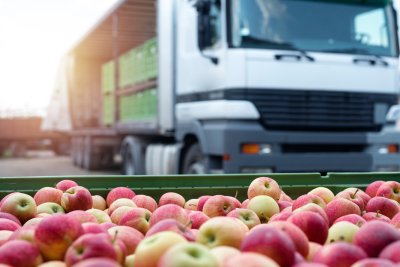
 Fruit and food distribution truck.. Credit: Aleksandar Malivuk / Shutterstock
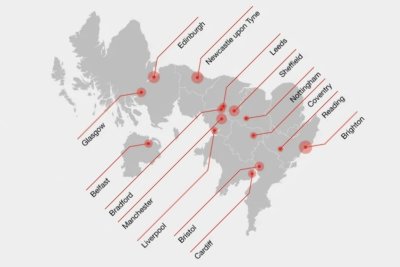
Sustainable Food Places: Network bringing together over 100 local food partnerships.