

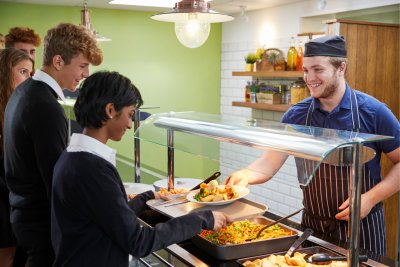
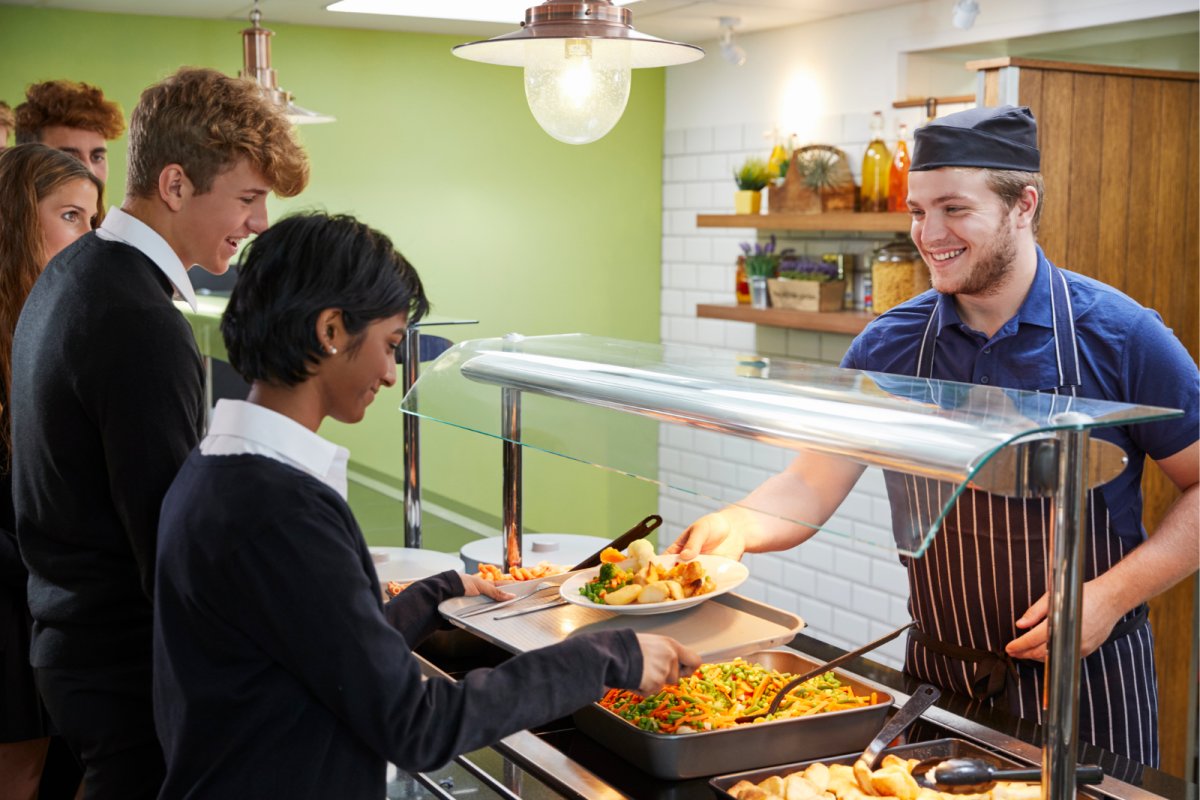
 Students being served meal in school canteen. Credit: monkeybusinessimages / iStock

A parent's journey to better school food
To mark National School Meals Week (9-13 November 2026), Children's Food parent ambassador Gemma McFarlane shares how she spoke up about the food at her children's secondary school and helped make a difference.
Good food has always been important to me, both personally and professionally. Having worked as a chef, I care about making sure people have access to food that’s good for them. I'm also involved with the local food partnership, which works to improve access to healthy food, and work in sustainability, promoting food that is better for both our health and the planet.
My children’s primary school had a ‘Healthy School’ accreditation. They didn’t allow food treats for birthdays, they checked lunchboxes to ensure they were reasonably healthy, and they sent messages home to promote healthy eating.
I assumed this was normal for schools – after all, helping children develop good habits for life should include promoting healthy food.
Good school food matters at every age
When my child started secondary school, they chose to take a packed lunch but told me how their friends ate sugar waffles or a piece of garlic bread at lunchtime. I was really disappointed that secondary school wasn’t continuing with the good work started by the primary school, particularly when young people are at an age when they’re making more decisions about the food they eat.
The school was really hot on achieving academic success but seemed to be overlooking how important good nutrition and bellies full of wholesome food contributes to this. The menu on the website looked good with two choices of a hot meal every day. I then found the snack menu, full of beige and fried foods - and Radnor Fizz! I later found out that out of a school of 1400 students, they only sold around 30 portions of the hot main meal. It’s a similar number in other secondary schools I’ve spoken to. Students have around 30 minutes for lunch and there’s never enough room for them to sit in the cafeteria so they choose ‘grab and go’ options.
Bringing parents and schools together
I emailed the Headteacher, stating my concerns and asked for a meeting. When we met, the Head agreed with what I had to say. They were not happy with the catering either but had not yet questioned the company themselves. School staff are so busy juggling a hundred things, they should be able to rely, without question, on the large company who has been given a contract through a thorough procurement process by the local council - and who provides food for many of the schools across the country - to provide the right food for the children.
The school has a Parent Forum where parents are invited each term to speak to the Head about any concerns. The Head invited me to speak at the forum about my concerns. The other parents in the meeting agreed this was something they would like improved. The catering company was invited to the next forum where we could ask them questions. They agreed to make some changes and trial healthier options. It was fortunate that the Head of Food Technology was also concerned so they were willing to support this too. They recruited student food ambassadors to survey other students to ask how they felt about the school food.
Keeping school food on the agenda
After a short trial, the food went back to how it was. I contacted the Head again. This was good timing as they had seen an article where a Headteacher had taken photos of the school food and had contacted parents apologising on his behalf for the food their children are served. This helped to motivate the Head to address this further.
I was invited to become a school governor as I was also supporting the school with sustainability projects. I joined further meetings with the catering company. The company agreed to support the Head of Food Technology in their application for ‘Healthy Schools’ accreditation. I helped to create a food policy for the school which was also needed for the accreditation. We had to meet with the Senior leadership team to have this agreed. Changes to the school food were agreed by the catering company but these didn’t last.
The Head came into contact with a different smaller catering company and invited them to visit the school to discuss the possibility of supplying the catering contract. I went to visit another school where they provided the food along with the Head of Food Technology. We were really impressed with the food offered. It was displayed like a hotel buffet which was very inviting. The staff were very committed to providing good food.
I’m happy to say the new company is now providing the school food!
The difference parents can make
From this experience, I’ve learned that it is always worth contacting someone if you are unhappy about something like this. I was fortunate that the Head and other staff were willing to work on this too. I’ve gone on to help with sustainability projects at the school, building a polytunnel, helping with a gardening club and provided cookery clubs so you never know where speaking up may lead!
If I were to give advice to other parents, I would encourage them to read the Fuel for Learning parents’ toolkit and look at the School Food Standards which school caterers should follow before emailing the school’s Headteacher with your concerns and asking what they can do to make improvements. The toolkit includes useful questions to ask, such as who in the school leads on food, how the menu is checked against the standards and how pupils and parents can give feedback. You could also contact your local Food Partnership as they may be able to give you advice or provide links to people who could help.
Check out the Fuel for Learning Toolkit
Looking ahead to better school meals
The timing for this couldn’t be better. On September 2026 the Government published new School Food Standards for England, which schools will need to meet from September 2027. They mean more fruit, vegetables, whole grains and pulses on menus, and tighter limits on sugary drinks and on foods high in sugar, salt and fat – with sugary desserts and deep-fried food on their way out.
Importantly, for the first time there will also be standards for breakfast and meal deals, so healthier options should be available across the whole school day and not just in the hot meal that so few of the older students choose. Schools will also be expected to publish their menus and food policies online and to name a school food governor. As a governor myself, I think this is a really positive step: parents will be able to see what is being served, and there will be someone in school responsible for asking the right questions.
The bigger picture
Changing the catering company was a big step, but it doesn’t fix the problem on its own. There are so many factors influencing the food our teenagers eat and they are not going to accept big changes easily. The new standards are a welcome step, but they will only make a difference on the plate if schools and caterers are properly supported to put them into practice, and if young people are involved in shaping what is on offer. I hope the Government provides that support, alongside the enforcement it has promised, as schools prepare over the next year.
Schools have until September 2027 to get ready, so now is a great time to start the conversation about school food. National School Meals Week is a chance to recognise the hard work of caterers and school teams who are already working to make school meals nutritious, appealing and affordable, while looking at how we can build on their efforts to make sure every child has access to great food.
Want to make sure parents have a say in the food children eat?
Like Gemma, you can use your experiences as a parent to help shape campaigns, influence decision-makers and push for a healthier food environment for every child. Find out more about becoming a Children’s Food Ambassador - we're currently recuriting for 2027!
Join the Children's Food Ambassador Programme
Celebrate National School Meals Week

Children's Food Campaign: Campaigning for policy changes so that all children can easily eat sustainable and healthy food.





Sustain
The Green House
244-254 Cambridge Heath Road
London E2 9DA
020 3559 6777
sustain@sustainweb.org
Our mission is to catalyse systemic change in the UK’s food and farming system – securing a healthy, fair, and sustainable future for all people, nature and a stable climate.
© Sustain 2026
Registered charity (no. 1018643)
Data privacy & cookies
Icons by Icons8
