

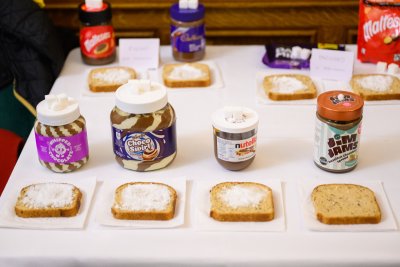
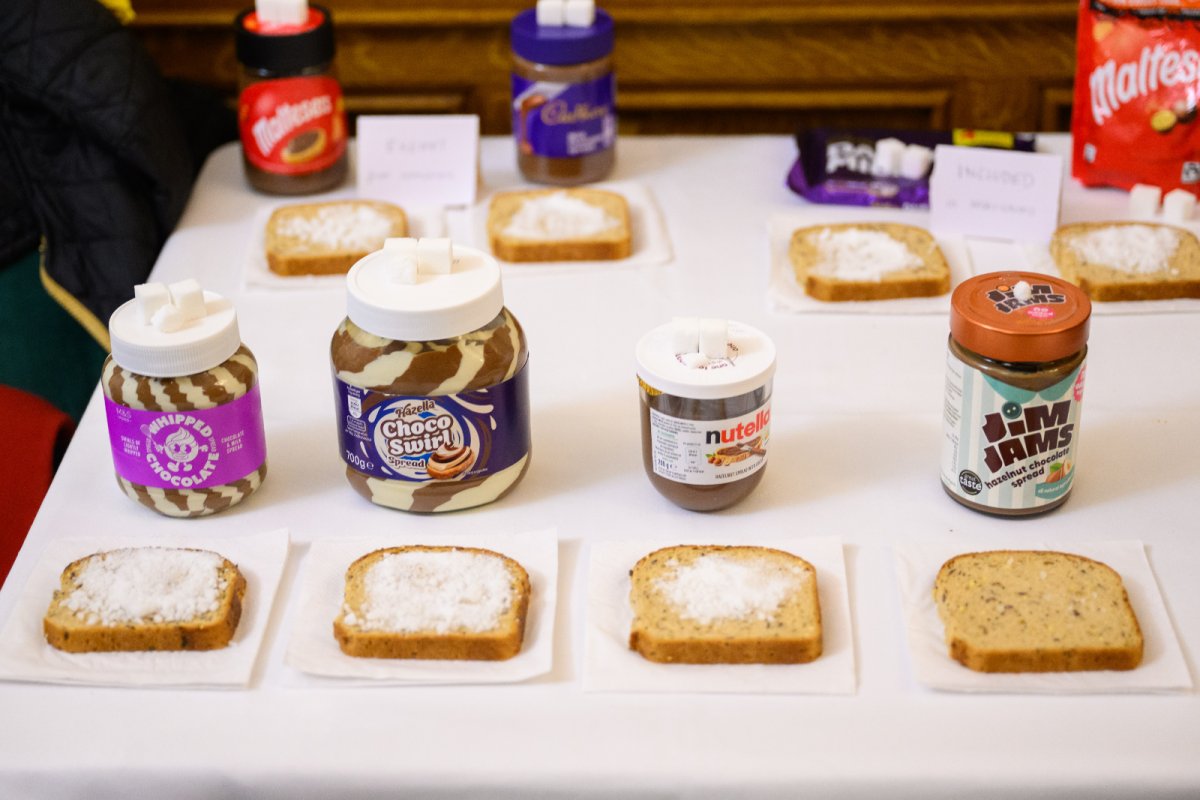
 Spreads displayed with their sugar content. Copyright: Matt Crossick

Spreading the problem: why sweet spreads are slipping through the cracks of UK food policy
Jam on toast, honey in porridge, a spoonful of chocolate spread on a pancake. Sweet spreads are a familiar part of everyday life, but how much sugar are we really consuming, and are current government policies doing enough to encourage healthier choices?
Excess sugar intake remains a major public health concern in the UK. The latest National Diet and Nutrition Survey shows that free sugars account for an average of 10.5% of energy intake in children and 10% in adults - around twice the recommended maximum. Among adults, preserves and confectionery are the second largest contributors to free sugars in the diet, yet sweet spreads – including jams, honey, nut butters and chocolate spreads – are currently, and confusingly, exempt from the advertising and promotion policies designed to protect public health.
New research from Action on Salt & Sugar, published for Sugar Awareness Week 2026, reveals the full extent of the problem. 78% of all sweet spreads on the market were found to be high in sugars and four in five were classified as ‘less healthy’, under the UK Government’s Nutrient Profiling Model (NPM) - the tool used to identify foods high in fat, salt or sugar (HFSS). So why are sweet spreads slipping through the cracks and what does it mean for public health?
A little goes a long way
Spreads are commonly eaten in small amounts, and it is easy to underestimate how much sugar they contain. As our research shows, a single 15g serving of honey can contain an average of 11.7g sugars, providing almost half (49%) of the maximum daily free sugars limit for a child aged 7 to 10. In reality, actual portions may be much larger than the standardised servings, clouding the true extent of how much we’re really eating.
The findings also challenge the idea that “natural” automatically means healthier as the level of processing alone does not tell us everything about a product’s nutritional quality. Honey and syrups were mostly not classified as ultra-processed, yet almost all were high in sugars, and the sugars they contain count as ‘free sugars’, the type we are advised to limit.
Slipping through the policy gaps
Beyond how much sugar these products contain, how they are treated under current government regulations shows a significant gap.
Under the Government's current NPM, 86% of the spreads surveyed were classified as HFSS, including 99% of chocolate spreads. Despite the high proportion of 'less healthy' products, sweet spreads remain outside the product categories covered by restrictions on HFSS food advertising and promotion. This creates a blatant inconsistency: in large supermarkets a chocolate bar classified as HFSS cannot be displayed at aisle ends or near checkouts, yet a chocolate spread with a similarly poor nutritional profile is not subject to the same restrictions.
This gap also extends to sugar reduction efforts. Under the Voluntary Sugar Reduction Programme, honey and syrups such as golden and maple syrup were not covered by the sugar reduction targets. Preserves covered by jam legislation, including traditional jams were also excluded, leaving significant parts of the spreads market outside these efforts. Meanwhile, the Government has already published an updated 2018 NPM, which better reflects current dietary recommendations, including the importance of free sugars rather than total sugars. However, the 2004/05 model remains in use meaning food policies still need to play catch up.
Lower-sugar spreads are possible
While sugar does play a functional role, particularly in shelf life and texture of jams and marmalades, lower-sugar alternatives are achievable and do already exist.
Our survey identified substantial differences in sugars content even within the same product categories, with some chocolate spreads containing less than 1g of sugars per 100g, compared with over 60g in others. Similarly, among jams and fruit spreads, some products contained as little as 2.4g of sugars per 100g, compared with 70.7g in others.
These differences highlight opportunities for lower-sugar product development. Extending the HFSS advertising and promotions rules onto sweet spreads could provide further incentives for manufacturers to improve the nutritional quality of their products.
The spreads solution
Consumers should not have to scrutinise every label or pay a premium to find healthier options, and the responsibility for improving the foods on supermarket shelves should not rest solely with individuals.
This Sugar Awareness Week, Action on Salt & Sugar are calling on the Government to improve that in four ways, by:
- Extending the advertising and promotion restrictions to a broader range of less healthy food categories, including sweet spreads.
- Implementing the updated 2018 Nutrient Profiling Model to existing and future food policies.
- Delivering on their commitment to mandatory healthy food sales reporting with meaningful targets, giving businesses a clear incentive to reformulate.
- Mandating front-of-pack nutrition labelling so that consumers can compare products at a glance.
The tools to improve the nutritional quality of our food already exist. What is needed now is the action to put them into practice. It is time to stop letting sweet spreads slip through the net.

Recipe for Change: Coalition coordinated by Sustain calling for an industry levy to help make food healthier.








Sustain
The Green House
244-254 Cambridge Heath Road
London E2 9DA
020 3559 6777
sustain@sustainweb.org
Our mission is to catalyse systemic change in the UK’s food and farming system – securing a healthy, fair, and sustainable future for all people, nature and a stable climate.
© Sustain 2026
Registered charity (no. 1018643)
Data privacy & cookies
Icons by Icons8
