

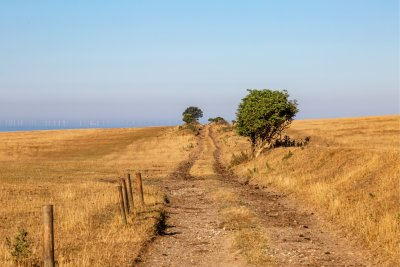
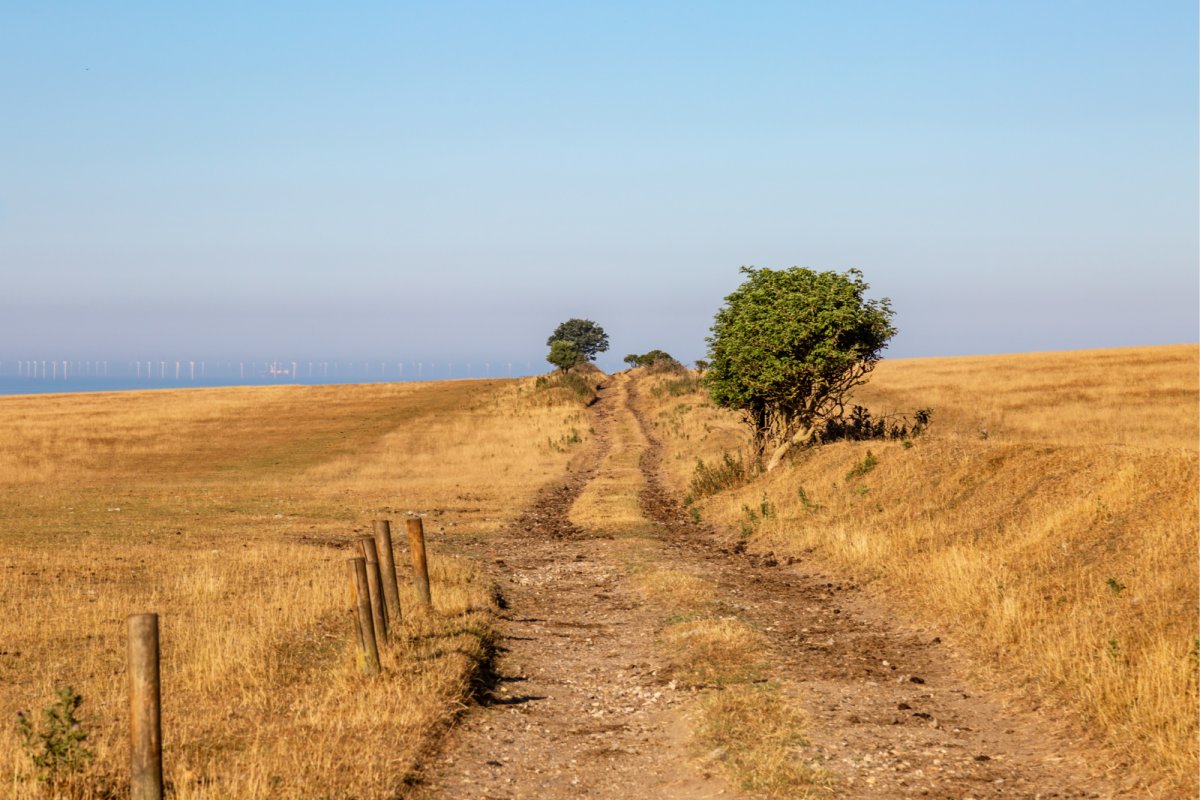
 A pathway in the Sussex countryside with parched fields either side due to a heat wave. Copyright: Lemanieh | Istock

Drought, resilience, and the future of farming
Multiple heatwaves and low rainfall have left England bone dry. Sustain argues we need to invest now in the systems that make farms more resilient for the future.
A combination of multiple heatwaves and low rainfall has led to two thirds of England being declared as “drought” areas.
In July, England had just 7% of its average rainfall. In some southern regions, rainfall was just 1% of its average for July. Temperatures have reached record highs since records began 190 years ago.
This drought hit harder than previous years. Although the UK experienced heatwaves last summer, they were punctuated by periods of rain. This year, much of the country has bone dry for several weeks, meaning we are now forced to dig deeper into our water reserves.
In response to the severe drought this summer, the Government announced a £65 million drought support package for farmers. While it is a welcome start, we need to invest now in the systems that make farms more resilient to climate change in the future.
What’s the impact of drought on agriculture?
Drought can lead to smaller harvests and higher production costs. Farmers experiencing water shortages are likely to see a drop in their yields.
Arable crops, such as wheat, have had an early harvest. While this may appear like a good thing, the crop is actually smaller than usual due to lack of rain and the plants maturing too quickly in the heat.
The Energy and Climate Intelligence Unit (ECIU) estimates that cereals and oilseed harvests will be 2.5m tonnes less than predicted, costing farmers £390m in lost revenue.
This year’s poor harvest comes on the heels of record lows in the last five years, exacerbating existing pressures on farm businesses. In their most recent ‘A Well-Adapted UK’ report, the Climate Change Committee found that in 2025, farmers in England were expected to lose over £800 million due to the impacts of the hot and dry spring and summer season. In the same year, oat and wheat yields fell more than 10% below the ten-year average.
Speaking to BBC News, Tom Lancaster, Head of Land, Food and Farming at ECIU, said:
"Farming is now the sector most exposed to climate change and the risks and damage that it brings."
Coping with dry conditions involves substantial costs for farmers. To keep crops watered and irrigated, they may need to pay water bills, unless they have access to their own water supply, for example through a bore hole (which can cost thousands to install). Paid licenses are required for extracting water from natural sources, such as rivers (through a process known as “abstraction”). Upgrading or installing infrastructure like irrigation and water storage can also be prohibitively expensive. Most farmers’ finances are on the edge right now, following unreliable harvests and geopolitical upheaval in the last five years.
For many livestock farmers across the country, no rain means that grass simply is not growing. To feed their animals, they are having to use their winter feed supplies, which will be depleted by the time we reach the colder months. Buying in more feed increases their costs and due to a poor harvest both last year and this year, prices for winter animal feed could be higher than usual.
One of the deadliest consequences of severe drought can be wildfires. In 2026, firefighters have responded to over 900 wildfires across England and Wales, including 185 in the first 10 days of August alone. Wildfires are highly unpredictable and can spread rapidly, destroying farmland, buildings and machinery, entailing not just huge financial losses but also devastating effects on wildlife.
How are farmers coping with the drought?
This year's drought has highlighted the value of farming systems that work with nature and hold more water in soils, reduce evaporation, and build resilience to extreme weather.
Building healthy soils to hold more water
Drought resilience begins beneath our feet. Research by the Rothamstead Research Centre suggests that, for every 1% increase in organic matter in the soil, an additional 25,000-40,000 gallons of water are held per acre.
The Nature Friendly Farming Network has shared stories on its blog of how its members are seeing the long-term benefits of building healthy soils.
Colin Chappell, an arable farmer and NFFN member based in Lincolnshire, said:
"We're looking for our soil to act as a sponge so it allows the water through when it's flooding, but still keeps it there for the plants to access during the rest of the year."
Keeping the soil covered for as much of the year as possible, through mulches and cover crops, helps it retain moisture and support the fungal networks and microbes that ensure plants can access the water and nutrients they need.
Using water wisely
Members of Sustain’s Capital Growth network have been sharing how they are managing in urban food growing settings.
Black Growth's Market Garden in Croydon has already lost an entire okra crop during the heatwave. To improve resilience, the team plans to sow cover crops over winter to build soil structure and continue using water-efficient irrigation systems.
In a recent blog by Capital Growth Network, Michaela Wilson, Head Grower at Black Growth CIC, said:
"We are trying to adapt, but the truth is that the land is changing faster than many of us can keep up with."
Another Capital Growth member, Black Rootz in Wolves Lane, shared their methods for conserving water. Head Grower, Pam Shore is using a technique known as “hydrozoning”, grouping plants with similar water needs together. This simple approach helps reduce water use while encouraging deeper root systems. Pam also highlights the value of indigenous growing knowledge, including companion planting methods such as the Three Sisters approach. Squash, beans and sweetcorn are grown together, with the corn providing a support for the beans, the beans sequestering nutrients in the soil, and the large leaves of the squash providing a living mulch that conserves water within the soil.
Taking a whole-farm approach
At Middle Ground Growers in Bristol, farmer and founder Hamish Evans describes a blog how years of investment in composting, agroforestry, water storage, and minimum tillage have increased soil organic matter and improved the farm's ability to cope with dry conditions.
The farm and market garden benefit from a “circular water design” based on permaculture principles. Whereas previously, excess water runoff led to localised flooding, now rainwater is redirected through a series of channels into ponds and other water storage features. From there, it is solar-pumped to crops that feed hundreds of people every week.
Yet these adaptation measures have limits. Hamish says that his business has seen drought-related crop losses and additional costs have exceeded £20,000 this year.
Sharing his reflections on Summer 2026, Hamish Evans said:
"Climate extremes are compounding what was already a tough deal for farmers. When we have a failed crop we pick up the bill, and when we have a bumper crop we can just about break even."
His experience highlights an important lesson: agroecological farming can improve resilience, but we cannot expect adaptation alone to fully shield farmers from increasingly severe climate impacts.
If we ask farmers to adapt to climate change without taking urgent action on greenhouse gas emissions, we are asking farmers – both at home and abroad - to fight fires of our own making. Preventing further increases in global average temperatures is absolutely essential, in order to relieve the pressure on farmers to fire-fight in future.
The Government must urgently prioritise reducing emissions if it wants to avoid worsening climate conditions devastating farm businesses and food production. Sustain’s Food for the Planet campaign highlights how policymakers can reduce emissions while also ensuring a just transition for farmers and communities, for example by halting the growth of polluting intensive livestock units and harnessing the power of public procurement to shift towards healthier, plant-rich diets.
What needs to change to prepare us for future droughts?
Now more than ever, it is clear we need a more resilient food system to withstand future disruption and an increasingly volatile climate. This means investing in nature-friendly farming, strengthening local and regional supply chains, and making healthy, sustainable food accessible to everyone.
As part of the UK Fruit and Vegetable Coalition, Sustain is helping to shape Defra's Horticulture Sector Growth Plan to ensure greater support for organic and agroecological growers. With the UK currently importing around 80% of its fruit and 47% of its vegetables, increasing homegrown production is not only good for the environment, it is also essential to ensuring the UK’s food security.
Resilience also depends on farmers receiving a fair return for the food they produce. Too often, the risks and costs of climate shocks fall on producers, while profits are concentrated elsewhere in the supply chain. Sustain is calling for fairer, more transparent, food supply chains that share value more equitably and enable farmers to invest in the long-term resilience of their businesses.
A transition towards more sustainable and plant-rich diets will also be necessary to bring down emissions and prevent further climate breakdown. A diet shift could also improve public health, but we need to make this food the easy choice. Sustain has worked with farmers, food businesses, and local authorities through its Bridging the Gap programme to get more fruit and veg to people on low-incomes, testing practical solutions that support resilient farm businesses and local food economies.
Finally, these ambitions must be backed by legislation. Sustain has joined forces with more than 100 organisations and food businesses to call for a Good Food Bill, which would create a joined-up framework for delivering food security and healthy diets.
This year's drought should be a wake-up call. We need to act now to build a food system that can weather the storms ahead.

Sustainable Farming Campaign: Pushing for the integration of sustainable farming into local, regional and national government policies.



Sustain
The Green House
244-254 Cambridge Heath Road
London E2 9DA
020 3559 6777
sustain@sustainweb.org
Sustain advocates food and agriculture policies and practices that enhance the health and welfare of people and animals, improve the working and living environment, promote equity and enrich society and culture.
© Sustain 2026
Registered charity (no. 1018643)
Data privacy & cookies
Icons by Icons8
