

Sustain / Real Bread Campaign / Articles
Today’s lesson is Real Bread
Tom Walker is head of food education at Hackney School of Food.
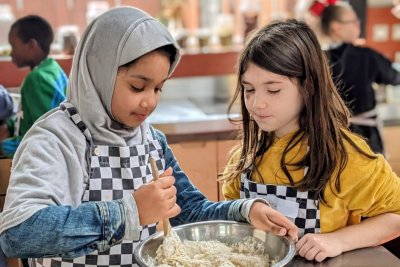




In a quiet corner of east London, a former school caretaker’s house and its surrounding underused playground have been reclaimed to create something remarkable: a seed-to-spoon sanctuary. Hackney School of Food opened its doors in 2020, when our very first recipe was seeded wholemeal rolls.
Since then, we’ve taught thousands of school children, community groups, chefs and office professionals that bread is far more than just a grocery item: it is the staff of life.
Not bish, bosh, bake, done
Here, bread isn't confined to a short, single baking lesson: we’ve created a diverse suite of programmes designed to turn this simple staple into a gateway for health, history and community. We curate a library of breads that adapts to the needs of our visiting schools, professional trainees, and community customers. Depending on the programme, we might be firing up the wood oven to bake hand stretched pizzas, tending to the complex tang of a sourdough, dimpling our focaccias or even slapping down our ciabatta dough. This variety allows us to translate deep Real Bread knowledge into tangible, practical skills that resonate long after the class has ended.
Our programmes are built around the fact that bread is ideal for a hands-on way of learning. We don't just teach recipes; we teach the entire life cycle of food through several key educational pillars. In our most immersive sessions, we have led students through the whole process, right from growing wheat in our gardens. Seeing the transition from a single seed, to several green shoots, then many golden grains offers children a firsthand understanding of agriculture and soil health that a supermarket shelf simply cannot provide.
Diving deeper
We take this exploration deeper by looking at the middle ground of food production, the often-overlooked stage of processing. Students take dry seeds and use a pestle and mortar or quern to grind the grain into flour. It’s a tactile experience that demonstrates how a basic ingredient in its natural state can be transformed by minimal processing into something more versatile. This helps to demystify origins of an everyday staple and connect children to the raw mechanics of human history.
This historical connection has even been recognised for its educational impact. An Ofsted report on Mandeville Primary School (one of our partner schools) highlighted how ‘leaders plan a rich curriculum which aims to enhance pupils’ lives.’ The report noted specifically that ‘pupils recently baked ‘Anglo Saxon’ bread […] revisiting and learning key historical facts while doing so.’
Soup and fire
By teaching about bread alongside seasonal soups, we create a nutritional crossover. Children explore how to balance a meal, matching wholegrains with pulses, legumes and seasonal vegetables. It’s a simple, foundational, delicious start to understanding what good food means in terms of what can be good for us.
We also take the learning outdoors to connect with ancestral cooking methods. Whether it is mastering the intense, dry heat of our wood-fired oven or the patient art of campfire breadsticks, the experiences are transformative. Students learn to roll sourdough around sticks, slowly rotating them over an open fire – a lesson in temperature control, patience and the fundamental relationship between humans and heat. We also use dough as a medium for artistic exploration. From plaited mermaids’ tails and spiked hedgehogs, to intricate focaccia canvases decorated with seasonal fare from our gardens, we ensure that Design and Technology objectives are met with artistic flair.
The leap-loop method
The biggest hurdle to schools teaching breadmaking is timetabling. The multi-stage process of measuring, proving, shaping and baking Real Bread doesn't naturally fit into a standard two-hour lesson slot. To solve this, we have an elongated, non-chronological teaching method. Rather than trying to squeeze a ten-hour proof into one morning, we use a cyclical process across our sessions.
When a class arrives, the children leap straight in with dough that was prepped by the previous group and proved overnight. This allows them to engage immediately with the high-skill, fun tasks of shaping and baking. Once their loaves are in the oven, the children loop back to weighing ingredients and making dough for the next class. This ‘here’s one I made earlier’ approach, focused on preparing for the next group, ensures that every child masters each stage of the process, from the initial shaggy mess of flour and water to the final golden crust. It allows them to discover that great things take time and that they are part of a continuous chain of makers.
Sensory and colourful
Our garden and the kitchen are in constant conversation. We use our bread as a vehicle for seasonal discovery. Students might forage for herbs to create herby rubs or pestos to be rolled into a vibrant swirling loaf. We often grate cooked beetroot directly into the mix to create striking pink breads, teaching children how vegetables can enhance both the colour and the nutritional profile of their food naturally. This integration reinforces the connection between the land and the plate, making nutrition a sensory and colourful experience.
Boundless outlet for creativity
Our immersive, multi-programme approach does more than fill stomachs; it builds food literacy. By breaking the process down and showing how it weaves through biology, maths and art, we are giving children a sophisticated understanding of the world around them.
Through the Hackney School of Food, we aren't just teaching kids to bake, we are growing a more thoughtful, skilled and resilient community. Whether it’s the slow bubbles of a sourdough, the bright harvest of our wheat patch, or the smoky aroma of Real Bread over a campfire, we are showing the next generation that food is a source of health, a product of nature and a boundless outlet for creativity.
@hackneyschooloffood
@tomthefoodchampion
Lessons in Loaf
Don’t forget to grab a copy of the Real Bread Campaign's Bake Your Lawn grow-a-loaf guidebook in time for spring or winter wheat planting, plus year-round recipes, info and bready lesson plans.
Originally published in True Loaf magazine issue 67, July 2026.
Got something to share?
See: YOUR words in print, My baker’s dozen, My favourite bakery, Who are your Real Bread Heroes? and Sharing your recipes.
See also
- New bread standards for schools
- Seed to sandwich in Washington State
- Chef in the classroom
- Seed to sandwich in Shaky Toon
- Bakers’ bush
- Playing fields of wheat
- Having a field day
- Toast for good health
- Ambassador profile: Marcia Harris
- I didn't know work could be such fun
- A breaducation
- Class act
- Yellow Door gets Northern Ireland schoolkids baking

Published Tuesday 13 October 2026
Real Bread Campaign: Finding and sharing ways to make bread better for us, our communities and planet.