

 School kids enjoying snacks during lunch break. Credit: LightFieldStudios / iStock


Honouring our communities: building a healthier food future for every child
For Black History Month 2026, Naema Jannath reflects on what it means to build a healthier food future for every child and why racial justice and equity must be part of that future.
The 2026 Black History Month theme is 'Honouring Our Communities'. It invites us to recognise the people whose everyday contributions shape, support and sustain Black communities across Britain – a reminder that history is not only made by famous figures or landmark moments, but built through care, leadership, organising, volunteering and the everyday work of people who help sustain their communities and thrive.
For us, this raises an important question: what does it mean to honour our communities when we think about children's food and health?
Across the UK, Black and minoritised ethnic communities are already doing so much to support children and families: sharing knowledge, looking out for one another, running community organisations that provide food and support, and helping families navigate the services and support available to them.
As an alliance, we work with many different communities, including farming communities, school communities, health networks and local community food partnerships. What has become very clear is that the food system does not work equally well for every community, or for every individual and family within them.
We have been reviewing the existing UK evidence on how race and ethnicity intersect with poverty, food insecurity, school food, food marketing and nutrition-related health outcomes. It shows that these inequalities are not simply the result of individual circumstances or behaviours. They are shaped by wider factors such as poverty, immigration status, employment, geography, access to services and by structural inequalities, including racism.
Inequality starts upstream
Some of the clearest inequalities can be seen in child poverty and food insecurity.
Child poverty rates are particularly high among Bangladeshi and Pakistani households and are also substantially higher among Black African households than among White British households. Similarly 21% of Black/African/Caribbean/Black British individuals and 19% of Mixed ethnic background individuals experience food insecurity, compared to much lower rates in White households (House of Commons, 2024).
These inequalities matter because children's health cannot be separated from the conditions families are living in. When household budgets are under pressure, healthy food needs to be affordable and accessible. When families face barriers to public support, the schemes designed to help children eat well need to be easy to access. And when children are surrounded by unhealthy food advertising, simply asking families to make “healthier choices” ignores the environment shaping those choices in the first place.
A healthier food system has to look beyond individual behaviour. It needs to address the conditions that shape children's opportunities to eat well.
A policy can be universal without being equitable
There have been important steps forward. The expansion of free school meals in England from September 2026 has the potential to improve access to nutritious school food for many children in low-income households. But being eligible for support does not always mean being able to access it.
The evidence we reviewed points to how administrative barriers can prevent eligible children from receiving support, while families with No Recourse to Public Funds face additional difficulties. Evidence from Lambeth found that automatic enrolment for free school meals disproportionately benefited children from minoritised ethnic communities – a clear sign of the role administrative systems play in creating, or reducing, inequality.
The same principle applies to school food itself. A meal might meet nutritional standards without working for every child. We found that culturally and religiously appropriate provision, including halal and kosher meals, varies considerably between schools. Where appropriate meals are unavailable or poorly signposted, some children choose a less suitable alternative or avoid school lunches altogether.
Universal provision is important. But universal does not automatically mean equal. If we want policies to improve children's health, we need to ask not only who is eligible, but who is actually able to benefit.
The food environment matters too
Children do not experience food in isolation. The places where they live, learn and spend time shape what food they see, what is available, and what is promoted to them.
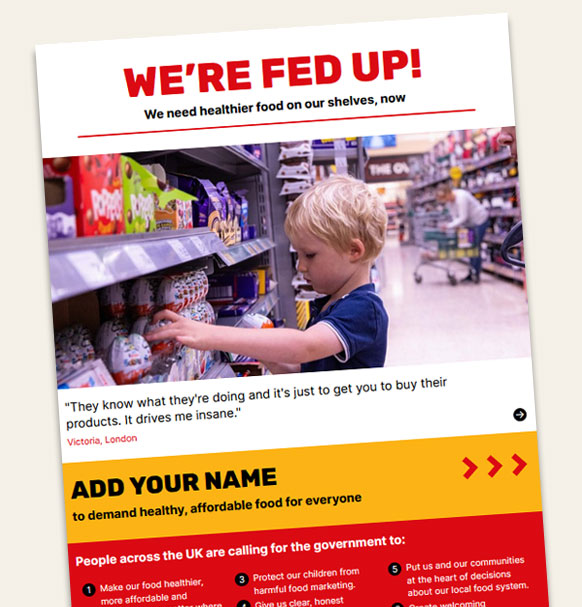
The evidence raises growing concern about unhealthy food marketing, particularly in more deprived communities. Research from Bite Back 2030 found outdoor advertising of high fat, sugar and salt (HFSS) foods at more than six times the rate in the most deprived neighbourhoods compared with the least deprived. Given the overlap between deprivation and some racially minoritised populations, these unequal food environments may contribute to inequalities in exposure to unhealthy food marketing.
Children should not have to navigate an unequal commercial environment in order to be healthy. We need action that changes the environments around children, rather than placing the responsibility for navigating them on children and families.
We also need to challenge assumptions about race and health
The evidence does not tell a simple story. Racially minoritised groups are not homogeneous, and health and nutrition patterns vary considerably between and within communities. For example, the latest Infant Feed Survey reveals that breastfeeding initiation and continuation are consistently higher among Black and Asian mothers than among White mothers, despite some of these groups experiencing higher levels of poverty.
This matters because we need to avoid narratives that position particular communities as having a problem with their diets or health. The question should not simply be 'what should this community be doing differently?' It should be 'what is happening around children and families, and what needs to change?'
That means recognising the strengths and knowledge already present within communities, while being honest about the structural barriers that make it harder for some families to access healthy food and support. It also means resisting the idea that there is one experience of being Black, Asian, or part of any other racialised group. Our review points to significant differences between communities – a reminder to listen to people's lived experience rather than treat communities and cultures as a single, homogeneous group.
Honouring communities means building change together
The theme of this year's Black History Month is ultimately about recognising the people who help communities thrive. That has a powerful connection to how we think about food policy.
Communities should not simply be seen as recipients of policies and programmes. Communities bring knowledge, experience and ideas about what would make policies and programmes work better. The evidence we've reviewed highlights limited racial diversity across the food, farming, climate and environment sector. Greater representation within policy, commissioning and decision-making could help ensure food policies better reflect the needs and experiences of diverse communities.
Engaging with communities cannot be an afterthought. It needs to be part of how we design the food system in the first place. And if we want change to last, we need to recognise and work alongside the communities already helping to build healthier futures.
We need better evidence, as well as better action
There is still much we do not know. Ethnicity-disaggregated data is inconsistent across nutrition programmes and health surveillance. Our review of the evidence found that participation and outcomes from the Holiday Activities and Food programme are not routinely reported by ethnic group. This makes it harder to know whether programmes are reaching children equitably, or reducing inequalities at all.
Better data matters because what we do not measure can easily be overlooked. But data is only one part of the picture. Numbers need to sit alongside lived experience and community knowledge if we're going to understand why inequalities exist, and what will genuinely make a difference.
What would it take to build a food system that works for every child?
This Black History Month's theme, 'Honouring Our Communities' is an opportunity to recognise the people and communities already working to create healthier futures for children and to ask what more needs to change. It means:
- tackling poverty and food insecurity that disproportionately affect some racialised communities.
- removing barriers to vital support such as free school meals and Healthy Start.
- making sure school food works for every child, including reflecting cultural and religious needs.
- protecting children from unhealthy food marketing, wherever they live.
- putting lived experience and community voices at the heart of food policy.
- collecting better data so inequalities cannot be overlooked.
Racial justice is not separate from building a healthier food system. It is part of making that system equitable for everyone.
This conversation should not just be for Black History Month. Building a healthier food future for every child means continuing to listen, learn and act with communities throughout the year, and for the long term.
More about Black History Month
Note: The Children’s Food Campaign is currently reviewing the existing UK evidence on how race and ethnicity intersect with poverty, food insecurity, school food, food marketing and nutrition-related health outcomes. This work is part of our ongoing commitment to racial justice and equity in children’s food and health.

Children's Food Campaign: Campaigning for policy changes so that all children can easily eat sustainable and healthy food.


Sustain
The Green House
244-254 Cambridge Heath Road
London E2 9DA
020 3559 6777
sustain@sustainweb.org
Our mission is to catalyse systemic change in the UK’s food and farming system – securing a healthy, fair, and sustainable future for all people, nature and a stable climate.
© Sustain 2026
Registered charity (no. 1018643)
Data privacy & cookies
Icons by Icons8
