

Sustain / Real Bread Campaign / Articles
Living knowledge at Bradwell Windmill
Sofia Gallo visits a mill restoration project in Buckinghamshire.
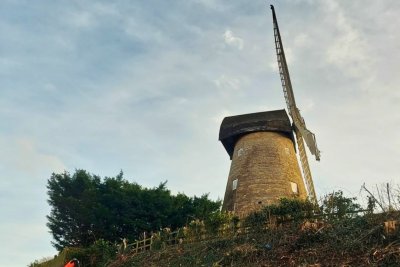


In the heart of Milton Keynes stands Bradwell Windmill. Built in around 1805 by Samuel Holman, this limestone tower mill, the only one of its kind in the area, was once an important part of the local food economy. Today, it offers a timely reminder of what Real Bread can mean: a connection to grain, place and community.
A legacy in stone and timber
In an age of long, opaque supply chains, resulting in additive-laden industrial loaves, Bradwell invites us to look to local history. This is not out of nostalgia but to recover knowledge that still matters for the future of bread.
The history of the mill is a story of local resilience and practical ingenuity. Positioned on a limestone ridge to catch the prevailing winds of the Ouse Valley, the mill reflects the engineering skill of the early nineteenth century. Unlike earlier post mills, which had to be turned bodily to face the wind, Bradwell is a tower mill. The main structure remains fixed while only the wooden cap, to which the sails are attached, rotates. This allows the miller to respond more efficiently to changing conditions.
Bradwell Windmill was designed to be versatile, grinding both barley for animal feed and wheat to make bread. Inside, the heritage is tactile and evocative. The stone floor still houses two distinct sets of millstones. The Derbyshire Peak stones were used for coarser grinding, while the French burr stones, highly prized for their hardness and silica content, were used to produce the fine, white flour that once filled local larders. The mill also contains an unusual detail: a ground-floor fireplace. In the nineteenth century, this would have brought welcome comfort for the miller, though it sat uneasily alongside the very real danger of combustible – and potentially explosive – flour dust. That mixture of domestic routine and occupational risk offers a glimpse of the working lives behind one of our most staple foods.
Though commercial operations ceased around 1910, as steam power and large-scale roller mills took over the industry, Bradwell was saved from dereliction. Today, thanks to the dedicated work of the Milton Keynes Museum and local volunteers, the art of traditional milling is being kept alive for a new generation of enthusiasts and bakers.
Bringing history to life
To explore the practical side of the restoration in more detail, I spoke with the project team about the mill’s stones, machinery and the challenges of keeping this landmark in working order. Their answers underlined how closely flour quality, mechanical knowledge and local history remain bound together at Bradwell.
One of the clearest themes to emerge from the conversation was that Bradwell’s value lies not only in its survival, but in the kind of flour it can help people to understand. The project team drew a sharp contrast with industrial roller milling, which typically removes the bran and germ to produce a more shelf-stable, white flour. At Bradwell, by contrast, the stones work more gently, retaining more of the germ’s oils, nutrients and flavour, producing flour with greater character. As they explained, this is flour that fits naturally with the Real Bread Campaign’s concern for process, minimally-processed ingredients and nutritional value.
They were equally keen to stress that flour quality depends on skill as much as machinery. ‘It comes down to the relationship between wind speed and the gap between the stones,’ they told me, describing the process of tentering, by which the miller adjusts that distance minutely to keep the grind under control. If the stones run too fast, the flour can heat up too much, affecting enzymes and dough performance. Good milling, therefore, depends on ‘monitoring the feed of the grain, reading the wind and keeping the flour cool and lively for long fermentation.’
The team also emphasised that restoration means preserving a working system, not merely a historic shell. A remarkable amount of the primary gearing is still original, or has been restored to original specification, though the wooden components demand constant attention: oak and elm gears must be watched closely for moisture, wear and rot. As they put it, caring for Bradwell ‘is not simply a matter of preserving a building; it means maintaining a working machine and the specialist knowledge needed to keep it moving.’
Alongside these mechanical concerns, the restoration has also revealed more of the mill’s social role. Research into the Holman family and the life of the site suggests that farmers did not simply arrive, drop off grain and leave; they waited, exchanged news and traded information. In that sense, Bradwell served as both workplace and meeting point. The current project hopes to recover something of that communal function through education and public activity.
A vision for the future
I lead bread-making classes for families and for more experienced home bakers. In time I hope to host sessions on site at the windmill itself. For families, that could mean children seeing grain as something more than an abstract ingredient, watching where flour begins, encountering the stones and then learning how dough is transformed through fermentation and baking. In a food culture shaped by convenience, there is real value in slowing the process down and making space for shared practical skills. A loaf followed from grain to oven carries a kind of understanding that cannot be bought off the shelf.
For skilled home bakers, working in a mill setting offers a chance to deepen their understanding of flour itself. Stoneground flours behave differently from commercial, standardised, roller-milled flour, calling for closer attention to hydration, dough strength and temperature. Exploring those differences at the point where grain becomes flour would add both technical insight and a stronger sense of connection to the craft.
That, perhaps, is the real promise of a place like Bradwell Windmill: not simply that it can be preserved, but that it can continue to teach. When milling, baking and sharing bread happen in conversation with one another, the grain chain becomes visible again, not as heritage behind glass, but as living knowledge within the community.
@bradwellwindmillproject
@in_cucinacon_sofia
Originally published in True Loaf magazine issue 67, July 2026. Be the first to read new articles by joining the Campaign.
Want people to see YOUR article here?
See: YOUR words in print, My baker’s dozen, My favourite bakery, Who are your Real Bread Heroes? and Sharing your recipes.
See also
- The mill that belongs to everyone
- Tuxford Windmill: Sails of the (nineteenth) century
- Run of the mill
- Lurgashall mill again
- Mill race for life
- Back to the urban grind
- Windy miller

Published Monday 19 October 2026
Real Bread Campaign: Finding and sharing ways to make bread better for us, our communities and planet.