

Sustain / Real Bread Campaign / Articles
Roots and resilience
Sofia Gallo explains how the future of Real Bread can learn from its mixed past.
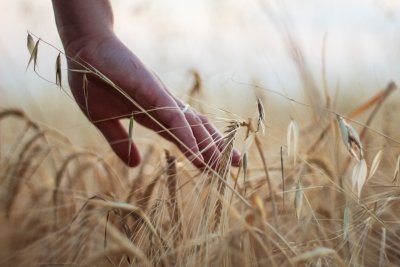


To break bread in pre-industrial Britain was to taste the immediate reality of the soil beneath your feet. Long before industrial milling imposed uniform wheat monocultures on the countryside, local loaves reflected local fields: their soils, weather, risks and rewards. The grains growing in those fields were often more diverse and resilient in than the simplified systems that replaced them.
Maslin and more
Take maslin, a forgotten staple of the British household. Historically, farmers did not sow single crops in isolated plots; they planted wheat and rye together in the same soil. Harvested, threshed and stoneground as one, this mixed crop was an act of agrarian common sense. Hardy rye helped weather the bitter frosts and damp springs that threatened delicate wheat, while its companion contributed the gluten strength that rye lacked. The resulting loaf captured nutritional and other qualities of both: wheat provided structure for an airy crumb, while rye delivered deep flavour, moisture and natural longevity.
In the rain-soaked uplands of Cumbria, Yorkshire and Scotland, the landscape shaped bread in different ways. Acidic soils made wheat a luxury, so oats more commonly sustained life. Because oats lack the gluten required for a well-risen loaf, domestic and professional bakers (also known as baxters in some places) tended to make flatbreads on hot griddles. One example was the now-almost-forgotten Cumbrian clapcake or clapbread. Fuel-efficient, quick-cooked and able to be dried and stored for months, it was a quintessential taste of the region’s identity.
Such examples matter and should be remembered because they show that Real Bread was never just a recipe but an ecological response. They were the results of regional knowledge turning uncertain harvests, grown in variable soils, into daily nourishment. That intelligence offers a useful lesson for today’s bakers, who are once again learning that diversity in the field can mean strength in the loaf.
Moving away from monoculture
The rich tapestry of regional microclimates and biodiversity was disrupted by the Industrial Revolution. By the mid-20th century, agriculture increasingly prioritised yield and uniformity over other factors, pushing farmers towards monocultures heavily dependent on agrochemical inputs. The arrival of the Chorleywood Process in 1961 accelerated that shift. Skills and knowledge in long fermentation of diverse grain varieties and populations was swept aside by high-speed ultra-processing, with little tolerance for variations in flour specifications. In simplifying the natural complexity of our fields and flours, we gained convenience but lost nutrient density, flavour and ecological stability.
Today, however, the tide is turning. As extreme weather and depleted soils expose the fragility of industrial farming, a growing wave of farmers, millers and bakers are looking to the past to learn for our future. The goal is not nostalgia, it’s resilience. By planting heritage varieties and population crops (evolutionary mixes that adapt dynamically to shifting, local growing conditions) farmers in the UK’s non-commodity grain networks are reducing their reliance on synthetic fertilisers. Working closely with a new generation of millers, the results are flours with distinctive characteristics.
Making Real Bread from such flours requires bakers to sharpen our craft, honouring how past generations worked alongside nature rather than attempting to dominate it. Restoring our bread identities is not about moving backwards; it is about reclaiming biodiversity as our strongest tool for a sustainable, additive-free future.
www.lamiacucina.co.uk
@in_cucinacon_sofia
Originally published in True Loaf magazine issue 68, October 2026. Be the first to read new articles by joining the Campaign.
Want people to see YOUR article here?
See: YOUR words in print, My baker’s dozen, My favourite bakery, Who are your Real Bread Heroes? and Sharing your recipes.
See also
- Baking A Better Tomorrow
- Barley vous?
- The rye-searcher
- Let's make Britain grain again!
- Grassroots grain Britain
- Cultivating a new local grain economy
- Why queue for YQ?
- Landrace for life

Published Monday 9 November 2026
Real Bread Campaign: Finding and sharing ways to make bread better for us, our communities and planet.