

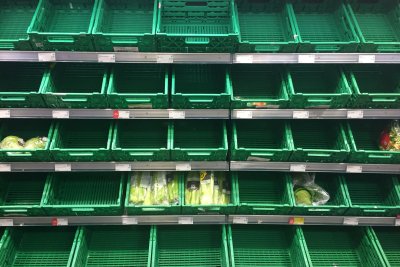
 Empty products shelves in a food store. Credit: Ink Drop / Shutterstock


Government warned not to rely on private sector to safeguard food security
Sustain calls on the Government to strengthen local and regional food supply chains after a National Audit Office report warned that Defra relies too heavily on private businesses to safeguard the UK's food security.
A new report published by the National Audit Office (NAO) has warned that the Department for Environment, Food, and Rural Affairs (Defra) is overly reliant on private businesses to deal with disruptions to food supply.
The NAO is the UK’s independent public spending watchdog. Its new report examines whether Defra is taking effective action against key risks that could result in catastrophic disruption to food supply, such as extreme weather events related to climate change.
While the NAO acknowledges that Defra has taken some positive steps to improve its preparedness for disruption, it warns that short- and long-term risks to food supply are becoming more likely and more severe.
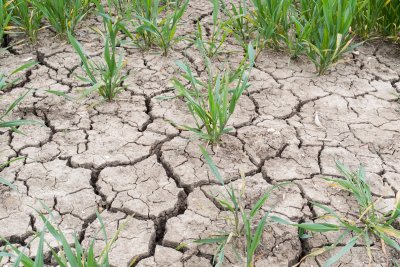
Recent disruptions have increased public and political attention on the resilience of the UK’s food system, such as this summer’s severe drought, which has resulted in lower yields and increased costs for farming businesses.
Alys Bannister, Sustainable Farming Campaign Manager at Sustain said:
"The NAO's report is a timely reminder that building a resilient food system cannot be left to the private sector alone. Following a difficult summer for many farmers and growers, it's increasingly clear that climate change is making the risks from drought, flooding and other extreme weather harder to ignore.
The Government needs to increase investment in resilience across our food system, rather than simply responding to disruptions when they happen. The Horticulture Sector Growth Plan is one opportunity to start making that investment now by strengthening local and regional food infrastructure, creating more routes to market for producers, and building resilience throughout the supply chain."
Julia Kirky-Smith, from Sustain alliance member Better Food Traders, said:
“The NAO’s warning should be a wake-up call for policymakers. As an organisation supporting local food enterprises across the UK, we’ve already seen how well they can adapt to crises like the COVID-19 pandemic.
We know the strength of locally-rooted businesses lies in their direct and fair dealings with food producers, their key role on local high streets, and their commitment to local customers — qualities that big business often lacks. We’d like to see more urgent action from the new Prime Minister to grow local food infrastructure and SME businesses so that more people can access sustainably produced, nutritious food near where they live.”
What changes are needed?
To date, Defra has largely relied on the private sector to manage disruptions to food supply. However, according to the NAO, the sector’s ability to withstand catastrophic events has not been tested, and that Defra must do more to prepare for future food supply chain disruption.
Sustain is calling on the government to:
1. Fix the supply - boost British fruit, vegetable, and pulse production while improving soils and reducing pollution through a well-funded and ambitious Horticulture Sector Growth Plan.
2. Fix the missing middle – increase local infrastructure for processing and distributing food, giving farmers fairer prices through more direct routes to market.
3. Fix the demand - Enable everyone to access good food, through better public procurement and coordinated action across government.
How to fix the food system for everyone: read the briefing
Sustain is also a programme partner of the Sustainable Food Places Network, which has been working with Government departments, regional authorities and resilience bodies, to ensure that local food partnerships – who bring together growers, businesses, councils and community groups – are at the heart of national and local plans to respond to crises.
Vera Zakharov, Local Action Coordinator at Sustain said:
“Food is designated by the Government as one of 13 Critical National Infrastructures (CNI) sectors that it considers essential to the country’s functioning.
We are seeing a growing consensus, and learning from the Covid-19 pandemic, that the private sector alone cannot safeguard public access to nourishing food in a time of crisis. What we need is a ‘whole of society’ approach, with coordinated and collective action across sectors led by community expertise.”
The new report, Civil Food Resilience in Practice, identifies a framework to put this into action at the local, regional and national level.
From boosting domestic fruit and vegetable production to strengthening local food infrastructure and improving access to good food, Sustain believes a more resilient food system requires coordinated action across the whole food chain.
Download Sustain’s briefings on taking a place-based approach to food security and resilience and how to improve affordable access to sustainably produced food
Learn more about how the Government’s Food Strategy could deliver more local food

Sustainable Farming Campaign: Pushing for the integration of sustainable farming into local, regional and national government policies.





Sustain
The Green House
244-254 Cambridge Heath Road
London E2 9DA
020 3559 6777
sustain@sustainweb.org
Sustain advocates food and agriculture policies and practices that enhance the health and welfare of people and animals, improve the working and living environment, promote equity and enrich society and culture.
© Sustain 2026
Registered charity (no. 1018643)
Data privacy & cookies
Icons by Icons8
