

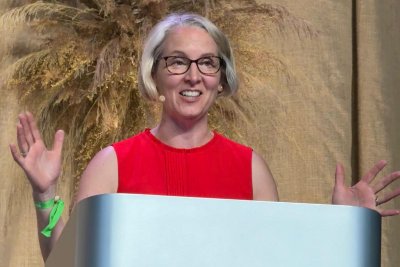
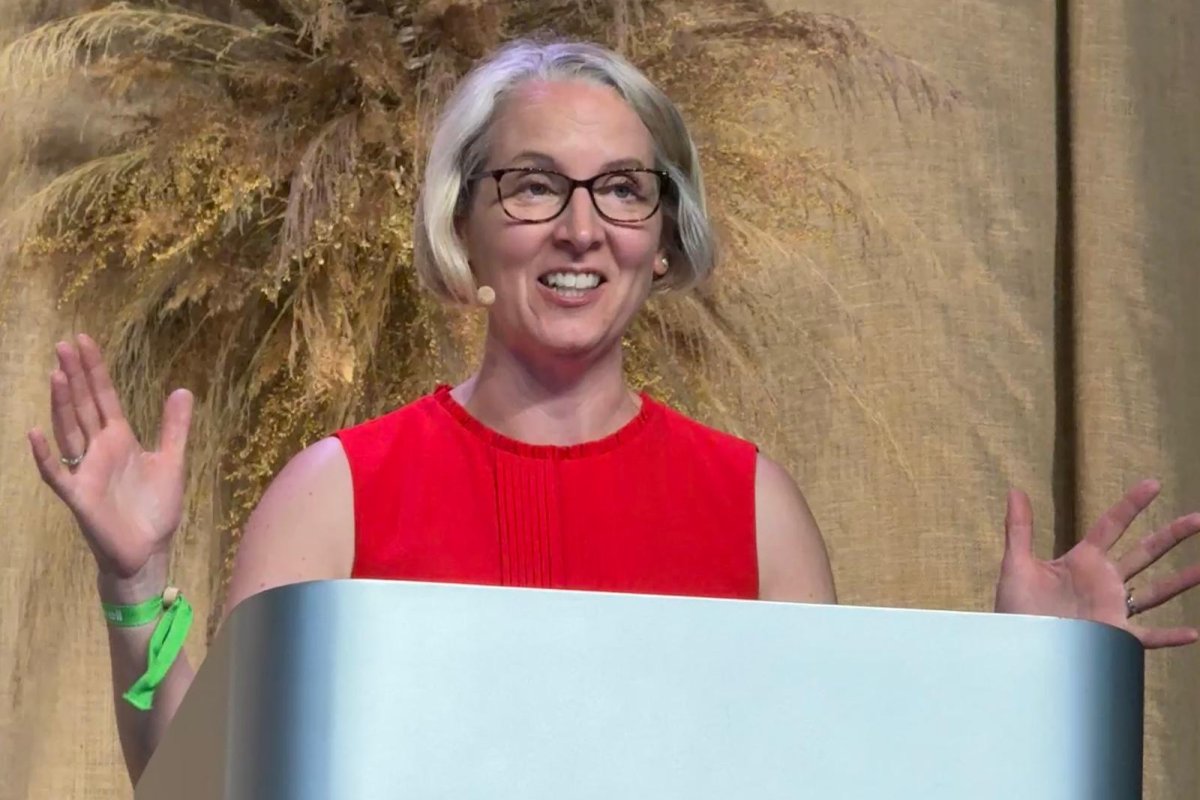
 Defra Secretary of State Emma Reynolds speaking at Groundswell. Copyright: Sustain

Three things we took away from Groundswell 2026
Momentum for change is growing, but how much of it will be turned into action? Sustain’s Sustainable Farming campaigner Georgina Edwards shares reflections from Groundswell 2026.
Groundswell has become one of the most important events in the farming calendar, bringing together farmers, growers, researchers, businesses, campaigners and policymakers to exchange ideas and shape the future of food and farming. For Sustain, it is an opportunity to showcase our work, strengthen relationships and test new ideas with a highly engaged audience.
This year's festival felt especially significant. From growing political engagement to increasing interest in alternative routes to market, Groundswell 2026 highlighted the momentum building behind calls for a fairer, healthier and more sustainable food system.
Here’s three things we took from the festival:
1. More politicians at Groundswell than ever before
One of the strongest takeaways for us at Groundswell this year was the level of political interest in the event. More politicians and policymakers than ever before were on site, reflecting a growing recognition that farming sits at the heart of some of the UK's biggest challenges and opportunities, from climate and nature to public health and food security.
Speech from Defra Secretary of State
That growing interest was evident in the return of a Secretary of State to speak at Groundswell. Sustain was pleased to have helped coordinate the appearance of Environment Secretary Emma Reynolds at the Big Top on Thursday 2 July, who touched on the recently published Farming Roadmap, £123 million of new funding for the Farming Innovation Programme, and changes to open up the Countryside Stewardship Higher Tier scheme.
Straight after, experts shared their reflections with Kath Dalmeny, Sustain CEO, who was in great company alongside Martin Lines (NFFN), Will Bax (Duchy of Cornwall) and Alistair Carmichael MP (EFRA Committee Chair) - discussing 'Farming in transition: building a fair and sustainable future.'
Kath noted that only an act of parliament would drive the change the sector is demanding to see. She shared with the room:
"Where is the expectation being set that the Food Strategy should be being lived out in every part of the country - the very phrase the incoming PM has used to describe his own ambitions? Where is the expectation on the 250 billion pound grocery market to set the standards in a way that works for agroecological farmers? Where is the expectation on the 45 billion pound catering industry, that the standards and the procurement will match the needs of farmers?
Only an act of parliament like a Good Food Bill would make sure this becomes a requirement.”
Shortly after her speech, Emma Reynolds visited the Agroecology Tent, where Sustain joined partners from the UK Fruit and Veg Coalition, the Landworkers' Alliance, the Organic Growers Alliance and others. The conversation covered challenges including support for new entrants, local food infrastructure, and supply chains, as well as solutions including land matching, reforms to planning guidance and public procurement. Sustain also emphasised the role of the horticulture sector to delivering public health, climate and food security goals.
Sustain meeting with Climate Minister Katie White
Elsewhere, I joined a meeting with Climate Minister Katie White at the Emergent Generation stand. Young people working across food and farming shared their experiences of securing affordable housing near their workplaces and the challenges of running small, environmentally sustainable businesses in an economy increasingly dominated by large-scale operators. The minister also heard about the energy, creativity and determination that young people are bringing to the transformation of food and farming systems.
Cross-party engagement
We also welcomed members of the cross party parliamentary group Peers for the Planet, who were keen to discuss the contribution that farming could make to a more sustainable future.
The political engagement at Groundswell extended well beyond these meetings. Reports suggested a wide range of politicians from across the political spectrum were also in attendance. Combined with recent developments including the Farming Roadmap, sector growth plans and the reopening of Sustainable Farming Incentive schemes, it feels as though food and farming are moving higher up the political agenda. For us, the challenge now is to help turn that political interest into practical action.
2. Increasing interest in alternative routes to market
Another theme that emerged strongly from Groundswell from several sessions Sustain participated in was the growing interest in supply chains, public procurement and alternative routes to market for farmers.
In the Wildlife Trusts tent, Sustain CEO Kath Dalmeny joined a panel to explore the role that supply chains can play in supporting a transition to more sustainable farming. The audience was packed. Findings from Sustain's supply chains work via the the Bridging the Gap programme prompted discussion on the importance of creating market structures that reward environmental outcomes while delivering fair returns for farmers.
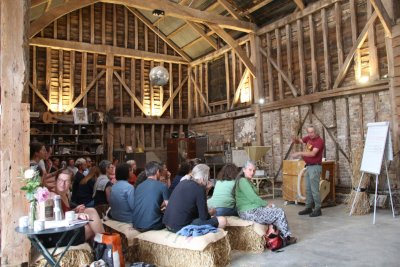
Sustain colleagues Hannah Gibbs and Barbara Crowther from our supply chains and children’s food work also led a second interactive session in The Workshop, asking the question: how do we ‘regenerate’ school meals by getting sustainably produced food onto children’s plates? Audience members brought a variety of perspectives to the table, from farming to distribution, procurement and catering. The energy in the tent highlighted the growing recognition that changing how food is bought, processed and distributed is just as important as changing how it is produced.
Interest in supply chains extended beyond the domestic context. Sustain’s climate team, Lily O'Mara and Ruth Westcott, led a panel discussion titled “No Farmer Left Behind”, exploring the importance of solidarity across food and farming communities in the UK and internationally. Alongside investigative journalists from Peru and Paraguay and others working on the frontlines of environmental and social justice, the discussion examined how increasing corporate control of food systems can affect farmers, communities and ecosystems. A key message from the session was that many of the challenges facing food producers are in fact shared across borders. Rather than placing responsibility on individual farmers, speakers focused on the need for collective action, stronger community voices and a just transition that enables farmers to prosper while protecting people and the environment.
Taken together, these conversations reinforced an encouraging trend of growing interest not just in regenerative farming techniques, but in the infrastructure, relationships and market opportunities needed to make sustainable farming economically viable in the long term.
3. Celebrating diversity in agriculture
Groundswell also provided an opportunity to celebrate and strengthen calls for greater diversity within food and farming.
As part of the Culture Roots Collective, Sareta Puri from Sustain supported the hosting of the first-ever BPOC gathering at Groundswell in the Esmée Fairbairn Foundation tent. The event brought together attendees from academics to farmers to soil scientists, demonstrating that people of colour are working across regenerative agriculture.
A display of photographs from the Culture Roots Collective brought the space to life, showcasing the diversity that already exists within UK food and farming. The images are now freely available through the Culture Roots Collective website, helping ensure that a broader range of people can see themselves represented in the sector.
Ila Rujula also spoke at an Emergent Generation panel on “Young Women in Food and Farming”, hosted by EmGen member Danielle Semple. Alongside Elva King, Neave Anderson and Veronica White, Ila reflected on the opportunities and challenges facing young women across the sector. The conversation highlighted both the barriers participants have encountered and the shared commitment that continues to drive positive change.
While the diversity of attendees at Groundswell continues to grow, there is still further to go. Of the hundreds of speakers featured across the festival programme, only a small proportion were people of colour. The success of this year's gatherings demonstrates the opportunity to build on that progress by creating more visible platforms for people from underrepresented backgrounds and encouraging even broader participation in future years.
Looking ahead
Groundswell 2026 left us feeling optimistic. Not because the challenges facing food and farming have disappeared, but because there is growing momentum behind the solutions.
Whether through increasing political engagement, stronger conversations about supply chains and routes to market, or efforts to build a more diverse and inclusive sector, the festival showed that more people are recognising the importance of creating a food system that works for farmers, communities, nature and climate.
As Emma Reynolds noted in her Groundswell speech, we see "nature-friendly farming not as an alternative to productive farming, but as its foundation. I believe that profitable, resilient farming comes from working with nature."
At Sustain, we will continue bringing together farmers, growers, businesses, community organisations and policymakers to turn that shared ambition into practical change. Groundswell demonstrated that the momentum is real. Our task now is to make the most of it.

Sustain: Sustain The alliance for better food and farming advocates food and agriculture policies and practices that enhance the health and welfare of people and animals, improve the working and living environment, enrich society and culture and promote equity.


Sustain
The Green House
244-254 Cambridge Heath Road
London E2 9DA
020 3559 6777
sustain@sustainweb.org
Our mission is to catalyse systemic change in the UK’s food and farming system – securing a healthy, fair, and sustainable future for all people, nature and a stable climate.
© Sustain 2026
Registered charity (no. 1018643)
Data privacy & cookies
Icons by Icons8
