

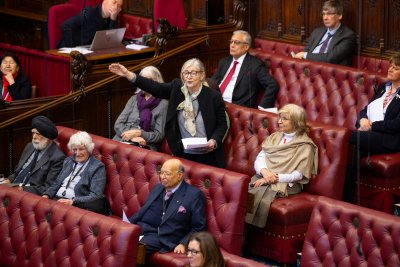
 Baroness Boycott speaking in the House of Lords. Credit: House of Lords 2024 / photography by Roger Harris
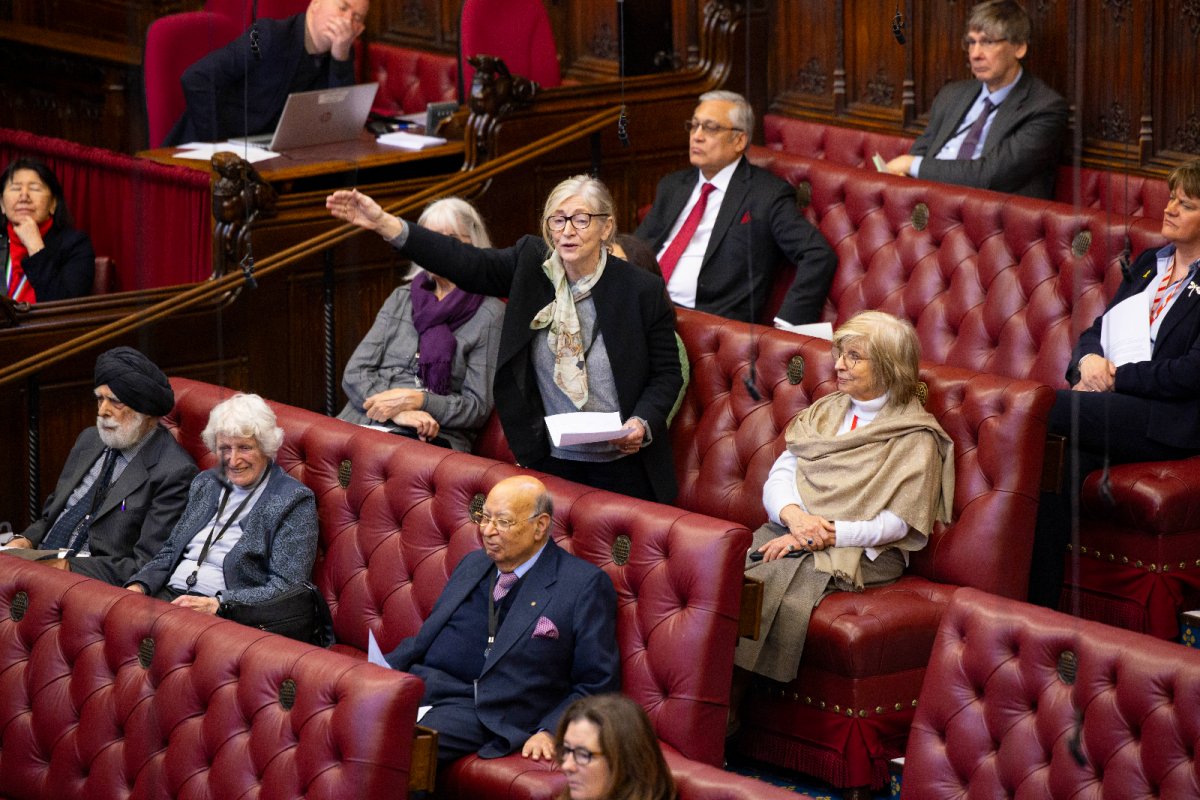

Lords food security debate puts local food systems centre stage
Peers showed support for a Good Food Bill, local food infrastructure and nature-friendly farming in last week’s House of Lords debate on food security. The Government’s reply shows how much now depends on joining these ambitions up.
Members of the House of Lords used a debate on food security last week to set out the UK’s exposure to climate shocks and fragile global supply chains. The debate, secured by Baroness Teather of the Liberal Democrats, drew on expertise from farming, food business, the church and public health.
Baroness Teather opened by warning of “multiple global threats that could create profound food shocks”, shocks she said would “fall unequally on our population”. Her central argument was that resilience requires thinking across silos, from farming and public health to local government and national preparedness.
The case for a Good Food Bill
“Now is the moment for a Good Food Bill,” Baroness Teather told the House. She described legislation covering “the full arc of the food system”, which would set targets on food security and domestic production and give farmers and businesses certainty about the direction of travel.
Earl Russell, also a Liberal Democrat, called for a food security and resilience Act placing a duty on government to ensure the public can be fed in a crisis.
Responding for the Government, the Lords Defra minister Baroness Hayman of Ullock, said ministers had “not yet made any decisions about bringing in dedicated food legislation”. Closing the debate, Baroness Teather took a “glimmer of hope” from the fact that the Minister did not say no.
The Minister’s reply itself made a strong case for the Bill. She set out the Good Food Cycle, a new food resilience framework, a food preparedness group, a public procurement target and the Good Food Neighbourhoods programme. Each is a welcome building block, but they sit across different teams and timelines. A Good Food Bill would bring them under one framework with the staying power to outlast any single spending round. That is the ambition behind the coalition of more than 100 organisations coordinated by Sustain, The Food Foundation and Green Alliance that wrote to the Prime Minister in July.
Building the missing middle
Between the farm gate and the plate sits the “missing middle”: the food hubs, storage, processing and distribution that let smaller producers sell to schools, hospitals and local businesses in the volumes they need. Where it is absent, food takes long detours. Baroness Teather explained that strawberries grown six miles outside Cambridge must travel 120 miles to New Covent Garden Market and back before local businesses can buy them. “That is madness,” she said. Cambridge has a vibrant local food partnership, yet the founder of the Cambridge Food Hub has spent 13 years seeking investment to fix the problem.
She contrasted this with Welsh Veg in Schools, where Food Sense Wales brokers deals with local growers who now supply over half of Wales’s councils. She noted that the Government’s new Organic Action Plan references Sustain’s Bridging the Gap programme, but is short on detail about investment in storage and distribution.
Baroness Boycott, a Crossbencher (ie. not belonging to any political party), showed why this matters for farm incomes. Farmers currently receive minimal return for the food they produce, with the rest going to processors, distributors and retailers. New York’s regional food hub gathers produce from farms across the state and distributes it directly around the city. By cutting out layers of intermediaries, it helps farmers earn around 40p in the pound.
The Minister reaffirmed the ambition for at least half of publicly purchased food to be locally produced or certified to high environmental standards. That target will deliver most for local economies when the infrastructure exists for smaller producers to meet it. Bridging the Gap works on exactly that connection, helping local growers reach public sector buyers.
Nature-friendly farming and the Organic Action Plan
Baroness Teather welcomed the Organic Action Plan, published the day before the debate, and called for backing for farmers trying organic and regenerative approaches built around soil health. She highlighted Vallis Veg in Somerset, an agroecological farm (one that works with natural processes and local ecosystems) that cannot afford the cost of organic certification. Crucially, she noted that small growers found the Sustainable Farming Incentive left them out by design.
Baroness Boycott made a passionate case for regenerative agriculture, which rebuilds soil by limiting ploughing and using grazing animals, reducing reliance on bought-in fertiliser. She described two neighbouring farms run by brothers at Groundswell, the regenerative agriculture festival. Through this summer’s drought, the regenerative farm kept its water and crops with almost no spending on inputs.
Some farmers are already showing what this looks like. The Organic Action Plan can help many more follow, especially if support reaches agroecological growers who sit outside both certification and the farm payment schemes.
Resilience that reaches every household
Peers were clear that full shelves alone do not make a nation food secure. Baroness Teather cited The Food Foundation's figures showing one in eight households are already food insecure, and noted that while the law ensures food is safe, no duty exists to ensure everyone is fed. The Bishop of Newcastle observed that “food on a shelf offers little security to someone unable to afford it”.
This is the question of civil food resilience: how food reaches people, especially the most vulnerable, when supply chains are disrupted. Baroness Teather argued that “only communities acting together” can provide it, and called for local plans built on an understanding of community assets.
Those assets already exist. Local food partnerships, which bring councils, businesses and community groups together across the Sustainable Food Places network, coordinated emergency food responses during Covid. Capital Growth, which Baroness Boycott helped found and Sustain has run, has brought 200 acres of London into food growing. Building these networks into resilience planning from the start would give national preparedness real local reach.
From consensus to delivery
The debate’s defining feature was its cross-party unanimity on a food system that supports farming alongside nature and puts good food within reach of every household.
The Government will respond to the National Audit Office’s food resilience report within two months, an early opportunity to turn that consensus into a joined-up plan. A Good Food Bill remains the surest way to make it last.
Read more about our campaign for a Good Food Bill

Sustain: Sustain The alliance for better food and farming advocates food and agriculture policies and practices that enhance the health and welfare of people and animals, improve the working and living environment, enrich society and culture and promote equity.



Sustain
The Green House
244-254 Cambridge Heath Road
London E2 9DA
020 3559 6777
sustain@sustainweb.org
Our mission is to catalyse systemic change in the UK’s food and farming system – securing a healthy, fair, and sustainable future for all people, nature and a stable climate.
© Sustain 2026
Registered charity (no. 1018643)
Data privacy & cookies
Icons by Icons8
