

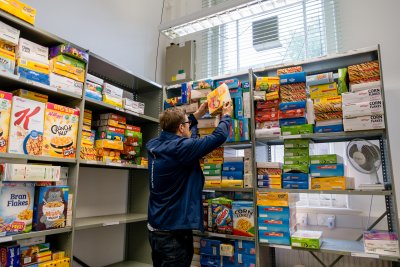
 A food bank worker (Trussell Trust) organises cereal food stores & donations. Copyright: HASPhotos | shutterstock


No UK regions have plans for food disruption
Freedom of Information Requests sent by Sustain to all 48 Local Resilience Bodies in the UK reveal total lack of emergency planning to get food to people in a crisis. But local food partnerships already play a key role, argues the Sustainable Food Places network, which gathers in Westminster today.
The UK’s food supply is a critical weak point according to the recent House of Lords National Resilience Committee report, and yet Sustain can reveal government is still failing to make food emergency planning a priority, leaving local food partnerships to step up instead.
There is no national statutory duty in the UK for food planning and making sure people get fed in an emergency, but Local Resilience Bodies – which hold the community risk register of their regions and dictate the response procedure during an emergency - can work with councils to make food emergency planning a priority. Yet according to Sustain, only three of 48 are starting to develop plans to support vulnerable households with food during a major emergency.
Sustain sent Freedom of Information Requests to all 48 Local Resilience Bodies in the UK, all 42 Local Resilience Forums in England and Wales, 3 Regional Resilience Partnerships in Scotland and 3 Emergency Preparedness Groups in Northern Ireland, asking them what plans they had for disruption of food supply in a crisis. The responses show none of the Resilience Bodies have outright plans for restoring food supply, particularly to vulnerable households, in an emergency; only three are currently working toward developing such plans.
A number of Local Resilience Bodies wrote back stating that food supply disruption is not historically their responsibility, deferring to national Government to set the priority on supporting the local population with food supply in an emergency.
The Government's official advice to the public to stockpile three days of food and water is inadequate for the millions of vulnerable households. The Government's own 2026 survey found that 29% of respondents said a lack of money had stopped them following official advice to prepare and stockpile for emergencies. Very few local authorities are planning how to support vulnerable households in crisis
Communities stepping up in the absence of central planning
The Sustainable Food Places network, coordinated by Soil Association, Sustain, Food Matters, Nourish Scotland and Food Sense Wales, gathers many of its member food partnerships in Westminster this 23 November to call for greater recognition of community groups stepping up where national Government is missing.
Local food partnerships will meet their local MPs and showcase their work connecting local authorities, community organisations, farmers, businesses and residents, as they start to build resilient communities before the next crisis hits.
Daphne du Cros, who leads the Shropshire Good Food Partnership, says that Covid was "a really interesting dry run of a crisis scenario" that showed "where the cracks were". Poor emergency planning meant Defra’s food parcels were delivered at random and were found to be often highly unsuitable for the needs of the local population, leaving the food banks to intervene, repackage and redistribute the aid.
Since then, Shropshire Good Food Partnership has worked with communities and town and parish councils to map local food assets and gaps and build relationships for crisis planning. Preparing for a longer disruption also means growing more food locally. Its Feeding Resilience pilot in Telford and Wrekin put that work into practice at neighbourhood level, bringing community organisations together to revive growing beds in Brookside and help residents grow fresh food and cook with what they harvested.
Lessons from COVID-19 highlighted the role of volunteers at the centre of emergency response, and the need for stronger supermarket and local authority coordination. In Barking and Dagenham, London, local charity Kingsley Hall which provides community spaces, a preschool, an affordable cafe and social supermarket, is currently in the process of setting up with the council a Barking Food Hub, a large warehouse that can store fresh and frozen produce. This collaboration means the borough will see over £1 million worth of frozen food coming into the borough every year.
Postcode lottery
These local food partnerships may be starting to prepare for when the next crisis hits, but they are not set up in every area of the UK and even when they are, they remain excluded from official emergency plans, and crucially funding. In the absence of central planning, emergency food delivery to vulnerable groups becomes a postcode lottery.
Findings in the Sustainable Food Places ‘Civil Food Resilience in Practice’ report show that local authority resilience leads, whose responsibility it is to direct local responses to emergencies, were unwilling to engage with their Local Food Partnerships or community food aid networks because they have not been given a directive via the National Risk Register to act on food supply disruption risk.
Whilst Sustain’s investigation revealed that some Local Resilience Bodies are interested and willing to engage with local food support networks, most are awaiting guidance from their nation Governments and the National Risk Register on how to prepare for food supply disruptions.
In response to these findings, Professor Emeritus of Food Policy Tim Lang, who published the report 'Just in Case: 7 steps to narrow the UK civil food resilience gap' for the National Preparedness Commission, said:
“We are entering a new era for food security. We cannot assume supplies will be seamless. It’s essential that public interests are taken seriously. Building civil food resilience requires more than advising people to store some food. Government’s own Resilience Framework says a principle is to include ‘the whole of society’. The House of Lords report this week suggests that’s not yet happening.”
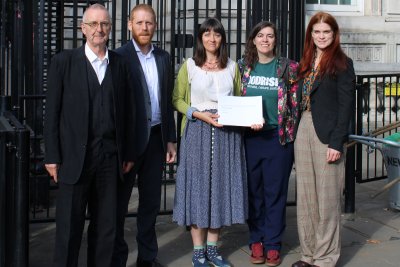
Professor Paul Behrens of University of Oxford, and signatory of Sustain member Foodrise's open letter to Number 10 warning the UK is unprepared for major food supply emergencies, said:
"While the public are being asked to store food and be prepared, it looks very much like Government is underprepared. Reports on food security are coming thick and fast, and finding similar risks. I would like to see a faster response the pressures the Government itself says are here and increasing.”
Vera Zakharov, Local Action Coordinator at Sustain, said:
“Not everyone has the luxury of larders and the money to fill them. If we want to ensure no one is left behind in a crisis, local community organisations and food producers must be at the forefront of planning – because they will be at the forefront of the emergency response.
Local food partnerships have been developing food disaster preparedness plans – while formal resilience bodies have largely ignored the issue and are notably difficult to engage.
Now is the time for Government to recognise the role of these local food organisations and include them in formal emergency planning – before the next crisis hits.”
Our FOI response reveals in full:
- Local Resilience bodies holding plans that consider food supply disruption risk
- None hold plans full stop
- Only 3 of 48 have one in development
- Only 9 of 48 have food supply disruption referenced as part of other plans, such as the Vulnerability Plan
- Only 3 of 48 consider plans for providing food to vulnerable households unable to stockpile for emergencies
- Other Local Resilience Bodies told us that it is a national Government responsibility to ensure vulnerable households are fed
- 2 Local Resilience Bodies are currently planning to convene a food-focused group that can assess food vulnerabilities and plan for food support in an emergency. 1 more references food support as part of the Voluntary and Community Subgroup. Only 2 others have had discussions around forming one, with no current plans in place to do so.
- Discussions on forming one - 4 inclusive of above
- Only 6 out of 48 are engaging with food organisations or food suppliers at all.
About the Sustainable Food Places Network
The Sustainable Food Places Network brings together 128 pioneering food partnerships from towns, cities, boroughs, districts and counties across the UK that are driving innovation and best practice on all aspects of healthy and sustainable food. Sustainable Food Places is a partnership programme led by the Soil Association, Food Matters, Sustain: the alliance for better food and farming, Food Sense Wales, and Nourish Scotland. It is funded by the Esmée Fairbairn Foundation.

Sustain: Sustain The alliance for better food and farming advocates food and agriculture policies and practices that enhance the health and welfare of people and animals, improve the working and living environment, enrich society and culture and promote equity.





Sustain
The Green House
244-254 Cambridge Heath Road
London E2 9DA
020 3559 6777
sustain@sustainweb.org
Our mission is to catalyse systemic change in the UK’s food and farming system – securing a healthy, fair, and sustainable future for all people, nature and a stable climate.
© Sustain 2026
Registered charity (no. 1018643)
Data privacy & cookies
Icons by Icons8
