

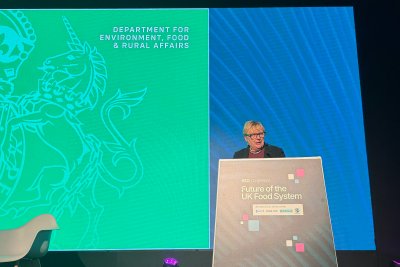
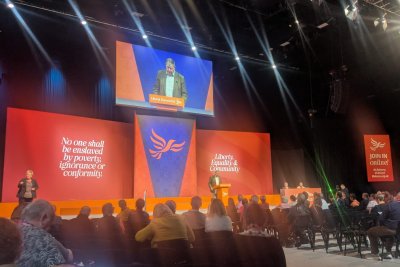
 Dame Angela Eagle speaking at the IGD Future of Food Conference. Copyright: Sustain 2026
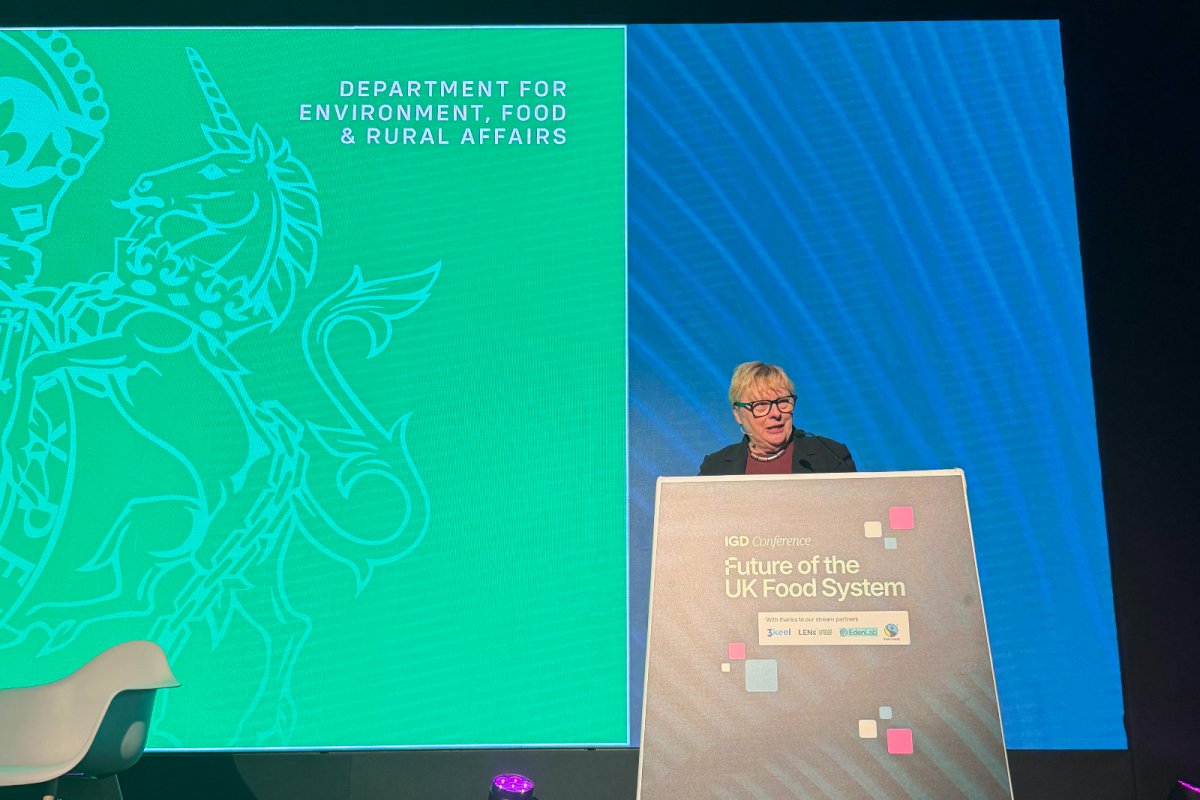

"Reforms in our food system urgently need to be made": Environment Secretary Angela Eagle IGD speech
Read the transcript of Dame Angela Eagle's address to attendees at the Institute of Grocery Distribution conference.
Addressing IGD's Future of the UK Food System conference this past 21 October, Defra Secretary of State Dame Angela Eagle set out the Government's approach to the Good Food Cycle and its four missions of public health, food insecurity, farm resilience, economic growth and food security.
The speech referenced a range of existing government initiatives and explicitly recognised the growing campaign for a Good Food Bill led by Sustain, The Food Foundation and Green Alliance.
Transcribed by Sustain from a recording of the speech as delivered; the official text may differ. Contains public sector information licensed under the Open Government Licence v3.0.
Her speech in full here:
"It is a great pleasure to be here and to join you at an interesting conference at an interesting time of change.
I’d like to thank the IGD for bringing us all together to understand the forces reshaping this sector and to translate our ambitions for the UK food system into action.
I think we find ourselves in a different political context from the inaugural Future of Food conference in 2025. There's a new Prime Minister and a new government. I'm back at Defra, this time as Secretary of State. And now I'm here, I don't want to waste any time, really. I want to focus on delivering the actions that will unlock the changes that we need in our food system.
All of us here today, retailers, suppliers, manufacturers, NGOs and politicians, understand the impact that food has on almost every other aspect of our lives: our health, our wealth, growth, security as a nation, and wellbeing as individuals.
But all of us here today also recognise that there are reforms in our food system that urgently need to be made. I've heard the desire from across the food system for bold action: proposals from the IGD itself and others for more coordinated industry action; the campaign for a Good Food Bill, for example, by The Food Foundation, the Green Alliance and Sustain; and the report of the Right to Food Commission, which was presented and launched yesterday in the House of Commons.
So despite its huge economic output, right now the UK food system is entrenching health and social inequalities. I'm not saying that it's doing it deliberately, but it is doing it.
I think this summer's extreme weather has shown that we need to produce food differently and to increase our own capacity to produce food on this island. The ongoing drought in some parts of the country compounds the other significant pressures that our farmers are feeling, arising from input costs, uncertainty there, and geopolitical instability and, increasingly, the effects of climate change.
As we contemplate the way we change our food systems, we need to remember the primary producers and the pressure that they are under. All of us have got to think about what we can do to help the farming transition into something more sustainable, incorporating nature, having healthier soils, using fewer artificial inputs so that we can have the strong primary production that we need to then go on to manufacture other food.
That's why last year, in terms of dealing with the changes that we need to the system, the government launched the Good Food Cycle, which is a vision to make our food system healthier, more prosperous and more resilient, and for it to deliver real results for the British people.
As a government, we've already expanded free breakfast clubs and widened free school meals to half a million more children. We're working with retailers to make healthier options clearer and more affordable. And we're also working with charities to ensure that surplus food gets from farms to kitchen tables and doesn't go to waste.
But the Good Food Cycle goes even further. It's about supporting British farmers, cutting waste and ensuring that the food on our plate is good for us, good for the planet, and affordable and accessible for all.
If we could achieve that, it doesn't sound like much, does it? But it would be a massive transformation in the prospects of a lot of people in our country who are in food insecurity and have to make unacceptable choices between heating and eating, making sure the kids eat rather than they eat, dealing with all of those pressures.
It’s important that, even though we are a rich country, we need to think very carefully about how our food is distributed and what sort of food is available in particular places for people to eat.
The Good Food Cycle sets ten priority outcomes divided into four core areas, which align with the four missions the IGD has been outlining in its conference today. They are: healthier and more affordable food; resilient and sustainable supply; good growth; and thriving food communities.
We're on track to publish our plans for monitoring and evaluation next year to show how progress towards the ten outcomes on the Good Food Cycle will be measured.
Today I want to briefly look at each of these four missions, highlighting the practical action the government has taken and continues to take, and where we collectively need to go further.
One of the ways we need to start thinking about healthier and more affordable food is that we now live in a society where there's a positive correlation between poverty and obesity. That is quite a change from what has been experienced in other periods in our history, and all of you will know why that is the case, having been at this conference all day.
According to the latest statistics, one in ten children are starting reception living with obesity, and that rises to around one in five by the time they leave primary school. And children living in the most deprived areas of our country are twice as likely to be obese.
This is not an abstract policy health issue. I see it in my own constituency, at Wallasey in the Wirral, where nearly one third of all residents face food insecurity. That kind of inequality is there for all to see, and it should make us all stop about how we have allowed this to happen and what we can do to put a stop to it.
Parents with limited incomes are being pushed towards cheaper, calorie-dense foods or are living in food deserts where they pay more for poorer-quality food. They often pay a higher proportion of their scarce income for smaller amounts of good food. That's known as the poverty premium.
Obviously, seeing that effect in young children, it narrows life chances, narrows opportunities and makes it much harder for children across our society to thrive. It also puts more pressure on those who are least able to deal with it.
In a country as wealthy as ours, nobody should be struggling to put food on the table or compelled to serve food that has negative impacts on their children's health.
We're not talking about a biscuit as a treat. We're talking about things that are much more systemically worse over time, which shorten life opportunities and shorten the likelihood that children from poorer areas will live as long as those from richer areas. It's a huge inequality. It has emerged in plain sight, and we need to do something about it.
Even if we were being completely utilitarian, which I am not, obesity is estimated to cost the NHS up to £9.3 billion a year, with wider societal costs reaching up to £107 billion per year.
It's in all of our interests as a society to make sure that the resilience we want to build across our society actually reaches those in the poorest areas too. Health and growth are mutually reinforcing. A healthier population supports a more productive economy.
So I'm working closely with the Health Secretary to deliver food-related elements of the 10-Year Health Plan for England. These include restricting aggressive junk food advertising and uplifting the weekly value of Healthy Start by 10%, helping low-income families buy healthier food.
School is one of the most foundational pillars of a child's development, and what children eat in the dining hall plays an important role in their health, wellbeing and ability to learn.
What they've eaten for breakfast, if anything, also gets them set up for the day, which is why breakfast clubs have been so important. I would like to see breakfast clubs serve healthier food as well, by the way. But the fact that they're there at all, which means that some children who otherwise would not have had breakfast at least have something so they can concentrate for the first part of the day and learn, is enormously beneficial to them.
That's why this government has published updated school food standards for the first time in over a decade, to make meals healthier, more balanced and more consistent across all schools.
Because good food shouldn't be a postcode lottery, and it shouldn't be absent completely from the areas where the poorest live.
We want to make the £4.9 billion the public sector spends on food and catering each year work harder in these respects: to support local businesses, encourage higher environmental standards and deliver better health outcomes. It's a win-win-win for everybody, and we've got to sort it out.
Many decisions on how to do that are best taken at the local level, which is why we've awarded nearly £800,000 to local authorities to improve how food is procured and increase the provision of healthier food options locally.
But of course, all parts of the system have a role to play, and I'd like to use this opportunity to welcome the industry's engagement on healthier food. From supporting the Healthy Start scheme to reformulation, getting some of the high levels of sugar and salt out of very common products, or at least reducing those levels, I'd like to thank the industry for engaging proactively in that.
I'd also like to recognise the important work that retailers are doing to keep prices affordable for consumers. That's always the balance that has to be struck.
So there's great progress being made, but we need to further accelerate efforts to ensure profitability for business is based on food that is good for individuals and good for society.
In practical terms, that means working together to support the introduction of healthier food sales reporting and targets, and the application of the new Nutrient Profile Model to our existing advertising and promotions restrictions on junk food.
The second mission set out in the Good Food Cycle is resilient and sustainable supply.
As I said earlier, food influences everything we do, including our economic security and our national security. The UK has a resilient food system, diverse supply chains, strong domestic food production and strong trade ties. But food security can't be taken for granted. Perhaps we've taken it for granted for a bit too long.
I learned this when I was Farming Minister, but also in my stint as Security Minister. Resilience isn't a permanent condition. It's something you either invest in or you can lose.
Right now, climate change, global insecurity and biosecurity threats are placing real pressure on our food system. We must not be complacent and assume that, because we haven't faced too many serious problems since the war, we aren't now facing a growing collection of challenges that we have to confront and deal with now.
A resilient and sustainable food supply depends on healthy soil, a reliable water supply, and food and farming systems that can withstand climate shocks while ensuring that farmers have an income they can rely on and businesses that remain viable. I believe that food production and nature recovery must advance together rather than being treated as competing objectives. They are two sides of the same coin, and in the current situation improving both of those things goes hand in hand. It is not an either/or.
That's why this summer we announced a £65 million package of support to help farmers build resilience and adapt to climate change, including improved access to water and a £15 million investment in on-farm reservoirs.
And that’s why we increased the Sustainable Farming Incentive window funding by £50 million to £233 million to help fund nature-friendly farming practices. It was so popular that funding was exhausted in six hours, as I'm sure you all know, and I'm certainly well aware of.
Farmers will receive close to a third of a billion pounds for three years through SFI 2026 agreements, meaning that there will be nearly a billion pounds going into resilient, sustainable farming. We want SFI 2027 to start as early as possible in 2027 and begin delivering these improvements. Over the coming months we'll be listening to farmers and working directly with industry representatives to learn lessons and find a scheme that we can administer even better.
Elsewhere, the Food Preparedness Group, which met for the first time earlier this month, brings together government, industry and civil society to help coordinate action across the food system in the event of serious food supply disruption.
As this work continues, my ask of industry is simple: know your dependencies, test your contingency plans and invest in preparedness measures before disruption arrives. The more we can do on prevention in this space, the better. Resilience is built before a crisis, not during one. Government will plan, coordinate and invest in resilience, but resilience is all of our responsibility, from the way you run your IT systems right down to things that may seem boring but become vital when they fail.
The third mission I want to talk about is good growth. Food is one of Britain's great economic strengths. The agri-food sector contributes £162 billion to the economy and supports over four million jobs, around 11% of the UK's workforce. Few sectors are as widely represented across the country as food and drink, making a significant contribution to the Prime Minister's mission for growth in every postcode.
The UK has a world-class reputation for high-quality produce, high welfare standards and innovation. That was brought home to me during my recent trip to India to promote our agri-food sector in what is a growing, and I have to say enormous, market with huge export potential, particularly now that we have concluded a trade deal.
The growing demand for iconic British produce is something to behold. Scotch whisky, yes, as you'd expect, but also salmon, cheese and biscuits. We produce things that others simply can't replicate, and there is significant demand when we can get our produce into other people’s markets.
So we should be incredibly proud of the sector: its quality, its heritage and its ability to innovate. And that's why the government is taking steps to support innovation, boost trade and foster growth across individual sectors. Last year's Industrial Strategy pledged at least £200 million for agricultural innovation by 2030.
I think we are in another agricultural revolution when it comes to innovation and technology in this sector. Earlier this year, we established the Farming and Food Partnership Board, and we're very pleased to have IGD represented on it by Sarah Bradbury. She knows how much we see each other, and that is because we are doing important work togther. The Board is focused on enhancing the productivity and profitability of our farmers and growers, harnessing expertise from across the whole supply chain.
Our network of agri-food attachés helps companies daily with everything from removing trade barriers for UK businesses to helping with consignments stuck at ports. They do a fantastic job, and if you're an exporter, or considering exporting, please get hold with our agri-food attachés and we can to help smooth the way.
While our wider network supports UK businesses to promote their products, tackle non-tariff barriers and establish commercial relationships within markets, we've made new and improved agreements with the US, India, the Gulf Cooperation Council and South Korea, which are already helping to grow British exports. Food to be a part of that.
Negotiations to establish an SPS agreement with our biggest market, the EU, to make agriculture cheaper and easier, continue at pace. We've agreed to complete negotiations before the UK-EU Summit on 20 November, and we will want businesses to feel the benefits as soon as possible.
To support growth in individual sectors, we're also developing sector-led growth plans for the horticulture and poultry sectors, with others to follow. Last week, we launched a long-term plan to grow England's organic sector and help farmers meet growing consumer demand.
Initiatives like Growing Communities in Hackney show how organic food can become part of everyday local food infrastructure, connecting residents directly with farmers while helping growers keep more of the value from what they produce and creating fairer routes to market. They buy directly from organic farmers and growers, supplying seasonal organic food to local people through veg-box schemes, collection points, schools and community retail outlets.
On skills, we know the needs of the workforce are changing to support innovation, including advanced engineering and AI skills. Alongside the traditional roles, there is much that is exciting for a young graduate, or even someone who hasn't graduated, to encourage them to consider a career in agriculture or food manufacturing. The Prime Minister's announcement earlier this summer to reshape and prioritise technical skills for the over-14s is crucial for the future of the sector. To grow, we need the sector to be attractive as a career path, which is why it's great to see initiatives such as the 10,000 work experience opportunities recently announced by Sainsbury's.
I know these are challenging times, with businesses facing uncertain operating pressures and rising costs, but industry and government must keep working together to support investment, innovation, skills, exports and local growth.
Finally, I want to talk about thriving food communities. I strongly believe that the Good Food Cycle will only succeed if it's shaped and delivered locally. A strong food system is built in places. It certainly isn't dictated by me sat in an office in central London.
We know that across the country people are stepping up: volunteers, affordable food clubs and cooking classes are helping families make the most of what they have. But emergency provision cannot be the long-term answer, which is why I want to do more to support grassroots efforts to improve access to healthy and affordable food.
Working across government, we will be investing in local delivery and partnering with businesses, charities and communities. Through the Food Neighbourhoods programme, which I announced recently at Labour Party Conference, the Government has pledged £10 million to 45 local authorities that include some of England's most deprived communities to begin to grow this facility. It will be delivered by those who know their local areas best, enabling those on the ground to develop, support and expand practical local initiatives that improve access to healthy and affordable food for the most vulnerable. We've given local authorities the flexibility to invest in what works for their communities. This could include community kitchens, educational programmes or pensioner lunch clubs that tackle loneliness and hunger side by side, because this is about more than what's on someone's plate. It's also about the ties that bind us together as a local community.
Whatever the initiative, the objectives of the Good Food Neighbourhoods are clear: to increase access to good food; to ensure it’s a community-led response to local needs; to focus support on those who are most vulnerable; to strengthen food system resilience; to improve health outcomes; and, of course, to reduce the dependence on emergency food parcels.
While local knowledge identifies what works, industry scale helps it to spread. So my ask of industry is to work with local authorities and communities to support targeted, hyper-local action to improve access to healthy, affordable food. Whether it's data, distribution networks or investment, you have the tools that could really assist us with this vital work, and I look forward to seeing how you help us make it a reality.
In closing, I want to thank the IGD once more for the invaluable work they're doing to convene the sector and facilitate sector-wide conversations that drive progress in this crucial area.
The benefits of a thriving food system are self-evident. Families are happier, they're healthier, businesses grow, communities are stronger, and the country as a whole is more secure.
What today has demonstrated really clearly is that improving our food system is a shared endeavour. Access to affordable, healthy food will not be solved through one programme, and it certainly won't be solved centrally by government.
But with continued cross-government action, meaningful engagement with partners like the Affordable Food Alliance, The Food Foundation and Felix, strong local partnerships, and commitment from across the food sector, I'm confident that we can get there and make this transformation.
The people, ideas and capability are already there. There's a will to do it. We now need to maintain momentum and turn ambition into action at the very local level.
Because first we have to make sure we eat, and it's after that that we can think about the other things in life that we have to do. We at the absolute centre of this transformation.
We've got a lot of progress we can, and I want to work with all of you to achieve even more.
Thank you very much."

Good Food Bill: New legislation is necessary to transform our food system, giving successive governments clear goals to ensure the country is well-nourished in an increasingly uncertain world, while providing food businesses, investors, farmers, and growers with the confidence they need to operate in the most sustainable and beneficial way possible.

Sustain
The Green House
244-254 Cambridge Heath Road
London E2 9DA
020 3559 6777
sustain@sustainweb.org
Our mission is to catalyse systemic change in the UK’s food and farming system – securing a healthy, fair, and sustainable future for all people, nature and a stable climate.
© Sustain 2026
Registered charity (no. 1018643)
Data privacy & cookies
Icons by Icons8
