

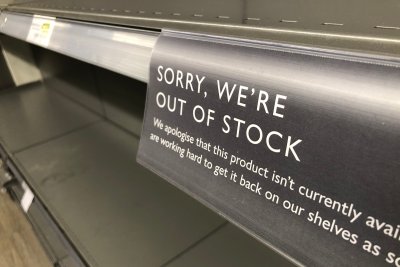
 Out of Stock sign in a supermarket shelf.. Copyright: Kauka Jarvi shutterstock


Lords call for food to be at the heart of national resilience
A House of Lords committee says the UK is underprepared for major disruption and names food supply as a critical weak point. Sustain welcomes the report’s call for stronger domestic production and strategic reserves, and urges Government to invest in resilient farming and community action.
The House of Lords National Resilience Committee has published Are we ready? Building a culture of resilience. It finds that the UK is underprepared for a world that is “more turbulent and insecure than it has been for decades”. The Committee calls for a shift from “just-in-time” supply chains to “just-in-case”, and puts food alongside medicines as an area of greatest concern.
The Committee looked to Finland as a model. Finland produces around 80% of its own food and holds grain reserves to feed the whole population for nine months, along with stocks of seed and fertiliser. It brings Government and grocery businesses together to spot supply risks early, and is building a network of around 300 shops with backup power so that no one is far from an operating shop in an emergency.
To reach this conclusion, the committee drew on evidence submitted by Sustain and many others, citing our warning that the UK relies on imports of food and fertiliser from increasingly unstable regions, and that recent international conflicts have pushed up food prices for UK households.
The report highlights that just nine retailers account for around 94.5% of food sold through UK supermarkets, supplied through 131 distribution hubs. Some commodities hold only two or three days of stock. It also notes the National Audit Office’s finding in September that Defra had not done enough to prepare for catastrophic disruption to food supply. The Committee recommends that the Government set out how essential food supplies will be maintained during prolonged disruption.
Joss MacDonald, Public Affairs Manager at Sustain, said:
“This report puts food where it belongs, at the heart of national security. Resilience comes from spreading the load, with more farmers and growers supplying local and regional markets and local food partnerships ready to step up when supply chains come under strain. The Government should back what works and give it the long-term support to grow.”
Resilient farming is the foundation
The Committee recognises that UK food production depends on imported nitrogen, phosphate and potash fertilisers. It points to organic production as a way to reduce that dependence, while noting it needs investment and time to scale.
This gives fresh weight to the Government’s Organic Action Plan for England, which rightly says organic farming “should not be treated as a niche”. With the Horticulture Sector Growth Plan under way, the Lords’ findings show why resilient horticulture, which does not rely on synthetic inputs, matters so much. The UK imports around 80% of our fruit and 47% of our vegetables, so growing more here with fewer imported inputs strengthens our supply of the foods most important for a healthy diet.
Sustain is calling for long-term support for resilient, agroecological farming: farming that supports natural infrastructure (soil, water and nature) so we can keep producing the healthy food we need well into the future.
Local food partnerships are ready to help
The Committee says the UK is “not starting from scratch”. It points out that existing community networks could provide much of the backbone for a whole-of-society approach. It recommends statutory status and sustainable funding for Local Resilience Forums. It also recommends requiring local resilience arrangements to identify and publicise local stocks of food and storage facilities. The report highlights “How Resilient is Cambridge”, which led to a food security section being added to the city’s draft Local Plan.
Any crisis hits hardest those with the least room to absorb it. People on the lowest incomes are least able to stockpile, and price shocks quickly push more households into food insecurity. The Committee heard that “highly vulnerable demographics cannot afford to stockpile”, and recommends local stocks of food for those who need them, with volunteers delivering to people who can’t get to the shops themselves. Resilience planning must put these households first.
Local food partnerships across the Sustainable Food Places network already do this work, bringing councils, growers, businesses and community groups together around food. The network has called for long-term government funding for local food partnerships, as Wales already provides.
A more decentralised food system is a more resilient one. Local storage, processing and distribution give food more than one route to reach people, and help smaller growers supply their communities when national supply chains are stretched.
Vera Zakharov, Local Action Coordinator at Sustain, said:
“Not everyone has the luxury of larders and the money to fill them. If we want to ensure no one is left behind in a crisis, local community organisations and food producers must be at the forefront of planning – because they will be at the forefront of the emergency response.
The National Resilience Committee Report rightly calls for the involvement of community, voluntary and faith networks in resilience planning, and the strengthening of local food supply chains.
Local food partnerships have been developing food disaster preparedness plans – while formal resilience bodies have largely ignored the issue and are notably difficult to engage.
Now is the time to recognise the role of these local food organisations and give them a seat at the table – before the next crisis hits.”
A Good Food Bill to join it up
Sustain agrees that food needs a durable legal framework. A Good Food Bill for England would join up policy on food security, climate, nature, public health and fair treatment of farmers. It would give the Government a clear long-term plan to work towards and make the food system ready for the shocks the Committee warns about.
The Government must now follow the Committee’s recommendations to shore up our food supply. That means a clear plan to keep food flowing during prolonged disruption, backed by investment in resilient farming and organic production. It also means a duty on Local Resilience Forums to plan for food, working with funded local food partnerships already on the ground.
Find out more about our campaign for a Good Food Bill.

Sustain: Sustain The alliance for better food and farming advocates food and agriculture policies and practices that enhance the health and welfare of people and animals, improve the working and living environment, enrich society and culture and promote equity.






Sustain
The Green House
244-254 Cambridge Heath Road
London E2 9DA
020 3559 6777
sustain@sustainweb.org
Our mission is to catalyse systemic change in the UK’s food and farming system – securing a healthy, fair, and sustainable future for all people, nature and a stable climate.
© Sustain 2026
Registered charity (no. 1018643)
Data privacy & cookies
Icons by Icons8
