

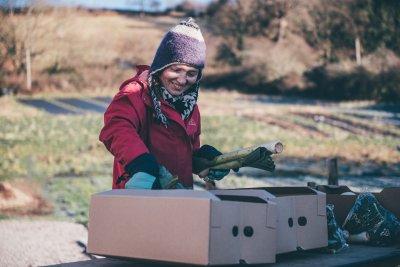
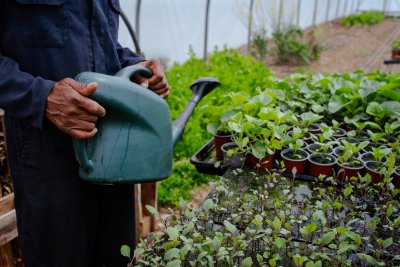
 Katherine Langton from Welsh Veg in Schools. Copyright: Food Sense Wales
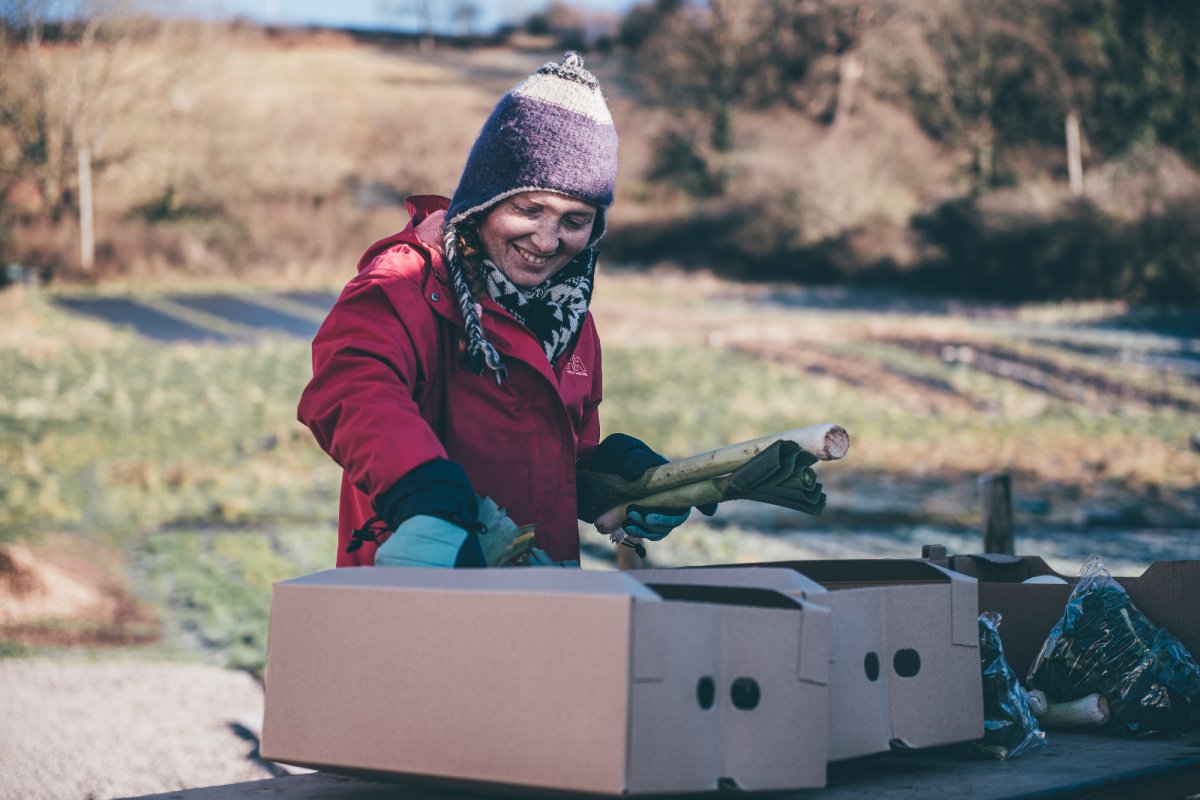

Unpacking organic: can it be a shortcut to better food and farming?
Sustainable Farming Campaign Manager Alys Bannister and Supply Chains Manager Hannah Gibbs unpack what organic really means for farmers, food businesses, and consumers, and ask what it would take to make organic more accessible.
In the UK, organic can mean different things to different people across the food system, including farmers and growers, wholesalers, retailers, caterers, investors and consumers. To help, Sustain has unpacked what the path to organic looks like for different people in the food system, why we can trust organic, and how we can make it more accessible for all.
What is the path to organic farming?
For the farmer or grower converting to organic, there is no easy shortcut in the journey. Converting to organic means changing your farming system, from how you build soil fertility to how you manage pests and diseases. For farmers rearing animals, it also changes the way animals are fed and managed.
This transition takes time, with the standard conversion period for land lasting around two years, and even then, only crops sown and grown after that period can then be sold as organic.
Farmers must farm to organic standards set out by the certifier (such as Soil Association or OF&G in the UK) throughout the conversion period, keep records, and undergo independent inspections to demonstrate that those standards are being met. During those years, farmers are already farming to organic standards but cannot yet sell their produce with the full organic status, which means taking on additional costs and risks before receiving the potential benefits of an organic market.
Do all organic farms become certified?
Some farmers and growers may farm to organic principles without becoming certified, particularly smaller-scale producers selling directly through box schemes, markets, or community-supported agriculture. Certification comes with costs and administrative requirements, so farmers selling directly to customers may feel it is less necessary where there is already a trusted relationship and accessible information about how their food has been grown.
But once food travels through longer supply chains, that direct relationship disappears. This is where organic certification becomes particularly valuable: it provides retailers, caterers and shoppers with traceability and independent assurance that the standards behind an organic claim have been met.
What about other terms such as regenerative farming?
Organic now sits alongside terms such as regenerative, nature-friendly and agroecological farming. These are not necessarily competing approaches, and all can play a role in moving towards a more sustainable farming system. However, they do not all mean the same thing or offer consumers the same level of assurance, which can be confusing in an already complicated landscape of food labels.
Some farmers and organisations, including Sustain, use the term “agroecological” because it captures organic principles alongside the social, ethical and community dimensions of farming. It can also encompass smaller-scale farmers and growers whose farming practices are closely aligned with organic approaches but who have chosen not to certify.
“Regenerative” and “nature-friendly” can also be useful ways of describing positive changes in farming practice – such as farmers and growers who are members of the Nature Friendly Farmers Network. However, without a single regulated definition, these terms can describe anything from meaningful whole-farm change to individual practices. This creates a risk that claims are difficult for consumers to interpret and, in some cases, can contribute to greenwashing.
This is where organic certification offers particular assurance, as it provides consumers with a clear and independently checked benchmark for how their food has been produced, rather than having to interpret a broad environmental claim. For example, if you buy organic carrots, you know they have been produced to defined standards that have been independently checked. A product described as “regenerative” does not currently give you the same certainty about what exactly is sitting behind that claim.
Is organic always better?
Evidence shows that organic farming delivers significant benefits for biodiversity (30% higher on organic farms) and soil health, alongside benefits for water quality, climate resilience, and animal welfare. Organic systems also support farm resilience by reducing reliance on fossil fuel derived artificial fertilisers or feed frown overseas, leaving businesses less exposed to supply chain shocks.
Like all things, organic systems come with challenges and limitations. Growers working with fewer chemical controls may rely more heavily on plastic crop protection. Organic supply chains also require certified processors, packers, storage, and distribution and locally grown organic crops can struggle to reach local market if that infrastructure is not in place.
Cost is also an issue for producers and consumers, as organic production can be more complicated, yields may be lower during transition, and certification costs itself. These costs can also be passed onto consumers, and worsened if supermarkets market organic products at a premium. However, cheaper food is not necessarily cheaper for society, as pollution, biodiversity loss, imported feed linked to deforestation, poor animal welfare, and the overuse of antibiotics all carry costs that are rarely reflected in the price paid at the till.
If organic offers these benefits, why aren’t more growers and farmers making the switch?
Converting to organic takes time and money for farmers, and farmers need confidence that there will be a viable market for what they produce.
We often ask why farmers aren’t producing more organic food, but we also need to consider whether we have created the reliable demand, routes to market, and fair returns that make the transition to organic possible, as farmers cannot create a market on their own.
Sustain’s Bridging the Gap programme tested what happens when support for consumers is paired with support for local supply chains. Pilots such as Welsh Veg in Schools also created a direct market for growers in Wales to sell organic vegetables into, which gave growers confidence to expand their production, causing a 20% increase in vegetable production in Wales.
The Government also has an important role in reducing the risk of transition, through long-term farming policy, advice and support, enabling access for organic farmers to public sector food procurement, and policies that stimulate dependable demand for organic food.
Why isn’t organic accessible to all?
In the UK, organic has too often been positioned as a premium lifestyle choice rather than a practical route to high standards, nature recovery, and trustworthy food. However, demand for organics is increasing, and the UK organic market has now grown for 14 consecutive years, reaching £3.9 billion, while only 3% of UK farmland is certified organic. Research involving 2,000 people has also found that lower-income shoppers were just as likely to buy organic consistently across several product categories. The barrier is not simply appetite; it is affordability and availability.
There are also supply chain constraints preventing further organic growth. Organic farmers need access to certified processing, packing, storage and distribution, yet this infrastructure can be limited or difficult to access. More investment in this “missing middle” would help farmers get organic produce to market and make conversion a more realistic commercial proposition.
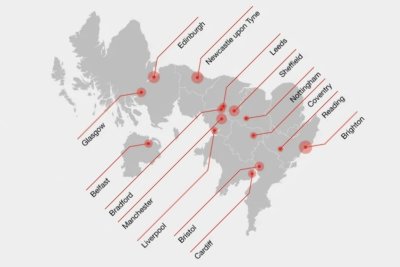
Sustain’s Bridging the Gap programme also showed that the price barrier to organic is not something we simply have to accept. Sustain tested different approaches across nine UK pilots such as vouchers, support for local retailers, and veg box schemes, and changes to school food procurement to make organic fruit, vegetables and pulses more accessible to people on lower incomes. These pilots showed that, with the right investment and routes to market, we can widen access to organic food while also supporting the farmers, growers, and local businesses supplying it.
This matters because affordability does not have to mean squeezing farmers on price. Rather than asking either consumers to pay more or farmers to accept less, Bridging the Gap explored how public investment and better-designed supply chains can help bridge the difference. Its modelling found £8.78 in social value for every £1 of public investment, alongside spending by shoppers, with benefits spanning health, communities, local economies, climate and nature.
What can we all do to support organic?
Everyone has a role, but responsibility is not evenly shared. Where possible, consumers can support farming systems through supporting organic produce where possible. Some switches to consider are:
- eating less and better (such as organic) meat
- eating more organic fruit, vegetables, and pulses
- where you can, buy from farmers, shops and caterers with transparent and principled sourcing policies, including organic and agroecological food
- support businesses that pay farmers fairly and make clear commitments about how their food is produced
The biggest shift, however, will come when government, investors, retailers, caterers and public institutions move together. We need policies that reward organic and agroecological farming; regulation that supports fair dealing; investment in the “missing middle” of processing, storage and distribution; and public sector procurement contracts that create dependable demand.
What is Sustain’s role?
The challenge is to turn growing interest in organic into long-term support for the sector.
Sustain, alongside our wider alliance, has long campaigned for an Organic Action Plan for England to give farmers and businesses greater confidence to invest, grow the sector and make organic more accessible. With the plan expected imminently, we look forward to seeing the ambition it sets and working with Defra to help turn that ambition into action.
Ultimately, if organic is to become a genuinely accessible ‘shortcut to better’, we need to create the conditions for more farmers and growers to make that journey, while ensuring more people can access the food they produce.

Sustain: Sustain The alliance for better food and farming advocates food and agriculture policies and practices that enhance the health and welfare of people and animals, improve the working and living environment, enrich society and culture and promote equity.


Sustain
The Green House
244-254 Cambridge Heath Road
London E2 9DA
020 3559 6777
sustain@sustainweb.org
Our mission is to catalyse systemic change in the UK’s food and farming system – securing a healthy, fair, and sustainable future for all people, nature and a stable climate.
© Sustain 2026
Registered charity (no. 1018643)
Data privacy & cookies
Icons by Icons8
