

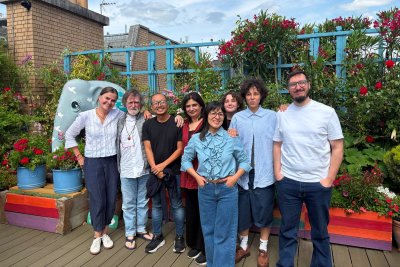
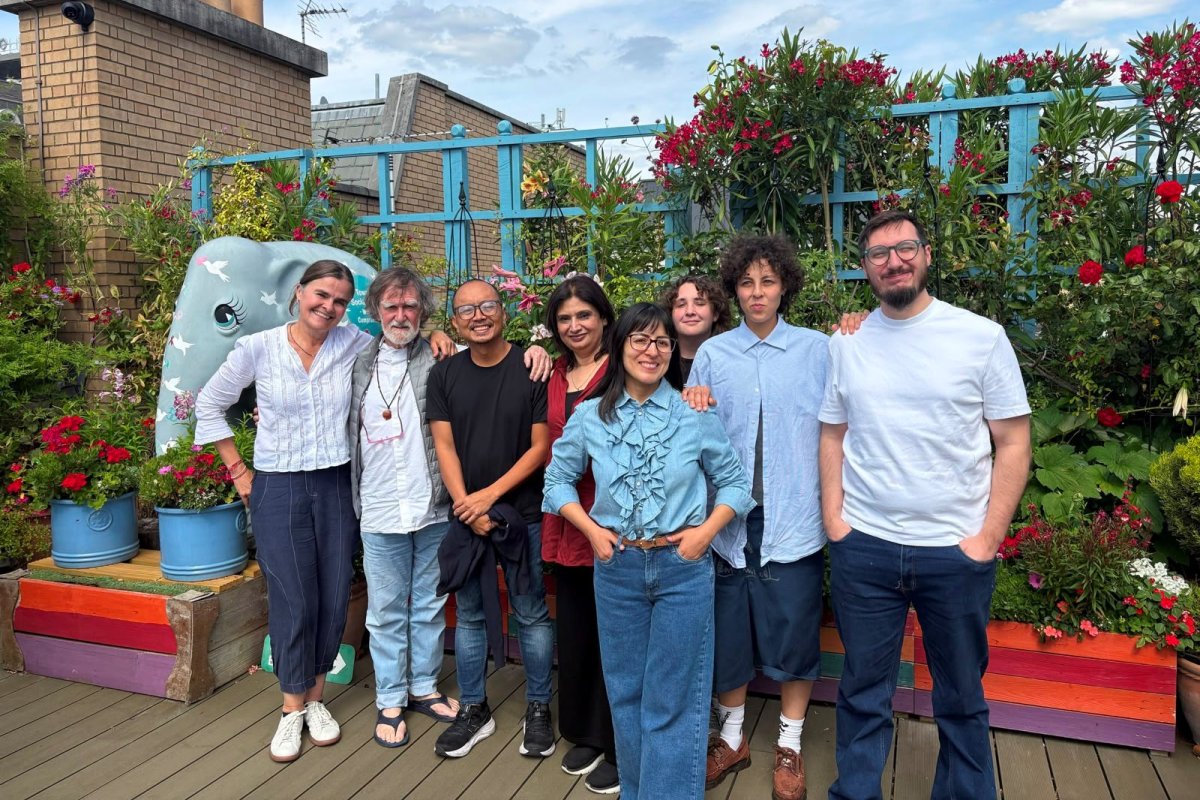
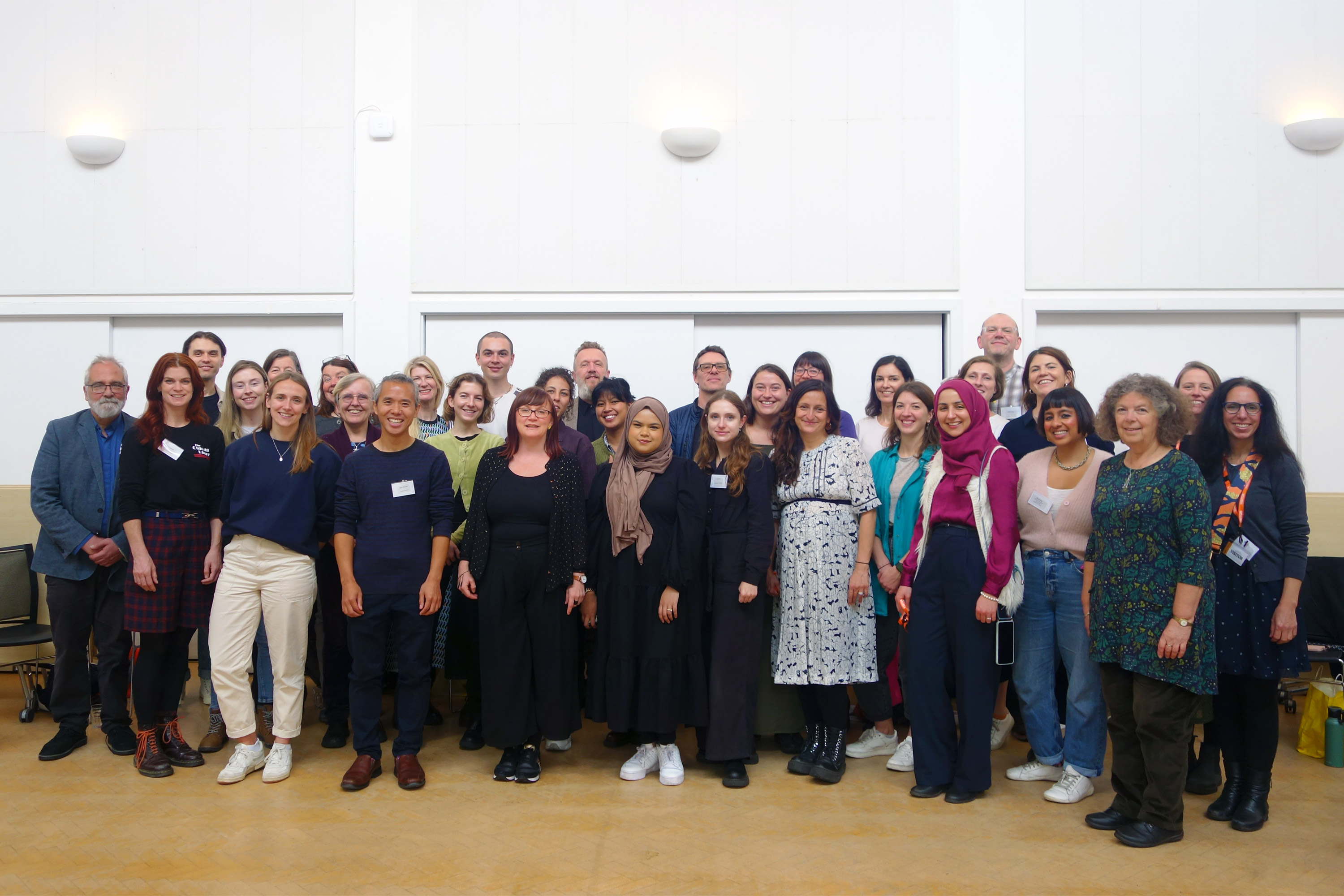
 Participants from the fellowship standing in a group. Credit: Bertha Challenge

No farmer left behind: Reflections from the Bertha Challenge Connect Fund Week
The 2025 Bertha Challenge food and farming fellows reflect on their learnings with Sustain's Climate Team.
We are living through a moment that demands global solidarity and building community and particularly the kind that is serious about addressing the power imbalances that run through our food systems. Sustain’s Climate Team welcomed six Bertha Challenge Food and Farming Fellows working across food, farming, corporate power and environmental justice in Uruguay, Peru, Pakistan, Sweden, the Philippines and the UK and organised a series of events this month to do exactly that: to bring our work to London, a city full of radical thinkers and people who want to take action, and a city that sits, whether it always acknowledges it or not, at the belly of the beast of the corporate food system, with all of the colonial hangovers that exist within it.
Here are 3 things we took from the week of activities that we feel are valuable reflections for those in our movement.
1. How to cultivate community and the power of grassroots, horizontal education
Across the world, from the Philippines to Pakistan to Sweden, farmers are not only being subjected to dispossession, they are also organizing to fight back and assert their rights. Few of these stories of aggression and resistance are heard by the broader public, especially those in other countries, however due to corporate control of the media or the lack of alternative means by which subordinate groups could link up with their counterparts from abroad.
Hoping to contribute towards overcoming this problem, we organized the screening of two documentary films, produced by 2025 Bertha Challenge Fellows Herbert Docena and Sumaira Aslam, that both deal with corporate landgrabbing and community mobilization in the Philippines and Pakistan respectively. Docena’s Wash Out is about a group of landless farmers that has been waging a two decade-long struggle for land against efforts by one of the Philippines’ largest corporations to remove them from their island so as to turn it into a luxury tourist destination. Aslam’s Raqba - The promised land follows tenant farmers in Pakistan resisting eviction from state land they have cultivated for generations. They refuse to disappear from lands under arbitrary state orders to make way or corporate takeover. What unfolds is not only a struggle over land, but over identity, dignity, and the right to belong. Farmers face intimidation, arrests, violence, and mounting pressure to leave, yet they continue to resist.
The screening, which was held at The Common Press event space in Shoreditch, London, was attended by around 30 people, including students and activists. It was followed by a talk-back during which both Docena and Aslam talked about what drove them to produce the films they did and why they think it is important to tell stories about dispossession and resistance. Participants noted the central role played by women in the movement, the importance of inter-generational solidarity in the struggle, and the complicity of the state in displacing farmers. They also noted parallels between the conditions faced by farmers in the Philippines and Pakistan and those faced by rural producers in the UK and other more developed countries.
Herbert Docena says:
Farmers around the world face a common enemy–a system that puts the needs of big corporations ahead of the needs of small farmers. It is essential that farmers from different countries and continents draw not only inspiration but also lessons from each other’s struggle.
Sumaria Aslam says:
As a filmmaker and journalist, bringing Raqba:The Promised Land to London was much more than screening a documentary. It was an opportunity to ensure that the voices of tenant farmers resisting displacement in Pakistan could be heard alongside the experiences of farming communities from other parts of the world. What struck me most throughout the week was how quickly people recognised the common patterns of corporate power, land dispossession and environmental injustice, even though our struggles unfold in very different political and cultural contexts. Those conversations reinforced my belief that documenting resistance is not only about preserving stories but also about creating opportunities for communities to learn from one another.
The week also reminded me that journalism should not end with publication or a film premiere. Whether through workshops, conversations with activists, or exchanges with farmers, our responsibility is to help turn evidence into action while ensuring the safety and dignity of the communities who trust us with their stories. I leave this experience with renewed hope that the relationships built during the Bertha Challenge Connect Fund Week will continue beyond this gathering, strengthening a global movement where farmers, journalists, campaigners and communities stand together to defend land, livelihoods and justice.
Another common problem farmers face, apart from not being able to tell their stories, has to do with not being able to know more about what they are up against. In many countries, corporations responsible for displacing communities or for subjecting them to environmental harm are able to conceal their activities and to mislead the public about the impacts of their operations. The interests behind destructive projects are often hidden from view, making it difficult to even just identify those who should be held responsible.
To equip activists working on issues affecting farmers and other food producers with the ability to expose wrongdoing, demand accountability, and seek redress, we also organized an Investigative Skills-sharing Workshop on July 2 at the London Action Resource Center in London, with Fran Mills as main resource speaker, assisted by Herbert Docena and Sumaira Aslam. Fran Mills went over how to carry out independent investigations–from planning, to hypothesis-making, to getting the word out there to reach more people. She also shared specific techniques and resources on how to gather information, including how to track the movements of ships or how to have water tested, and so on. Docena gave tips on how to work with communities in carrying out investigations while Aslam discussed precautions activists can take to minimize harm to communities and to ensure their safety.
2. The importance of building solidarity between farmers and rural communities internationally, and how to do it
Farmers in the UK face a compounding set of vulnerabilities: the pressures of climate change, chronic policy and funding gaps, and an increasingly industrialised system that leaves little room for the kind of farming most people actually want to do. We took our panel, No Farmer Left Behind, to the majority farmer audience at Groundswell Agricultural Festival to make the case that farmers in their own communities are not alone, and that the corporations driving more industrial, corporate food production are often the same ones operating across all of our contexts.
We presented the work of Maximiliano Manzoni and Fabiola Torres - investigations that between them reveal how the livestock industry across South America is pushing to change the way methane emissions are measured in order to obscure the sector's true climate impact, and how agro-export corporations in Peru's Ica valley are extracting water at more than twice the rate the aquifer can naturally recharge, draining a desert water supply to produce fruit for global markets while local communities face worsening scarcity.
Torres’s investigation is part of SED: The Other Side of Peru’s Agro-Export Industry, a series examining the environmental and social costs that remain hidden behind the sector’s economic success. For her, bringing the Ica case to Groundswell helped show why the water crisis cannot be understood solely as a local management problem.
“In Peru, water scarcity is often discussed as if it were only a local management problem. But in Ica, we cannot separate the pressure on the aquifer from the expansion of the agro-export industry, the public decisions that have enabled that growth, and the companies that benefit from intensive access to water,” Torres said.
The group reflected that we must, as a movement, interrogate and resist the expansion of corporate agriculture, and call for policy and action that protects farmers and rural communities here and overseas.
Torres stressed that connecting producing regions with international markets should not result in placing the primary responsibility on the people who buy the food.
“We do not want the discussion to end with consumers being blamed for the water footprint of a piece of fruit. The most important decisions are not made in the supermarket. We also need to look at the companies that decide how and how much to produce, the buyers, the authorities making decisions about water, and those who receive the greatest profits from this model.”
For Torres, this was one of the central lessons of the discussion at Groundswell: the sustainability of the food system cannot be reduced to individual consumer choices. It also requires asking who controls natural resources, who decides how they are used, who receives the economic benefits, and who ultimately bears the environmental and social costs.
Maximiliano thinks that the “experience at Groundswell reaffirms the need to reach beyond our already convinced audience to underscore the value of our work through journalism and activism”. For him, “the event not only put the poise and rigor of the work carried out during the fellowship to the test, but also allowed us to reach new eyes and ears that, due to algorithmic bubbles, would never have been exposed to the complex (and sometimes uncomfortable) findings and discussions that might arise”.
“Without a doubt, personally attending the most important festival on regenerative agriculture seemed like an oxymoron at first, but after the event, my impression was far removed from that preconception. We saw an audience hungry to hear something more than just hype and corporate fluff, ready to engage in discussion with solidarity on both sides of the Atlantic as the central theme” he said.
The climate crisis demands that any debate about interests—and about who wins (a few) or who loses (many) due to the concentration of Big Ag—be centered on that solidarity, not only in terms of resources but also in terms of the narratives that shape our understanding of the problem and perhaps its solutions.
Fabiola also highlighted the importance of bringing journalistic findings beyond the usual audiences of investigative journalism and environmental organisations.
“An investigation should not end when it is published. We need to take the evidence into the spaces where production, public policy and trade are discussed, and make it available to farmers, communities and organisations that can use it to demand change.”
For her, presenting the investigation at a farming festival was also an opportunity to listen to producers working in a different context and understand how they interpreted the findings from Ica.
“Journalists often arrive in these spaces to explain what we have found, but we also need to listen. Groundswell allowed us to hear the questions of farmers located at another point in the food system and to think about how we can build alliances without erasing the differences between our contexts,” Torres said.
3. There is a growing appetite for global collaboration and knowledge sharing between NGOs, journalists, campaigners and activists, acknowledging power imbalances
We gathered over 20 stakeholders from across the UK’s food, farming, and climate sphere to hear about our work and discuss how best to embed global solidarity into our organisational and personal strategies. In a fragmented and fractious moment of division, we wanted to foreground the power and strength of global struggles against corporate capture of farming and environmental destruction for profit and how they can strengthen and inform struggles in the UK.
We observed that many of the tactics that are pushing unsustainable and unjust farming are common globally, and that it is in working together that we can truly expose the harms to communities and the environment.
Maximiliano Manzoni says:
Encouraging organizations to consider what they could contribute through their existing structures proved crucial to building goodwill and a spirit of collaboration.” Above all, this helped ensure that the workshop was not merely a cathartic exercise, but rather a catalyst for new alliances among think tanks, grassroots organizations, journalists, and lawyers. The fact that concrete proposals emerged from the workshop—such as creating a joint database of actors involved in the Big Ag lobby across all its dimensions—is of a value that goes beyond the product itself, since at its core, the activity catalyzed a shared belief that none of us is big enough to tackle such an asymmetrical struggle alone, nor small enough not to have something to contribute.”
For Fabiola, bringing the investigation to London was valuable because it allowed evidence gathered in a food-producing region to reach organisations and audiences positioned at another point in the global supply chain.
“We had already shared our findings with communities in Peru, where the environmental costs of agro-export production are being felt. Presenting the work in London allowed us to bring that evidence to another side of the supply chain and ask how organisations, buyers and decision-makers here could respond.
She said that the next step should be to transform the connections established during the week into sustained exchanges and concrete forms of accountability.
“Solidarity becomes meaningful when it moves beyond recognising that our struggles are connected. It must help us share evidence, coordinate strategies and identify what each organisation can do to challenge the decisions and business practices that produce harm across borders.”
Closing: what we're taking away
We are really proud to be part of a cohort that has produced such important and challenging work, and prouder still to be able to showcase it in London: a city that is in many ways continues to disproportionately shape the global food system and whose diets far exceed our planet’s ecological limits. Unfortunately the UK optimises food systems that each of us has spent the last year investigating and trying to disrupt. We had all, in different ways, already presented our work back to the communities we worked within, but this experience allowed us work with NGOs, journalists, farmers and activists in London to help shape what we do next.

Food for the Planet: Helping local authorities to tackle the climate and nature emergency through food.

Sustain
The Green House
244-254 Cambridge Heath Road
London E2 9DA
020 3559 6777
sustain@sustainweb.org
Sustain advocates food and agriculture policies and practices that enhance the health and welfare of people and animals, improve the working and living environment, promote equity and enrich society and culture.
© Sustain 2026
Registered charity (no. 1018643)
Data privacy & cookies
Icons by Icons8
