

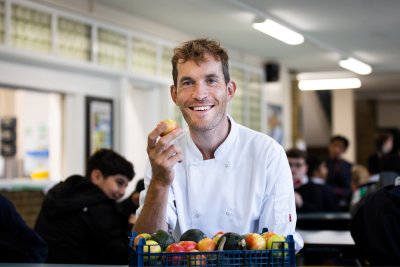
 School chef James Taylor in a Hackney school, as part of Sustain's Bridging the Gap programme. Copyright: Eleanor Church | Sustain
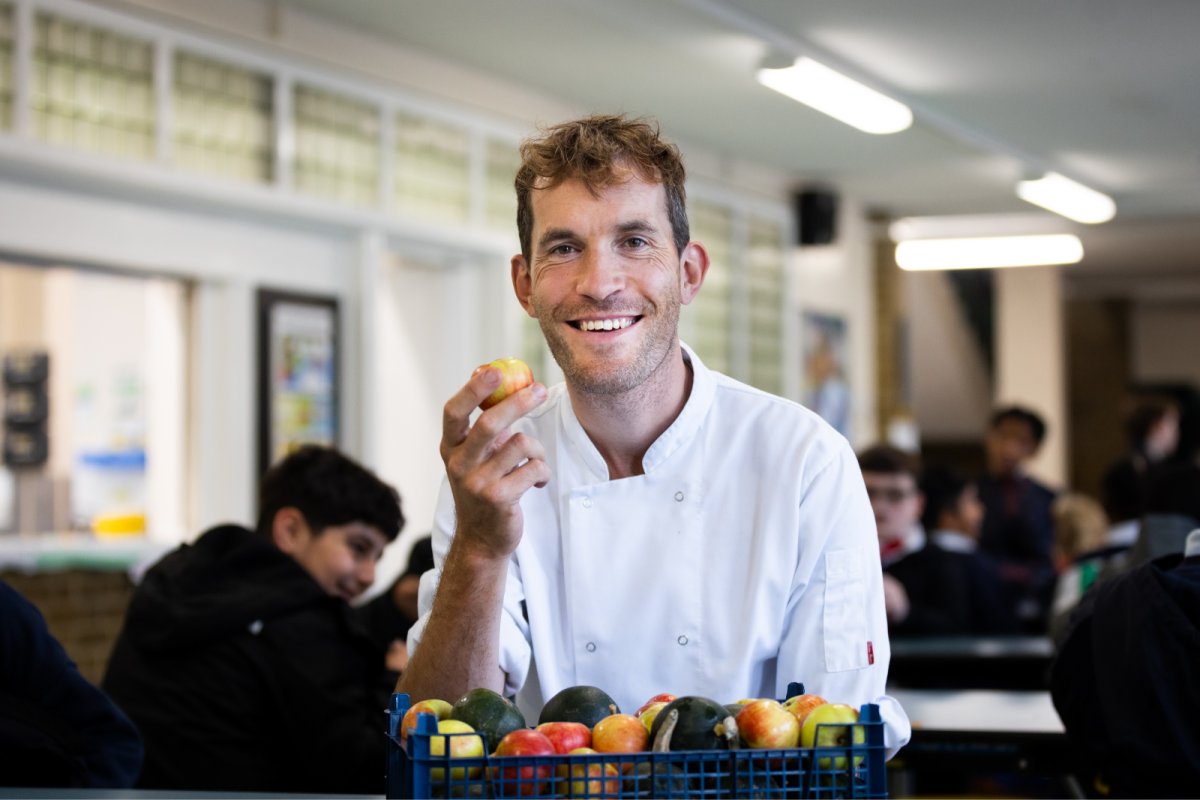

New Organic Action Plan recognises school food as opportunity for English growers
England’s first Organic Action Plan sets out sector growth strategy and cites Sustain alliance research on public procurement as way to help drive demand and production of organic.
The Department for Environment, Food, and Rural Affairs (Defra) has published its long-awaited Organic Action Plan for England (OAPE). Co-developed with the English Organic Forum, and chaired by Sustain alliance members OF&G and the Soil Association, the plan sets out to grow domestic production, strengthen supply chains and make organic food more accessible.
The plan recognises public procurement contracts as a strategic opportunity for UK growers, a key campaign area for Sustain and its alliance members. Sustain’s Bridging the Gap programme is mentioned as a successful case study which tested how strengthening supply chains and creating demand through school food can support organic production while widening access to organic.
Over the course of the Bridging the Gap programme, over 150,000 children, of which 33% were from low-income backgrounds, ate organic fruit and veg as part of their school meals. The school pilots also secured benefits for the environment and local community, as well as a reliable market for growers.
The plan comes at an important time for England’s organic sector. The UK organic market has grown for 14 consecutive years and was valued at £3.9 billion in 2025. However, domestic production has not kept pace with demand and many UK organic growers have been locked out of public procurement contracts, meaning imports are increasingly filling the gap. This presents a significant opportunity for farmers and growers in England to meet more of this growing appetite for organic.
Hannah Gibbs, Fair Supply Chains Programme Manager at Sustain, said:
“We welcome the plan’s focus on public sector food procurement and its recognition of Sustain’s Bridging the Gap programme’s pilot projects in schools. Public sector food has huge potential to create stable demand that gives farmers, growers, and suppliers the confidence to invest, while helping make organic food accessible to many more people.
Organic doesn’t need to be a premium niche. With coordinated support for farmers, supply chains, and secure demand, it can play a much greater role in a resilient food system that supports nature while making sustainably produced food accessible to more people.”
What’s included in the plan?
The OAPE sets out how government and the organic sector intend to work together from 2026 to 2031 to grow the proportion of England’s farmland under organic systems from 3.4% towards 10%.
The plan takes a whole-system approach to growing the organic sector, recognising that organic production needs to grow alongside increasing demand for organic. The plan will focus on three key areas:
- supporting new and existing organic farmers, growers, and processors
- aligning domestic supply in line with demand
- building demand for English organic products through greater consumer awareness and public sector procurement.
Sustain’s reaction to the Organic Action Plan for England
Sustain and its alliance members have called for a joined-up approach to growing the organic sector, and we welcome the plan and the Government’s decision to co-develop it with the English Organic Forum.
Supporting the growth of organic farming systems is a crucial component of the agricultural transition. Evidence shows that organic farming delivers significant benefits for climate and nature, as well as farm resilience by reducing reliance on synthetic fertilisers and other inputs. As UK farming becomes increasingly at risk from climate change, volatile input costs, and geopolitical shocks, the need to support the growth of sustainable and resilient farming systems, has never been so crucial.
Sustain also welcomes the Government's recognition of organic’s contribution to nature recovery, healthier soils, cleaner water, climate resilience and higher standards of animal welfare. This builds on the Farming Roadmap 2050's recognition that food production, restoring nature and tackling climate change are not competing objectives, but fundamental to the future resilience of farming.
Alys Bannister, Sustainable Farming Campaign Manager at Sustain, said:
“We really welcome this long-awaited commitment to growing organic farming in England. Organic can deliver for nature, soils, and farm resilience, but converting is a significant investment. Farmers and growers need confidence that there will be demand for what they produce before making that transition.
“The real strength of this plan is that it recognises production and demand need to grow together. Creating reliable markets, better routes to market and the right infrastructure will help give more farmers and growers the confidence to invest in organic.”
What’s next for the organic sector?
The plan will be delivered by Defra and the English Organic Forum. Sustain looks forward to working alongside Defra, the organic sector and its wider alliance to turn the plan’s commitments into meaningful change.
Sos Stopes, Co-chair of the English Organic Forum and Policy Advisor to Organic Farmers & Growers CIC, said:
“It is encouraging to see the Organic Action Plan for England published. The English Organic Forum, representing the organic sector, has worked hard with Defra on the development of a credible plan.
"Defra’s leadership and the positive support of the Environment Secretary Dame Angela Eagle for growth in the organic sector is a well-deserved acknowledgement of the practical ways that organic farming helps deliver the government’s environmental ambitions.”
Adrian Steele, Co-chair of the English Organic Forum and Soil Association Farming Advisor, said:
"An Organic Action Plan for England is a win for the UK's food and farming system.
"It recognises that more organic land can help the government to deliver its wider environmental goals, from healthier soils and cleaner water to more biodiversity and less reliance on artificial inputs like pesticides.
"With growing consumer demand for organic often being met by imports, we have long called for a more joined-up approach that breaks down supply chain barriers and helps farmers meet that demand.
"England has an innovative and entrepreneurial food and farming sector, and we welcome this plan which we hope will create the right conditions for organic farmers, growers and businesses to invest and thrive."
As the plan is implemented, there is an opportunity to ensure its ambitions reach farms of all sizes. Some small-scale horticultural growers currently fall below the 3-hectare threshold for Environmental Land Management schemes. Sustain will continue to work with Defra through the Horticulture Sector Growth Plan to help create the right conditions for organic and agroecological horticulture to grow.

Sustainable Farming Campaign: Pushing for the integration of sustainable farming into local, regional and national government policies.


Sustain
The Green House
244-254 Cambridge Heath Road
London E2 9DA
020 3559 6777
sustain@sustainweb.org
Sustain advocates food and agriculture policies and practices that enhance the health and welfare of people and animals, improve the working and living environment, promote equity and enrich society and culture.
© Sustain 2026
Registered charity (no. 1018643)
Data privacy & cookies
Icons by Icons8
