
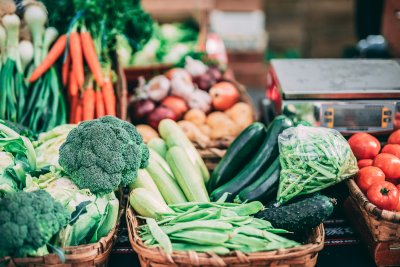
 VideoSeveral baskets of colourful vegetables on a table. Credit: Iñigo De la Maza | Unsplash
What: This school food pilot supplied organic veg from 15 growers in Wales to schools via three wholesalers to 13 local authority catering services. It continues to expand in 2026.
Where: Over half of the Local Authority Areas across Wales.
What we learnt: Public procurement can drive a market for UK produce and generate new income streams for farmers, which build stronger, local sustainable food systems whilst supplying healthy food to schools.
Story
Wales has a strong agricultural history, but until a few years ago it seemed impossible that Welsh organic vegetables could be served in school dinners. In 2022, Food Sense Wales partnered with wholesaler Castell Howell to change that story. Realising the benefits that growing local supply chains could bring, they co-designed a pilot to bridge the price gap and supply local, organic courgettes into the Food and Fun school holiday programme in Cardiff.
With funding from Welsh Government, Bridging the Gap and in-kind support from Castell Howell and Lantra, the project evolved into Welsh Veg in Schools, which now works with half the local authorities in Wales to get a variety of Welsh veg routinely into school meals.
Welsh Veg in Schools has received significant interest from government, the wider food sector, and the media. Encouragingly, Welsh Government financially supported the pilot between 2023 and 2025 to expand into more local authorities and develop a business model for cooperation between small growers. The Future Generations Commissioner (who oversees implementation of the Future Generations Act 2015), has publicly called for local authorities to sign up to the project, in their Future Generations Report 2025.
In April 2025, Food Sense Wales published a series of reports noting the project's achievements. You can read the various reports by clicking on the relevant links below:
- Welsh Veg in Schools: Summary Report
- Welsh Veg in Schools: Full Report
- The Story of Welsh Veg in Schools
- Appendices
By working together, the farmers are able to plan their planting to meet the needs of the school menus. The guaranteed income and support of the pilot has allowed the growers to plant more, and in some cases, new crops.
You can learn more about Welsh Veg in Schools by reading the latest press release here and read the recently published leaflets:
Specific learnings
Supply
- Growers need time and resources for training, learning and development
- More growers are necessary to increase resilience in supply
- Scaling pathways are needed for new growers
Policy recommendations to fix the supply
- Introduce a cross-departmental horticulture growth strategy
- Integrate the horticulture growth strategy with an organic action plan
- Introduce a collaborative layer to farming schemes – and fund actions within this – to support coordination between multiple growers
- Create a strong domestic market for UK organic and agroecological horticulture by harnessing the power of public sector procurement
Missing middle
- More local food infrastructure, such as processing facilities and farm machinery, is necessary to deliver veg at scale to catering services
Policy recommendations to fix the missing middle
- Invest in and support shorter SME supply chains by creating a national or regional investment pot or grants targeting organic and agroecological supply chain SMEs
Access
- Health and safety standards, together with support to meet these standards, are needed for growers to supply schools and reassure wholesalers their British Retail Consortium accreditation was not at risk
- Ordering needs to be streamlined to reduce storage time
- Crop planning is needed. Continuous feedback loops between growers, wholesalers and Local Authorities are necessary in advance of the growing season for growing plans to match school requirements
- Relationships between convenors, farmers and growers, wholesalers, caterers and consumers are vital and farmers and growers needs must be prioritised
- Hurdles for kitchen staff include ordering, kitchens being designed for frozen or pre-prepared veg and the time, storage, preparation space and skills needed for fresh, unprepared veg
- Farm visits, cooking sessions and tastings can improve children’s willingness to try veg and inspire children to successfully campaign for organic, local Welsh veg in their school
- Veg must be prepared and served to children in acceptable, familiar and sensory-friendly ways
Policy recommendations to fix the access
- Invest in supply chain facilitation roles and facilities
- Fund and incentivise public sector food procurement frameworks that support local, sustainable and British sourcing, shorten supply chains and enable participation by British producers and SMEs, such as Food for Life Served Here
- In Wales, Local Authorities to leverage the Social Values and Public Procurement Act to optimise the integration of quality assured produce into school meals (e.g. organic certified)
- Review and reform school food funding to reflect the true cost of delivering sustainable and nutritious meals, including food, labour, workforce and skills development, and local infrastructure
- Set ambitious environmental and health targets for organic fruit, veg and pulses in schools and public sector food settings within buying standards and school food nutrition standards specific to each nation
- Increase pulses on school menus, including where relevant, relaxing requirements to serve meat
- Require schools to have a food policy and food on the curriculum
Project partners
Welsh Veg is schools was founded by Food Sense Wales, Lantra and Castell Howell Foods. It is a movement of stakeholders led by Food Sense Wales and Lantra striving to increase the production, supply and access of organic fruit and vegetables in Wales.
-
Growers
-
Wholesalers
-
Local Authorities
Meet the Growers
There are 15 fantastic growers on the Welsh Veg in Schools project. Here’s some more information on some of the producers taking part.
- Abi Reader is a third-generation mixed farmer just outside Cardiff. Abi is also President of National Farmers Union (NFU) Cymru; a former NFU Cymru Wales Woman Farmer of the Year and in 2019 she was honoured by the Queen with an MBE for her services to agriculture. Enthused by the work of Welsh Veg in Schools, Abi decided to put two acres of land within her farm into conversion and has been growing polytunnel and field-scale crops for the first time. Her cucumbers and tomatoes successfully went into surrounding schools, through the local wholesaler, during the summer and early autumn. This year, her cucumbers will be going into schools in Cardiff.
- David and Katherine Langton started their growing careers by producing micro greens in their spare room, they then went onto 3 acres of rented land in Crickhowell where they established a successful market garden and box scheme. They started producing for Welsh Veg in Schools in 2023 and have now moved to a 70 acre farm in Ceredigion from where they supplied over 10 tonnes of broccoli into schools in 2025.
Next steps: In 2026, led by Food Sense Wales and Lantra, Welsh Veg in Schools will extend to 16 Local Authorities, work with 20 growers and 5 wholesalers, and deliver around 100 tonnes of organic veg to schools and other markets with support from charitable, private and public funds.
Read more about Welsh Veg In Schools in Bridging the Gap reports
Bridging the Gap: How to fix the food system for everyone
How to make school food work for children, farmers and planet


Bridging the Gap: Demonstrating ways to make organic food more accessible via farmer-focused supply chains.