
Are indie bakeries booming ‘up north’?
Majority of 15 UK cities with highest ‘independent bakeries’ to population ratio are north of Watford.
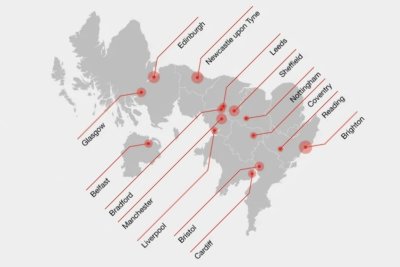




In September 2026, an insurance company reported the 15 UK cities with the highest ratio of (probably) independent bakeries* to population, 11 of which were north of Watford Gap.**
The list was topped by Brighton in East Sussex, with 22 ‘independent’ bakeries per 100,000 people. Most of the rest (Newcastle upon Tyne, Edinburgh, Manchester, Sheffield, Glasgow, Bradford, Belfast, Liverpool, Leeds, Coventry and Nottingham) however, are north of this marker. Only Bristol, Cardiff and Reading are to the south of it.
Indie bakeries all over the place
If these figures are any sort of guide, they might help to dispel the notion that Real Bread bakeries only exist in south east England; London’s not on the top 15 list, for example. Of course, our own Real Bread Map shows already disproves that myth, though indicates there are places where Real Bread bakeries are currently few and far between.
What the numbers don’t show, is what sort of bakeries they are. How many of them are what might be categorised (loosely, because there’s no legal definition) as ‘craft’ bakeries? How many are ‘artisan’ bakeries, which (despite our Honest Crust Act lobbying) is an equally ill-defined term?**
When it comes to other criteria, policies and practices, places to search for bakeries with ones that align with your own wants and needs include the Better Food Traders map and The British and Ireland Community Grain Association map.
Supply and demand
The report also shows the cities with the highest number of Google searches using terms like ‘bakery near me’, which was topped by Edinburgh, followed by Brighton, Manchester, London and Glasgow.
As the flipside to cities with the most ‘probable independent’ bakeries per 100k population, the authors also listed those with the fewest. The ‘cities with the biggest bakery supply gap’ were Portsmouth, Birmingham, London, Leicester and (oddly) Reading, which also appeared in the top 15.
The authors cautioned would-be bakery owners: ‘a supply gap on its own does not guarantee success. Business owners still need to consider practical factors such as rent, staffing, footfall, and logistics.’
You can find information and inspiration about starting our building your own bakery business in our Knead to Know…more handbook.
*The report was conducted by Hiscox Experts. They looked at OpenStreetMap data of bakery locations in cities around the UK, discounted ‘known chains’ (e.g. Greggs, GAIL’s, Wenzel’s) to identify ‘probable independents’, then divided the number by calculated how many there were per 100,000 people in cities across the UK.
**I added this arbitrary marker, which is some people’s tongue-in-cheek boundary between ‘The North’ and ‘The South’. This doesn’t align with official definition of Northern England and, of course, the UK isn't just England and Scotland lies even further north.
***Even the Craft Bakers Association doesn’t seem to have a clear definition of ‘craft bakeries’. I tend to think of them as businesses, typically family owned for generations, that mainly follow 20th century British baking traditions.
We believe that a true artisan baker doesn’t use any additives. There is overlap between people who identify as being ‘craft’ and ‘artisan’ bakers. I’ve found, though, the latter are more likely to embrace things not included in (or scorned by) 20th century bakery manuals, such as sourdough bread making, but don’t sell iced buns.

Published Saturday 10 October 2026
Real Bread Campaign: Finding and sharing ways to make bread better for us, our communities and planet.