

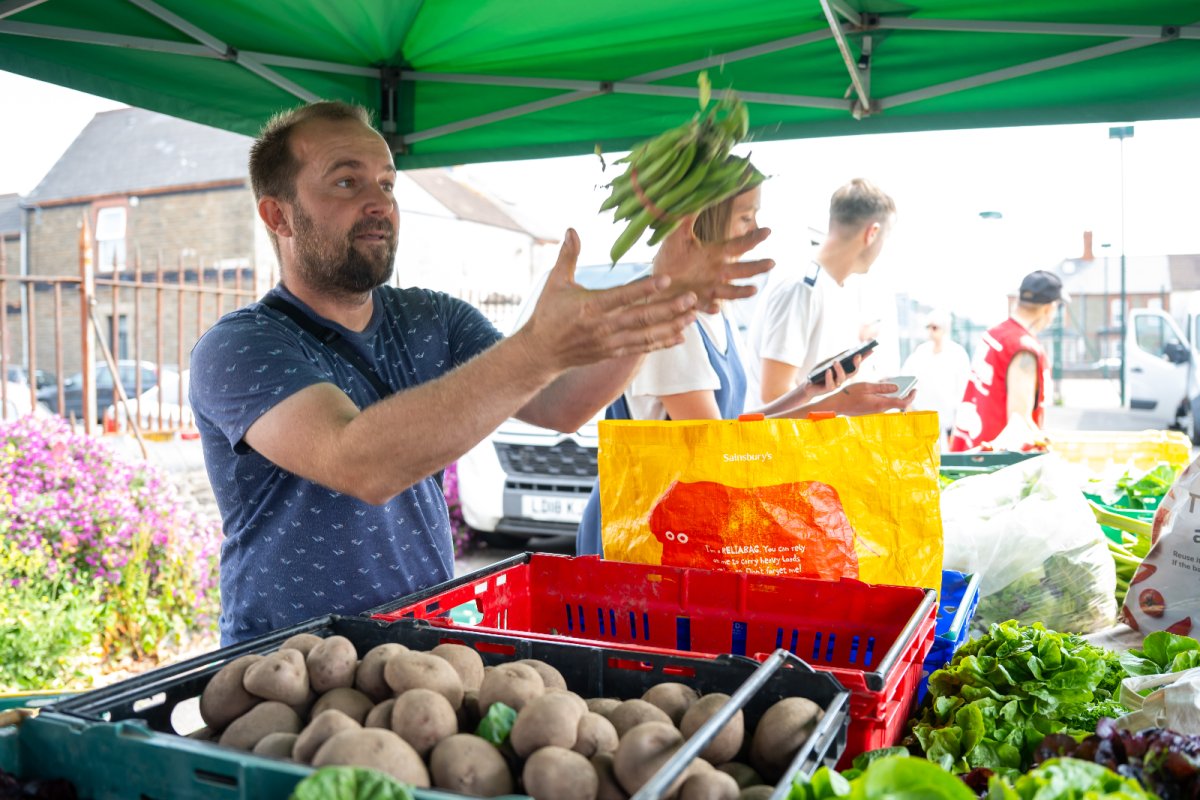
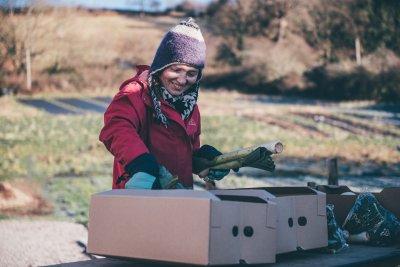
 Paul's Organic Veg, Cardiff. Credit: Riverside Farmers Market

More organic please!
The latest Organic Market Report from the Soil Association confirms that people want more organic, so we need to produce it - it’s time for an Organic Action Plan for England.
The latest Organic Market Report from the Soil Association confirms that citizen demand for organic food continues to grow strongly in the UK. But while people of all incomes are choosing to buy more food produced in ways that protect biodiversity and climate, government policy in England is still failing to support farmers to meet that demand.
For the last few years, Bridging the Gap has been working to enable people experiencing low incomes to access climate and nature friendly fruit and vegetables. What we have learned from this work is that a key barrier to access is the lack of supply, particularly of locally grown organic fruit and veg. As we see demand climb this needs to be matched by government commitment to support increased supply through and Organic Action Plan for England.
A thriving market could be a missed opportunity
The UK organic market has now enjoyed its 14th year of consecutive growth and was worth around £3.9 billion in 2025, after expanding by 4.2% over the year. Organic sales have doubled in value over the last decade, and organic products are growing 4 times faster in volume than their non-organic counterparts in major retail.
This continued growth – even during a cost-of-living crisis – reflects strong public support for food that is produced with higher environmental, animal welfare and health standards.
But while demand is increasing, the supply side of the UK food system has not kept pace. Only around 3% of UK farmland is organic, leaving the UK heavily reliant on imports to meet consumer demand.
This mismatch represents a missed opportunity: for farmers, for the environment, and for public health.
Organic farming delivers for climate, nature and health
Organic farming delivers multiple benefits: improving biodiversity, water quality, soil health and climate adaptation, animal welfare and even financial resilience in the face of external price shocks on fossil-fuel derived fertilisers.
Yet farmers in England who want to transition to organic production still face barriers to moving into organic which requires an upfront investment in time and effort.
Scotland leading the way to increased organic production
In January 2026 Scotland launched its new Scottish Organic Action Plan 2026-2029 with the aim of significantly increasing organic farmland and production.
Working in partnership with industry and government, the plan aims to scale up organic production, strengthen supply chains and meet growing demand for organic food and drink.
Scotland has already seen significant growth in organic agriculture in recent years. The area of land committed to organic production grew by over 26% between 2021 and 2024, reaching around 131,500 hectares when including land in conversion.
Government support schemes, including payments for organic conversion and maintenance, have helped underpin this progress.
The lesson is clear: policy support works.
England needs its own Organic Action Plan
In December 2024, Sustain and partners from across the sector called for an Organic Action Plan for England in a joint letter to then Farming Minister Daniel Zeichner MP and a target to increase organic farmland to 10% of the farmed landscape.
An Organic Action Plan for England could:
- Support farmers to transition to organic production
- Strengthen domestic organic supply chains
- Increase access to organic food in public procurement
- Reduce reliance on imports
- Deliver measurable benefits for climate, nature and public health
Crucially, it would provide the long-term certainty farmers need to invest in organic systems.
Bridging the gap between demand and supply
The Organic Market Report demonstrates that the public appetite for organic food is already there, something that the Bridging the Gap pilots clearly demonstrated. What is missing is the policy framework to help farmers meet that demand.
It is time for England to follow Scotland’s lead.
The opportunity is clear: support farmers, grow the organic sector, and build a food system that works for people, nature and climate.

Bridging the Gap: Demonstrating ways to make organic food more accessible via farmer-focused supply chains.


Sustain
The Green House
244-254 Cambridge Heath Road
London E2 9DA
020 3559 6777
sustain@sustainweb.org
Our mission is to catalyse systemic change in the UK’s food and farming system – securing a healthy, fair, and sustainable future for all people, nature and a stable climate.
© Sustain 2026
Registered charity (no. 1018643)
Data privacy & cookies
Icons by Icons8
