
Does Defra care about honest and accurate food labels?
A year of silence suggests…




In November 2024, the Real Bread Campaign learned from a senior policy officer at Defra that official guidance, titled ‘Criteria For The Use Of The Terms Fresh, Pure, Natural Etc. In Food Labelling’, had been 'archived', without a plan for updating or replacing it.
After almost a year of silence from Defra on the subject, last week I again asked for an update.
Please note that this is not a commentary on just one political party. Our experience is of successive governments since 2008 showing little to no appetite for our our proposals for improving composition, labelling and marketing standards.
Why this matters
This type of food labelling and marketing affects millions of shoppers, as well as many thousands of SME bakery workers and owners. When misused, it has the ability to give an unfair advantage to dishonest businesses, while undermining the producers of foods and drinks that genuinely are fresh, natural, pure etc.
When assessing a complaint of misleading marketing, consumer protection officers first consult the relevant statutory instrument(s). While legislation requires that food labelling and marketing must be accurate, truthful and must not mislead, it does not go into every possible claim and detail, and some of it is open to interpretation, hence the need for official guidance.
As there is no specific definition or regulation of the marketing terms in the 'fresh, pure, natural...' document, the official guidance has been a key tool in enabling officers to determine whether or not claims are misleading and in breach of the legislation.
Background
Along with the Trading Standards Institute, Chartered Institute of Environmental Health and Which?, in 2008 Sustain was involved in supporting the Food Standards Agency (FSA) to introduce the 'fresh, pure, natural...' guidance. Its purpose was to stem a rise in misleading and unfair use of product descriptions and marketing terms that are known to be of high value to manufacturers and retailers.
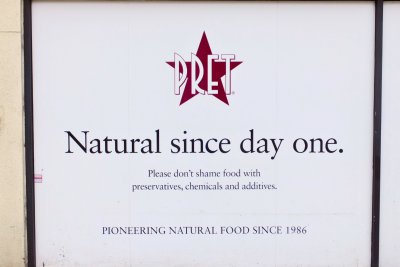
Over the years, trading standards officers, environmental health officers (when performing trading standards and business advice functions) and marketing regulators such as Ofcom and the Advertising Standards Authority have used this statutory guidance as the basis for rulings on misleading advertising and other marketing, noting that it provides the necessary, specific detail to enable authoritative assessments. One example from the Real Bread Campaign’s work was Pret a Manger being forced to remove the word ‘natural’ from its logo and other marketing, as the company sold a number of products that were made using additives.
In February 2025, Sustain CEO Kath Dalmeny wrote to the Minister of State for Food Security and Rural Affairs, proposing the temporary reinstatement of the 'archived' guidance while Defra worked on a revised version or replacement.
When I followed this up in March 2025, the senior policy officer wrote: ‘I recognise the value of the guidance and we are currently considering the future for it. We don’t have a timescale for any decision at this stage whilst we continue to prioritise our workload.’
In May 2025, the Chartered Trading Standards Institute (CTSI) added its support to our call on the Government to update and improve standards and guidance on food labelling and marketing.
At the end of May 2025, the Minister of State replied to our February letter: 'Whilst we do not currently have a timeframe for updating this guidance, we are looking at options in this area.'
The current situation
While food production and marketing have moved on since 2008, as have consumer knowledge and expectations, nothing has changed that warrants this guidance being dropped without replacement. In fact, FSA and industry research suggests that consumers are ever-more attracted to descriptors with stated or implied health and wellbeing associations, as some of those in the guidance have. There remains an elevated risk of ‘fresh, natural, pure’ and related terms being misappropriated and shoppers being misled into making buying choices, and even into paying premium prices based on those promises.
‘Archiving’ the guidance has created a vacuum in which consumer protection officers will find it harder to ensure consistent, appropriate outcomes. As an example, our trading standards complaints about ‘freshly baked in store today’ type claims being made by most of the UK’s 10 largest supermarket chains are currently in limbo.
In December 2024, I asked the Defra officer what companies and consumer protection agencies / officers should do if they need clarification, in the absence of the official guidance. The reply was: ‘Food businesses should contact their local Trading Standards office to discuss the use of these terms on their products. Trading Standards officers have processes in place to get advice and ensure consistency of enforcement.’
The officer did not state what the processes were, but (as noted above) they include referring to official guidance...
What needs to happen
We stand by what we urged Defra to do back in September 2024: review and revise the guidance to ensure that it is up to date and fit for purpose.
Also still standing is our offer to work with Defra, relevant Sustain alliance member organisations and other stakeholders in updating and improving legislation of commonly-used food marketing terms, and official guidance for their use.
As we said in November 2024 (in response to learning the guidance had been ‘archived’), in the meantime Defra should reinstate the 2008 version pending a review and update - especially given that won't be until some indeterminate date in the future.
What you can do
The Real Bread Campaign continues to lobby for an Honest Crust Act of updated and improved composition, labelling and marketing standards.
If you support this, you can:
- Write to your local MP, asking them to urge the government to take action.
- Support our work so that we can continue fighting this fight.
See also
The future of bread: Minister of State responds

Published Tuesday 5 May 2026
Real Bread Campaign: Finding and sharing ways to make bread better for us, our communities and planet.