


The Prime Minister has called for the UK to remodel itself for a more uncertain world. But while energy security has long dominated the national conversation, our food system remains fragile, import-dependent, and increasingly exposed to climate and geopolitical shocks.
The Prime Minister’s piece in the Guardian this morning makes clear that business as usual is no longer an option for the UK:
“The war in Iran must now become a line in the sand, because how we emerge from this crisis will define all of us for a generation…Doing things differently – thinking about the long-term, and remaking this country so that Britain is prepared for a world where shocks like this are more frequent. Because resilience is what gives us control.”
This could not be more true when it comes to the UK’s food supply, which has too often been taken for granted by British politicians and now looks increasingly under threat.
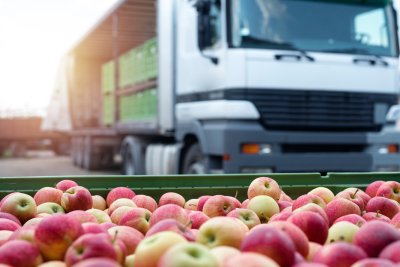
The UK imports 40% of our food and 78% of our fruit and vegetables, much of it from Southern Europe and North Africa, which are particularly exposed to climate shocks. As Professor Tim Lang made clear in the Guardian these long supply chains as well as a lack of regional processing infrastructure, and high levels of social inequality are leaving our food supply dangerously vulnerable.
What’s more, the fruit and vegetables which we do grow in the UK too often rely on artificial fertilisers. These fertilisers are often created using crude oil, and are a key reason why fresh produce is rocketing in price. Investing in agroecological farming which better supports nature, soils and human health is not just desirable, but a matter of national food security.
Our meat, poultry and dairy industry is similarly dependent on imported feed. Expanding intensive meat and poultry production in response to rising food prices is a political reflex, not a policy born in evidence: animal feed, which we import from across the globe, and is grown using synthetic inputs is also rocketing in price.
And there is a deeper, more troubling dimension to this. The climate shocks and nature loss that are increasingly disrupting our food supply are themselves being driven by the way we produce food. Synthetic fertilisers, intensive livestock systems and the destruction of soil health all contribute to greenhouse gas emissions and nature loss, which in turn make harvest failures, extreme weather and supply disruptions more frequent and severe. Our current food system is not just vulnerable to ongoing global crises – it is contributing to them.
If the Prime Minister truly is ‘thinking about the long term…so that Britain is prepared for a world where shocks… are more frequent’, then remodelling our food and farming system should be a key place to start.
Sir Keir’s article uses the metaphor of investment in ‘homegrown energy’ – but for our continued food security, we must also use ‘homegrown’ more literally by expanding sustainable production of fruit, vegetables and pulses. The changes needed to our food and farming system are even more complicated and long-term, but the consequences of getting it wrong are even more severe.
That is why Sustain is co-leading a campaign for a Good Food Bill for England. The complexities of our food and farming system require a strong tool to drive change.
The Bill would give the Government legal targets for fruit and vegetable production, and household food insecurity, to sit alongside existing legal climate and nature targets. The Bill would also give both local and national government a legal requirement to implement food plans while ensuring accountability across Government departments through a population-level reference diet.
We know that without change in our food and farming system, it is the poorest in our society that will suffer the most with rising prices, but what has been missing up until now is the political will to implement a durable legal framework to improve our food resilience that will outlast any one crisis, any one government, any one Prime Minister. If this crisis truly is to define us for a generation, let it be the moment we finally choose to take back control of what we grow, and who gets to eat well.

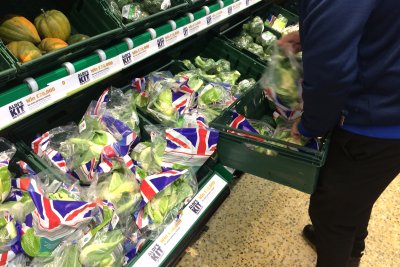
 Vegetable display at a UK supermarket in Lincolnshire. Copyright: Matylda Laurence | shutterstock
Good Food Bill: New legislation is necessary to transform our food system, giving successive governments clear goals to ensure the country is well-nourished in an increasingly uncertain world, while providing food businesses, investors, farmers, and growers with the confidence they need to operate in the most sustainable and beneficial way possible.