

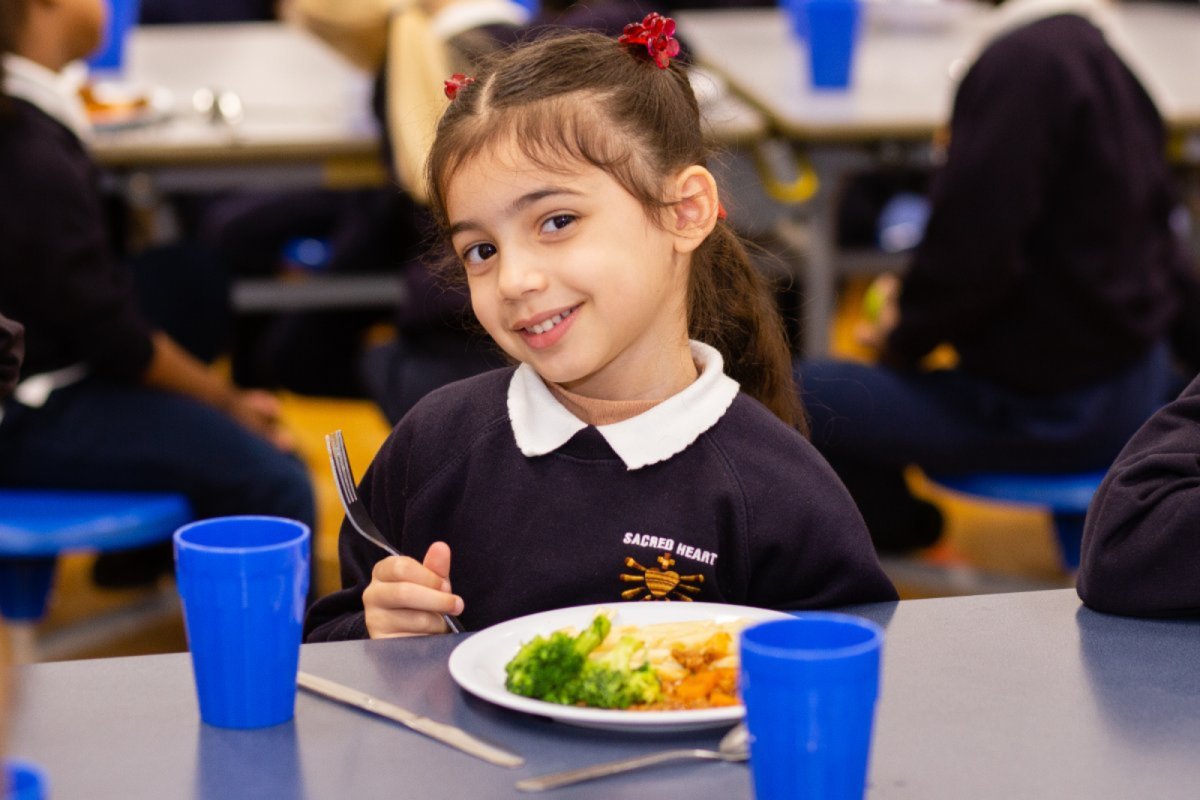
 Enjoying a healthy lunch at Sacred Heart School, Battersea. Credit: Jon Goldberg / Children's Food Campaign. Credit:

International school meals day: nourishing every child everywhere
This International School Meals Day, Children's Food Campaign officer Naema Jannath explores how different countries are making progress and showing what’s possible in delivering good nutrition, better learning whilst also supporting families, farmers, and sustainable food systems.
International School Meals Day is a global moment to recognise the huge power of school food to support children’s health, learning and wellbeing. The 2026 theme centres on sustainable, nutritious school feeding programs that also support local farmers and provide climate-smart food solutions.
The Global School Meals Coalition, launched in 2021 as a post-Covid response to childhood food insecurity, has quickly grown into a huge international movement with the aim of ensuring every child has access to a healthy school meal by 2030. As of March 2026, it has 113 member countries (although not yet the UK), as more and more governments increasingly recognise that providing healthy, sustainable food in schools is one of the smartest investments they can make for children and society.
International School Meals Day is a chance to take stock and celebrate that progress and imagine what more could be possible.
School meals superpowers
On International School Meals Day in 2025, with our partners in the School Food Review group, we launched an updated Superpowers of School Meals evidence pack, bringing together research on the wide-ranging impact of school food. It neatly summarises current insights on how access to healthy school meals have delivered better nutrition, addressed stigma and inequalities, eased pressure on family budgets and support local communities.
A good school meal does far more than fill a stomach. It helps children concentrate in the classroom, improves attendance and supports their physical and mental health, while also shaping how they learn about food, shared meals and healthy habits.
The impact also extends beyond the school gates. When governments invest in good school food, they are investing in public health, supporting local farmers and helping build a stronger, more sustainable food system. Sustain & Bremner & Co's recent Follow the Carrot report revealed the potential economic and health win-win for children, schools and farmers alike that could be achieved via linking commitments to 50% local, sustainable sourcing of public sector food with expansion of universal healthy school meals.
What the world could teach us
While the UK continues to debate how far school food policy should go, an increasing number of countries already deliver universal healthy school meals as a core part of their education systems.
Finland: the pioneer of universal school meals
Finland has provided universal free school meals since 1948, making it the longest running universal free school meal programme anywhere in the world, with every pupil guaranteed a hot lunch. Meals are designed to be balanced and nutritious, but they are also seen as part of the learning experience helping children understand nutrition, sustainability and shared mealtimes.
Sweden: healthy meals as a public service
In Sweden, free school lunches have been provided to all primary pupils since 1946. They are paid for via their municipalities, and must meet strict national nutrition standards. Every child receives the same meal offer, helping ensure that school food is universal and stigma-free.
Brazil: feeding children and supporting farmers
Brazil has been providing free school meals to families on low incomes since the 1940s, but was scaled up in 2009 to become a universal school meals programme, feeding around 40 million children a day with strict nutritional guidelines. The programme links to local agriculture by requiring a minimum of 30% of ingredients to be sourced from local family farms and smallholders, supporting rural livelihoods while ensuring children receive fresh, culturally appropriate meals.
Japan: where lunch is part of the lesson
In Japan, school lunch is treated as part of the curriculum. Students often serve meals to their classmates and eat together with teachers, turning mealtimes into an opportunity to learn about nutrition, respect for food and shared responsibility. Japan's funding system does not provide universal free school meals. Instead, it asks parents to cover costs of ingredients, whilst facilities and staff are covered by the education system, with additional funding and support to families on low incomes.
Portugal: expanding access locally
In Portugal, every child is offered a standardised menu, but a three tier system of payment is operated with free meals, subsidised meals and paid for meals, depending on family income. However, in March 2026, two municipalities - Nisa and Vila Real de Santo Antonio - have announced additional funding to guarantee free school meals for every student in its schools, ensuring children can access a daily meal regardless of family income. It’s another example of how governments and local authorities are continuing to strengthen school food systems.
India: better nutrition through connecting with local, indigenous knowledge
India's mid-day meals scheme is perhaps the most ambitious universal school meal programme in the world, feeding over 125 million primary and upper primary schools. In the north east region of Meghalaya, the programme has innovated further to combine indigenous knowledge, local farming and foraging to meet nutritional needs in a programme called "Linking Schools to Agrobiodiversity for Improved Diets, Nutrition and Livelihoods."
Bridging the gap here at home
The UK has also made real progress in expanding access to free school meals in recent years.
In England, all children aged 4–7 receive Universal Infant Free School Meals, whilst targeted Free School Meals are offered to children in families earning less than £7400 per annum, after tax and before benefits. However, this is now set to change radically, as free school meals will be expanded to include all children in families receiving Universal Credit from September 2026, a move which is expected to help lift around 100,000 children out of poverty and benefit an estimated 500,000 children altogether. London is the only region of England to provide universal primary school meals, supported by the Mayor of London, in a programme that has provided over 100 million meals, with positive evaluation from pupils, parents and teachers on reducing stigma, financial pressure and the chasing of school dinner debts.
Meanwhile, Wales has become the first UK nation to achieve universal free school meals for all primary school children, in a move that was rolled out over 3 years. A recent evaluation has revealed how the programme has reduced financial pressures on families, and the administrative burden of chasing 'dinner money debts' for schools. The programme is also increasing opportunities for local farmers to supply Welsh veg in Welsh schools. In the build up to forthcoming elections, Plaid Cymru has also pledged to expand free school meals to all secondary pupils from households in receipt of Universal Credit.
Scotland now provides universal meals for all pupils in Primary years 1-5, and to pupils from households receiving the Scottish Child Payment in years 6 and 7. The government is now also working with eight local authorities to pilot free school meals for all pupils in Secondary years 1-3 in receipt of the Scottish Child Payment.
Despite recent steps forward, there’s still a postcode lottery of access to free school meals because eligibility rules remain restrictive, and because the current system relies on families navigating complex applications.
Where do we go next?
Ensure all eligible children access healthy meals. Too many eligible children miss out simply because families must navigate complicated application systems or are unaware they qualify. Automatically enrolling children who are eligible would help ensure support reaches those who need it most. It would also reduce stigma for families, remove unnecessary administrative barriers, and help schools receive the pupil premium and other funding linked to free school meal registration.
Ensure free school meals are good quality and properly funded. Expanding eligibility to free school meals will only deliver its potential impact if the food served up is nutritious, appealing and delicious. The government is now updating School Food Standards to bring them into line with latest nutritional guidance, and will be consulting on these. We are also pushing for an effective monitoring and improvement system to be implemented alongside revised standards. Funding of free school meals must also ensure schools and caterers can deliver these without having to cross-subsidise from other budgets. It is critical that funding covers the true cost of food, labour, infrastructure and keeps pace with inflation. Both Scotland and Wales have increased their funding to £3.20 and £3.40 per meal respectively. Meanwhile England offers a grant of £495 per eligible pupil per year in England - equivalent to just £2.61 per meal, if based on 190 days attendance each year. Success in achieving expansion of school meals therefore require more attention to both quality and funding.
Create a win-win-win for children, farmers and the planet. There is also a bigger opportunity within reach. As our Follow the Carrot report shows, expanding free school meals universally in England could deliver 540 million additional meals every year while generating a £600 million boost for UK farmers and growers. It’s a true triple win: improving children’s nutrition, supporting families and strengthening demand for British produce. A new Bridging the Gap report estimates significant return on investment for sourcing organic and local produce, with pilots in Hackney, Scotland and Wales all showing the way. However, without decisive government action on funding, procurement and investment in supply chains, this opportunity could easily be missed.
Support parents with a roadmap towards universal healthy school food for all. Parents are calling for change too. Polling released by the Children’s Food Campaign of more than 2,000 parents across the UK found overwhelming support for expanding access to healthy school meals:
- More than 7 in 10 parents (75%) would like all children of all ages to have access to a free school meal, regardless of their background.
- Nearly 8 in 10 (77%) would like to see a progressive, phased expansion of school meals to all children.
- 8 in 10 (81%) parents support automatic registration for free school meals for all entitled pupils, instead of the current application system
The message from families is clear: healthy school food matters, and more children should benefit from it.
So this International School Meals Day, the question isn’t just how we celebrate school food. It’s how we build a system where every child has access to a delicious, healthy and sustainable school meal every day, that also connects to the very best of our local, sustainable farming and boosts the whole community.

Children's Food Campaign: Campaigning for policy changes so that all children can easily eat sustainable and healthy food.



Sustain
The Green House
244-254 Cambridge Heath Road
London E2 9DA
020 3559 6777
sustain@sustainweb.org
Sustain advocates food and agriculture policies and practices that enhance the health and welfare of people and animals, improve the working and living environment, promote equity and enrich society and culture.
© Sustain 2026
Registered charity (no. 1018643)
Data privacy & cookies
Icons by Icons8
