

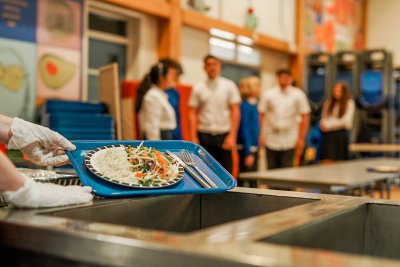
 . Credit: © 2023. Provided by Impact on Urban Health licensed via a?CC BY-NC-ND 4.0 license


What do parents want to see in future school food standards?
The government's recent consultation on England’s School Food Standards is the biggest overhaul in over a decade. As we wait for government to confirm changes, Children's Food Campaign Officer Naema Jannath reflects on what we heard from parents, and their clear message that a good school food system must also look beyond what is on the menu.
The government’s consultation on overhauling the School Food Standards in England has now closed, marking the biggest review of what children can eat at school since 2014. Parents, young people, teachers, caterers and campaigners have had their say on everything from breakfast clubs and fizzy drinks to bread, fruit and veg, and cheese.
The Children's Food Campaign worked closely throughout to ensure parent voices were heard, shaped through workshops with parent ambassadors, alongside findings from a nationwide Survation survey of more than 1,000 parents.
As well as feeding insights into Sustain's official response to the consultation, our Children's Food parent ambassadors also wrote an open letter directly to ministers. It sends a clear message that school food must improve: and this is not just the food on the menu, but also changes to the food culture that children experience in schools.
Here are six priorities parent ambassadors want the Department for Education to consider as it decides what happens next.
1. Create a healthier food environment throughout the whole school day
For healthier eating to become the norm, it needs to run through every part of the school day – not just lunch. Breakfast clubs, break times, lunches and after-school provision should all work to the same principles: less sugar, fewer processed and fried foods, and more fruit, vegetables and fibre.
It's a pattern many parents recognise. Children leave primary school with healthy routines, only to find that secondary school brings shorter lunch breaks, busier dining halls, more 'beige' and less appealing food options that make those habits harder to maintain.
Parent of primary and secondary children says:
"My big one is with the secondary school and the length for lunch breaks. It's just, it's not long enough... my son gets half an hour, he gets 15 minutes... in that time they've got to go to the toilet, queue for the lunch, can't go to toilet in between... by the end of the day, he said the behaviour of the kids is through the roof. He said they just haven't had any time to be with their peers."
The polling reflects a strong appetite for consistency. 85% of parents say it's important that school meals use fresh, minimally processed ingredients, while 78% want school food to reflect what children are being taught about healthy eating in the classroom.
The Real Bread Campaign's submission highlighted the opportunity to improve one of the foods children eat most often: bread. By encouraging additive-free, higher-fibre options in schools, the campaign argued that small changes to everyday staples could make a meaningful difference to children's diets.
Parents were particularly clear about drinks. Water and milk should be the default, with sugary drinks removed altogether. Many point out that the issue isn't simply how much sugar children consume at once, but how often they're exposed to it throughout the day. A steady stream of sweet drinks throughout the day can shape taste preferences that last for years. Keeping sugary drinks out of schools can provide a healthy break from this.
Parents noted confusion around fruit juices being seen as a healthy option because they are marketed as one of our five-a-day. Yet juice can contain as much free sugars as a can of fizzy drink and still raise concerns about dental health. If schools stop offering juice based drinks, parents say, a healthier approach to encouraging water and milk drinks can more easily become the norm at home too.
"I think the challenge that I have as a parent is that because it's [fruit juices] marketed as one of the five a day, it's seen as healthy and I think people don't appreciate the impact that it has on dental decay... if it then becomes the norm that you don't have it in schools, then it's kind of a bit accepted and it makes it easier to give those choices as a parent."
The survey found that 60% of parents support restricting school drinks to water, milk or unsweetened alternatives. Support rises to 65% among parents of primary-aged children, while 73% believe the same rules should eventually apply across both primary and secondary schools. Several parents also questioned why sugary drinks remain available in some secondary schools long after primary pupils have made the transition to healthier options.
2. Make healthy school food inclusive for every child
Inclusion means more than simply providing an alternative meal. It means making sure that alternative is nutritious, appealing and every bit as good as the standard option.
The polling showed schools generally perform well when it comes to allergies, with 75% of parents reporting satisfaction. But confidence drops sharply elsewhere: just 59% are satisfied with how cultural dietary needs are met, 56% with religious requirements, and 54% with SEND or sensory-related needs.
As menus evolve under the new standards, closing these gaps matters just as much as the headline nutrition rules.
Cheese offers a good example of how these issues play out in practice. For some vegetarian children, cheese on toast, plain pasta with grated cheese or a cheese baguette become the default simply because they're easy options for kitchens to fall back on. Rather than 'taking cheese away', parents of vegetarian children also saw how limiting cheese as the main protein source could be a big opportunity to encourage more genuine variety of dishes for children, including beans, lentils, chickpeas and healthy plant-based protein options, whilst limiting heavily processed alt-meat substitutes, especially if high in salt or fat or full of additives.
"My daughter's a vegetarian and the vegetarian options at the secondary school were often limited to plain pasta with grated cheese or pizza, despite the requirement to provide a vegetarian option."
At the same time, some parents of children with autism or ADHD emphasise that familiar foods can provide predictability and comfort. Any changes must be introduced with flexibility so children aren't left without foods they feel safe eating.
The consensus is that greater variety is welcome, provided it's introduced thoughtfully and supported by appropriate alternatives. There is clear support for moving in this direction as long as they're done well rather than simply replacing one processed product with another.
3. Invest in a positive school food culture and food education
New standards alone won't change what children choose to eat. The wider culture around food matters too.
That means involving pupils in menu decisions, linking lunchtime choices with what children learn in food and nutrition lessons, and giving them opportunities to try unfamiliar foods gradually rather than all at once.
Desserts offer a useful example. Some parents want schools to remove sugary desserts altogether and just have fresh fruit and yoghurt on offer, whilst others supported sugary puddings being scaled back, but not entirely removed from menus. Instead, parents also see schools as the ideal place to model healthier versions of dessert – fruit, yoghurt or lower-sugar options – while allowing children time to adapt rather than abruptly removing familiar foods.
"Banning it completely or demonising the solution doesn't help those kids in the long term. There's an opportunity to give them the chance to understand the difference between confectionery and something made with real ingredients."
Parents clearly believe schools have an important role to play. Nearly nine in ten (87%) think schools should help children develop healthy eating habits. Yet only 65% say they're satisfied with the quality of school meals overall. Among parents of secondary school pupils, satisfaction falls to 58%.
4. Ensure standards are properly funded, monitored and enforced
Parents want reassurance that these changes will happen in practice, not simply exist on paper. They want confidence that schools are supported to meet the standards and that loopholes won't undermine their purpose.
Their concerns are understandable. Compliance with the current standards is already patchy, with only a small proportion of secondary schools meeting existing restrictions on confectionery and deep-fried foods.
Government should provide adequate funding, training and support for schools and caterers, alongside clear arrangements for monitoring and accountability. Importantly, that support should explain not just how to meet the standards, but why they matter, helping school staff feel confident and motivated to champion healthier choices.
Parents strongly support greater transparency. 74% favour naming a governor or trustee with responsibility for school food, rising to 78% among primary parents. 83% support schools publishing their food policies online, while 81% believe Ofsted should consider food policies and practices during routine inspections.
5. Communicate clearly about why these changes matter
Families are far more likely to support change when they understand the reasons behind it.
Parents, pupils, school staff and caterers all need clear explanations about how healthier school food supports children's long-term health, learning and wellbeing.
At present, awareness remains surprisingly low. Half of all parents surveyed were unaware that the consultation was taking place, while 45% had never heard of the School Food Standards before taking part in the research.
Better communication can build trust, reinforce healthy habits at home and help parents play an active role in supporting change. With 70% of parents worried about whether their child eats healthily, there is clearly an audience ready to engage. The challenge is making sure the information reaches them.
"I'd like to see more accountability. I'd like the government to use what levers they can to ensure that accountability is there, because we know in the past when we've set standards they've not been adhered to. There's got to be accountability and I'd like to see the local authority play a role — but they need to be resourced, as do the schools."
6. Be ambitious and act quickly
Some reforms will inevitably need to be phased in as schools adapt menus, contracts and kitchen facilities.
But phasing should not become an excuse for delay.
Where there is a clear health benefit, particularly around reducing sugary drinks and limiting unhealthy options, government should move quickly and set clear expectations for implementation.
The bigger picture
For some children, a school meal is the most nutritious food they’ll eat all day. Families do what they can but schools are essential in helping children thrive.
Parents want schools where healthy eating is the norm, nutritious food is accessible to every child, and good habits are reinforced daily. Children’s health must stay the priority, with no dilution of ambition through delay or inconsistency.
This is a golden opportunity to build a school food system that supports children’s health, learning and wellbeing for generations.
Be bold. Our children are counting on you.
Read Sustain's School Food Standards Submission
Read Real Bread Campaign's Submission
The survey was conducted online by Survation between 5–12 May 2026 among parents in England aged 18 and over with children in primary and/or secondary education. A total of 1,020 parents took part. The data was weighted to account for differential response rates across demographic groups. For more information, email naema@sustainweb.org

Children's Food Campaign: Campaigning for policy changes so that all children can easily eat sustainable and healthy food.




Sustain
The Green House
244-254 Cambridge Heath Road
London E2 9DA
020 3559 6777
sustain@sustainweb.org
Our mission is to catalyse systemic change in the UK’s food and farming system – securing a healthy, fair, and sustainable future for all people, nature and a stable climate.
© Sustain 2026
Registered charity (no. 1018643)
Data privacy & cookies
Icons by Icons8
