

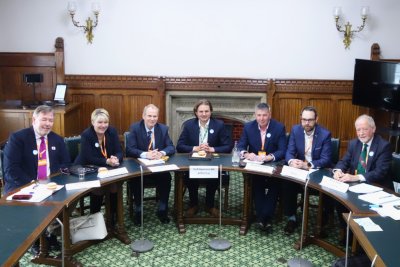
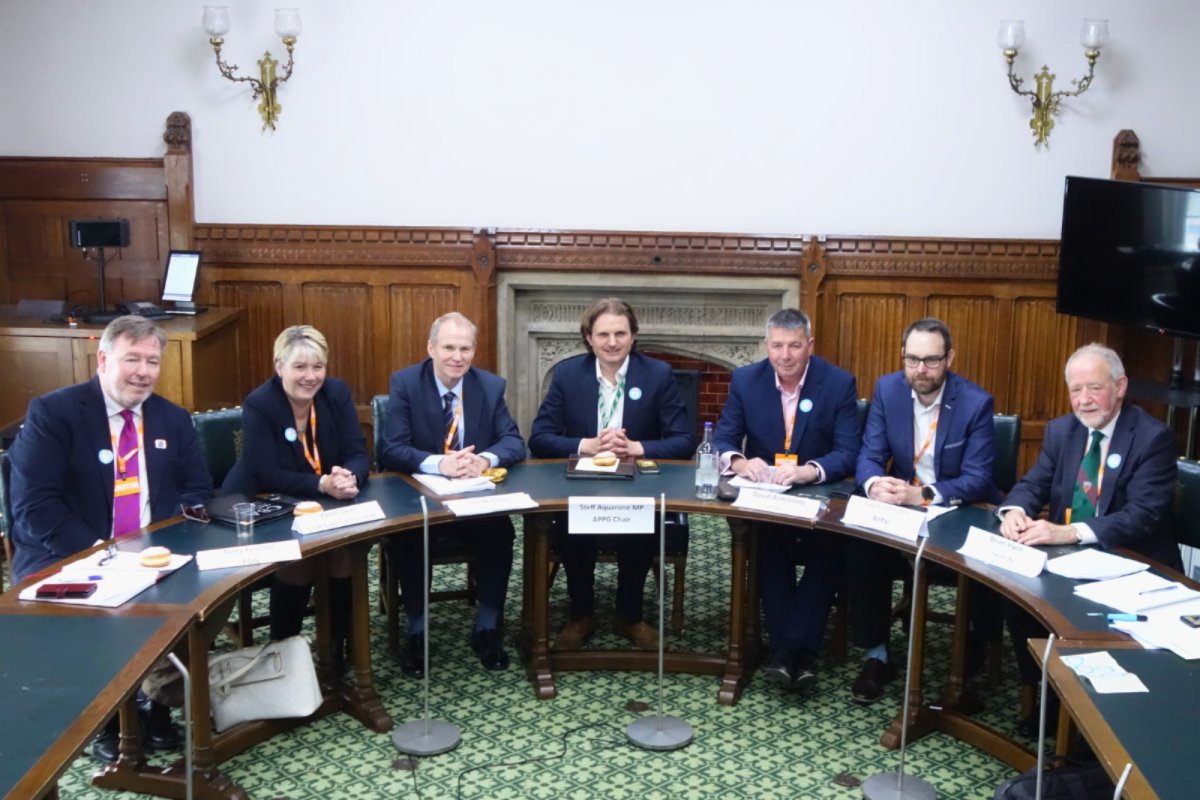
 APPG for The Bakery Industry first meeting panel. Credit: Chris Young / www.realbreadcampaign.org CC-BY-NC-SA-4.0

APPG for The Bakery Industry
First meeting for cross-parliamentary group.
Having been launched in July 2025, on 19 May 2026, the All Party Parliamentary Group (APPG) for the Bakery Industry held its first meeting at the Palace of Westminster.
On the panel were David Armstrong (The BAKO Group), Karen Dear (Craft Bakers’ Association) Terry Fennell (FDQ), Brian Irwin (Irwins Bakery NI), Gavin Johnston (Betty’s Bakery) and Ian McGhee (McGhee’s Bakery). In attendance were bakers and representatives from organisations including the Craft Bakers Association, Federation of Bakers and the Real Bread Campaign.
Key points
The APPG and meeting Chair, Steff Aquerone MP, said it’s a reasonable ask for the baking industry to be treated as a strategic sector. He mooted whether it had been a victim of its own success, especially during pandemic: ‘government tends to concentrate on things that are on fire.’
Summarising, at the end of the meeting, he said he felt it had indicated a clear path to greater advocacy for the sector and a step by step chain to making things better. ‘We need to get recognition for the value of the sector and being seen as a strategic sector. We need to demand the industry is consulted on the big moving parts of the policy agenda.’
Real Bread Campaign co-ordinator Chris Young said: ‘I came away with the understanding that bakeries of all types and sizes are facing, albeit at different scales, similar pressures. One of the key issues continues to be sharply rising costs, on both sides of the counter. These are forcing bakeries to make decisions between stomaching even narrower profit margins, or raising prices at a time when people are feeling the squeeze from all sides. Another is the difficulty in attracting new people with the right skills and aptitude to be professional bakers.’
The next meeting will be in June 2026.
Purpose
The invitation to the event stated: ‘The Baking Industry is a thousand-year-old industry, which contributes £6.65bn to the UK economy every year. It is an industry which Britain is already a world-leader in and, with the right support, could boost economic growth even further – across all corners of the country. With this in mind, we’ve convened a panel of leading industry voices, diverse in their business and regional experiences, to speak to MPs about the challenges and opportunities which they see the industry facing, and what needs to happen to strengthen this vital and historic industry – for the benefit of businesses and consumers across the country.’
Notes
The following are some of the points raised by panellists and other attendees.
Skills shortage
- Shortage of skilled bakers.
- Baking is not seen as a skilled industry.
- Not enough are apprentices coming into the industry from schools and colleges, leading to a skills shortage. Fewer than 150 bakery apprentices in England p/a. There are more in N. Ireland, despite its much smaller population.
- Hosting a bakery apprentice can attract £9k funding for a bakery but this is much lower than other sectors.
- Baking and apprenticeships should be treat on a par with welding, energy sector etc.
- Funding for colleges has not kept in line with inflation, so courses are shutting down.
- One bakery said it relied on a Swiss connection for skills training.
- Chris Young said bakeries in the Campaign network had raised the issue of changes to Skilled Worker Visa scheme (which included downgrading bakers from ‘highly skilled’ to ‘medium skilled’) making it almost impossible to employ skilled bakers from outside UK. Asked if other bakeries / organisations have experienced difficulty.
Rising costs
- Increases in: National Insurance, minimum wage, energy, ingredients, compliance with new employment legislation.
- Reduced consumer spending.
- Hidden cost of compliance, (e.g. EPR, net zero, HFSS, carbon) collecting and reporting data.
- Need energy business relief.
- Scottish rate relief ‘debacle’ needs sorting.
- Make business grants (for energy efficient ovens etc.) easier to apply for.
- Medium sized businesses not eligible for many grants, which are hard to apply for.
- Employment tax laws are a major issue.
- Additional issue in Scotland is proposal for a food price cap.
- Volume is okay but turning that into profit is increasingly hard.
- Inflationary pressures have not fully hit yet.
- Domestic food inflation is higher than for imported food.
- Markets and regulation creating inflation – what can gov’t do?
- Energy relief needed: fuel accounts for about 10% of costs, second after employment.
- It’s getting harder for a bakery to remain profitable. Having to consider very carefully before making any capital investment.
- Business rates rises and lack of relief for small businesses damaging high street – a bakery needs a high street and high street needs a bakery.
- Baker: In an ideal world, you pass your costs on but bakeries are nervous to do that – realistically, should be adding 4-5%.
- ‘Probably some of the cheapest bread in Europe’ Due to baking industry and supermarket sector is incredibly competitive.
- CBA sending out legislation updates about twice a month. Compliance with these costing small businesses money – either to employ someone or pay for consultancy.
- Bakery should be included in British Industrial Competitiveness Scheme to reduce energy costs.
- Cut in inheritance tax business relief is affecting family businesses. One bakery said it would face £400K tax bill for children taking over.
Food security and resilience
- Food security needs to be a focus.
- Bakery should be recognised by government / policymakers as a critical industry. Cornerstone of food is bread and should be treated accordingly.
- Industrial loaf manufacturers produce 12.5million units a day. Any disruption to the supply, people notice the next day, and the day after that panic sets in.
- Government needs to treat bakeries as a strategic asset, rather than an afterthought.
- It took six weeks to settle into situation created by lockdown.
- Cost pressures coming from global issues – fuel and fertiliser costs.
- Industrial bakers say the security, safety and confidence in farming and milling sectors is high.
- Employee rates bill, producer responsibility adds cost. Regulatory pressures (e.g. net zero) need to be toned down or deferred until global situation calms down.
- Investment in UK fertiliser production needed.
- Bakery contributes to society – diet and health. Government should ‘let us get on with that’.
Other
- Rising costs leading to lower confidence – seeing a decline in store opening, investment in people, capital and training. Need global and national stability – been in a state of ‘wait and see for six years’
- Still feeling aftermath of lockdown.
- Review 2% inflation target – flexibility will allow capital investment.
- ‘Bread’ contributes 40%+ of daily fibre to national diet, though this could be improved.
- Govt. should consult with national and SME bakeries, not multinationals, on policy matters. There should be an indie business test for every policy.
- The Government needs to defend and invest in the Food Standards Agency.
- High street bakeries are part of our childhood and our culture, so should be supported.

Real Bread Campaign: Finding and sharing ways to make bread better for us, our communities and planet.




Sustain
The Green House
244-254 Cambridge Heath Road
London E2 9DA
020 3559 6777
sustain@sustainweb.org
Sustain advocates food and agriculture policies and practices that enhance the health and welfare of people and animals, improve the working and living environment, promote equity and enrich society and culture.
© Sustain 2026
Registered charity (no. 1018643)
Data privacy & cookies
Icons by Icons8
