

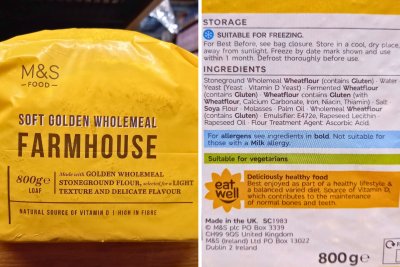
 Non-wholemeal flour higher on ingredients list than salt. Credit: Chris Young / www.realbreadcampaign.org CC-BY-NC-SA-4.0
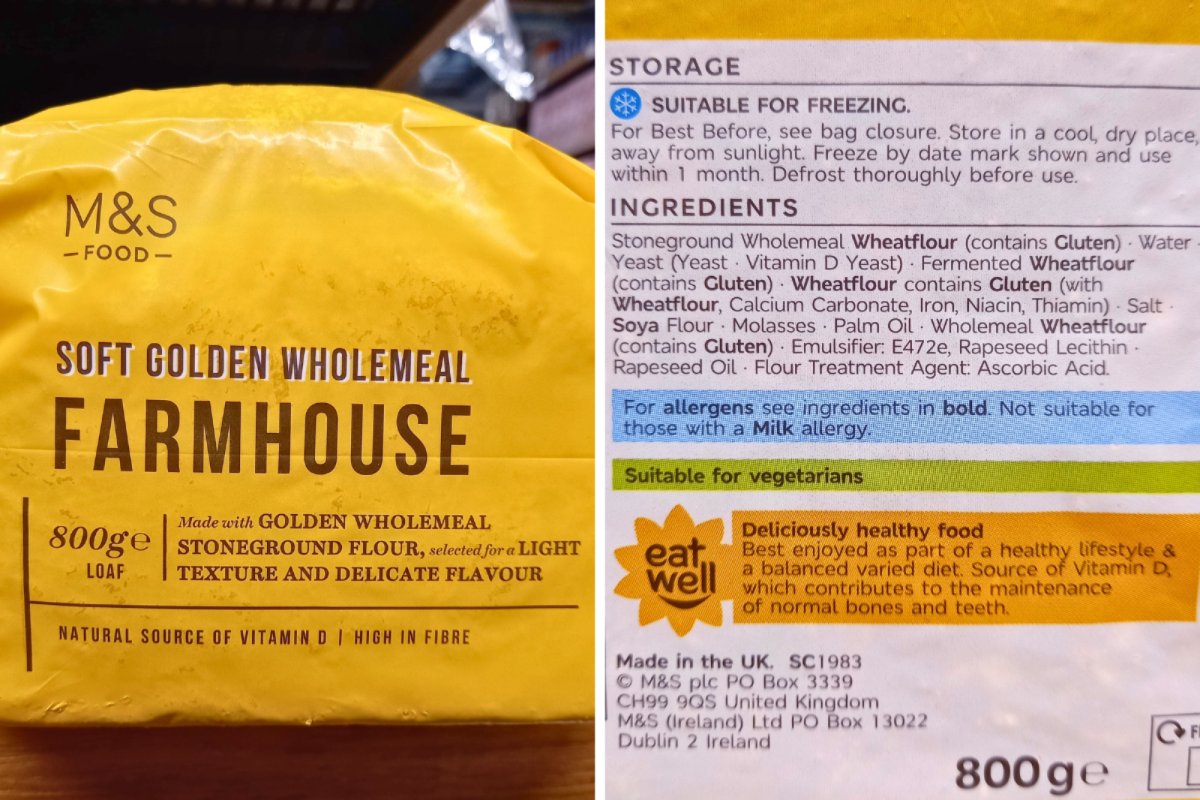

M&S claims white flour in wholemeal loaves isn’t an ingredient…
…and a trading standards officer agrees!
After almost three years, a trading standards officer has closed the case on a complaint by the Real Bread Campaign about Marks & Spencer using non-wholemeal flour in ‘wholemeal’ loaves.
On 24 June 2026, a trading standards officer at London Borough of Tower Hamlets (Sustain’s / the Real Bread Campaign’s local authority) advised:
‘M&S state that the additional non-wholemeal flours referenced are not considered part of the Regulation 6 requirement relating to the preparation of bread. These materials are applied solely as a surface dusting to the crust post-bake/oven exit, once the bread has been prepared, and therefore do not form part of the bread-making process to which Regulation 6 applies.’
The officer concluded: ‘LBTH is in agreement with this assertion and has taken no further action in respect to this. Case closed.’
Laughable
Regulation 6 of The Bread and Flour Regulations (1998) requires that: 'There shall not be used in the labelling or advertising of bread, as part of the name of the bread, whether or not qualified by other words […] the word 'wholemeal' unless all the flour used as an ingredient in the preparation of the bread is wholemeal.’
Real Bread Campaign coordinator Chris Young, who had been pursuing the case since July 2023, said: ‘The company’s defence, that the flour is added after baking so isn’t an ingredient, is laughable. What isn’t a laughing matter is that trading standards officers at two local authorities have swallowed that line.’
Flour is not a 'processing aid'
M&S had previously claimed that the non-wholemeal flour was a 'processing aid', a defence that the trading standards officer accepted.
The Campaign responded by highlighting that, as laid out by assimilated Regulation (EC) No 1333/2008, a ‘processing aid’ is: any substance not consumed as a food by itself, intentionally used in the processing of raw materials, foods or their ingredients, to fulfil a certain technological purpose during treatment or processing, and which may result in the unintentional but technically unavoidable presence of residues of the substance or its derivatives in the final product, provided that these residues do not present any health risk and do not have any technological effect on the finished product.
Effectively, it is an additive but not classified as such.
By contrast, flour is an ingredient, which fails to meet to meet a number of criteria that would allow it to be deemed a ‘processing aid’:
- Flour is consumed as a food by itself [albeit it rarely without combining it with at least water and being cooked in some way]
- Flour is not used in the processing of raw materials, foods or their ingredients to fulfil a certain technological purpose.
- Rather than leaving unintentional but technically unavoidable residues, the flour itself is intentionally present in the final product.
- Flour has a technological effect in the finished product.
The officer replied: 'Thank you for reaching out but this position will not change at this stage.'
Young responded: 'the company’s defence is based on an incorrect assertion. Flour fails to meet the regulatory criteria for being classified as a processing aid or additive. It is a food ingredient.'
Not just M&S
In July 2023, the Real Bread Campaign found ‘fortified’ (i.e. non-wholemeal) flour listed in own-brand products marketed by Aldi, Asda, The Co-operative, Sainsbury’s, Marks & Spencer and Waitrose using the word wholemeal. The Campaign wrote to each of the companies and subsequently submitted trading standards complaints.
See also
- M&S relabelling thanks to Real Bread Campaign
- Where are the bread police?
- What's hiding behind the word wholemeal?
- Wholemeal law update (2025)
- New bread and flour guidance: gains and omissions
- Wholemeal: better bred bread
- Loaf fabricators challenge ‘all flour must be wholemeal’ law (2024)
- Wholemeal law breakers? (2023)
- Wholegrain and wholemeal: a decade demanding definition (2023)
- 100% wholemeal? Update (2018)
- A wholegrain of truth? Industrial loaf names, claims and contents (2013)

Real Bread Campaign: Finding and sharing ways to make bread better for us, our communities and planet.


Sustain
The Green House
244-254 Cambridge Heath Road
London E2 9DA
020 3559 6777
sustain@sustainweb.org
Sustain advocates food and agriculture policies and practices that enhance the health and welfare of people and animals, improve the working and living environment, promote equity and enrich society and culture.
© Sustain 2026
Registered charity (no. 1018643)
Data privacy & cookies
Icons by Icons8
