

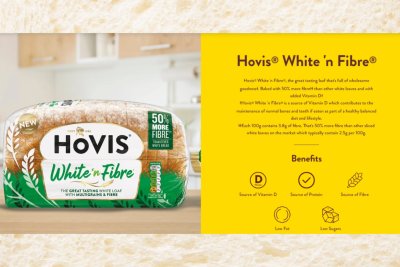
 There are other loaves that have more than 2.5% fibre. Copyright: Hovis (fair use)
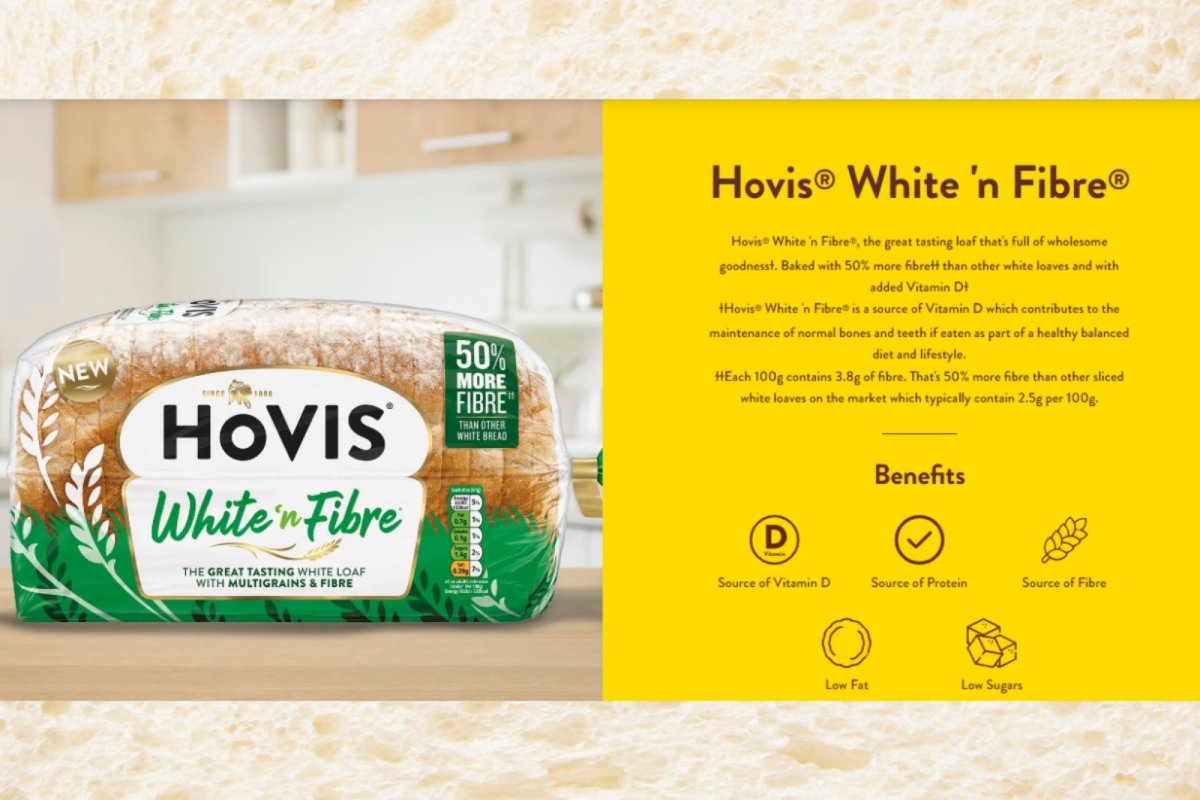

Hovis 50% better than the rest?
The Real Bread Campaign's trading standards complaint.
On 19 May 2026, the Real Bread Campaign submitted a complaint about Hovis claiming a product contains significantly more fibre than other sliced white loaves.
'White 'n Fibre' has 3.8g fibre per 100g, which Hovis markets using the claims '50% more fibre than other white bread' and '50% more fibre than other sliced white loaves on the market'. The company also states that other white loaves 'typically contain 2.5g [fibre] per 100g'. Hovis does not substantiate these claims on its website or product labels.
Real Bread Campaign coordinator Chris Young said: 'We believe these "health halo" claims are likely to be understood by the average consumer to mean the product is 50% higher in fibre and, therefore, significantly "healthier" or otherwise "better" than most or all other white loaves. We believe this is misleading because there are many examples of white loaves, even within Hovis's own range, that have more than 2.5% fibre.'
A brief online search shows that 'White 'n Fibre' is not 50% higher in fibre than all other sliced white loaves on the market. Products that contain more than 2.5g fibre per 100g include: ASDA ‘Just Essentials’ white (3.2g fibre per 100g), Morrisons white (3.2g fibre), Bertinet Bakery 'White Sourdough' (3.2g fibre), Waitrose ‘Essential’ white (2.9g fibre), and Sainsbury’s ‘Stamford Street’ white (2.8g fibre).
The '50% more fibre than other white bread' claim is not even borne out by Hovis's own range. 'White 'n Fibre' does not contain 50% more fibre than the company's 'Signature' white (3.5g fibre per 100g), 'Farmhouse Batch' (2.9g fibre), or 'Mothers Pride Scottish plain' (2.6g fibre).
We complained to Hovis on 12 May 2026 and on 19 May 2026 received the response below. We therefore asked the trading standards department of London Borough of Tower Hamlets (LBTH, our local authority) to review our complaint and liaise with the company’s Primary Authority to resolve it.
Hovis's response
'It’s genuinely encouraging to hear your support for bakeries working to increase fibre in the UK diet — that’s something we care deeply about as well. At Hovis, our aim is to give people meaningful choice while supporting healthier eating habits, and we’ve seen a growing recognition of the benefits of fibre among UK consumers.
At the same time, our research shows that a significant proportion of people still choose white bread, which typically doesn’t provide a meaningful source of fibre. Rather than ignoring that reality, we wanted to find a way to meet people where they are — by improving a product they already enjoy. That’s why we developed a soft white loaf with added fibre, offering 50% more fibre than standard white breads in that category, while still delivering on the taste and texture people expect.
We absolutely recognise the importance of transparency and trust in this space. As a business, we operate strictly within UK and EU regulations and are committed to ensuring that all communications are clear, accurate, and not misleading. Our intention is to contribute positively to public health goals, while responding to real consumer behaviours in a constructive way.'
See also
- Hovis bloomers ad complaint
- Hovis ‘wholemeal’ case referred to government
- As good today as it's always been?
- Dirty secret behind factory loaf 'clean labels'?
Updates
LBTH = London Borough of Tower Hamlets, Sustain’s / the Real Bread Campaign’s local authority. Bucks = Buckinghamshire and Surrey Trading Standards, Hovis’s Primary Authority for trading standards.
10 July 2026: A member of the Public Protection & Integrated Enforcement Division at LBTH forwarded to the Campaign the defence sent by Hovis to Bucks. The company stated: 'to develop a soft white product with 50% more fibre was an obvious choice for the business, especially in today's world where fibre has become "sexier"...'
This marketing ploy, however, seems not to have been successful. LBTH noted that Bucks: 'has been advised at the end of May that Hovis decided to delist the product due to low uptake in the listed areas.' For this reason, LBTH concluded: 'We will close this matter our end.'
Hovis also outlined that to make the marketing claim, the company had: 'looked at higher volume selling standard white breads (thereby looking at the majority of products being sold within the marketplace), with similar nutrition profiles & recipe make up, which included Branded products (Hovis / Warburtons / Kingsmill / Roberts), Retailer Brand products (Tesco / Sainsbury's / Asda / Morrisons) and also Discounters (Lidl)...'
Responding to the Campaign's complaint, LBTH wrote: 'The PA pointed out that the sample set reviewed by the Real Bread Campaign encompassed a wide range of white bread products available in the market — including white sourdough loaves, products designed for specific dietary requirements, and white breads containing added ingredients such as pulses — and suggested focusing on a more consistent group of products with more comparable nutritional profiles and composition.'
Real Bread Campaign co-ordinator Chris Young said: 'We encorage people to eat more dietary fibre but Hovis omitted the material fact that its claim was based on a handful of cherry-picked examples. The company did not make clear to shoppers that the product contained 50% more fibre than only some other sliced white loaves on the market, rather than all of them, as we believe the claim implied.'
He added: 'All of the examples we cited in our complaint were mass-produced, sliced and wrapped white factory loaves, widely available from UK supermarkets and so directly comparable by shoppers to the product in question.'

Real Bread Campaign: Finding and sharing ways to make bread better for us, our communities and planet.
Sustain
The Green House
244-254 Cambridge Heath Road
London E2 9DA
020 3559 6777
sustain@sustainweb.org
Sustain advocates food and agriculture policies and practices that enhance the health and welfare of people and animals, improve the working and living environment, promote equity and enrich society and culture.
© Sustain 2026
Registered charity (no. 1018643)
Data privacy & cookies
Icons by Icons8
