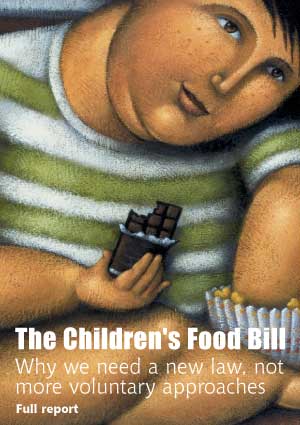
The Childrens Food Bill: Why we need a new law, not more voluntary approaches

This report places the crisis in children's diet-related health in the context of the unhealthy food environments which have become part-and-parcel of their every day lives. Using a range of examples from a number of policy areas (for example, control of tobacco advertising, alcohol promotion and marketing of breastmilk substitutes), the report explains how industry is unable, in a competitive market, to exercise the social responsibility required to make voluntary approaches successful. It also demolishes the many arguments used by the food and advertising industries to promote self-regulation rather than effective legislation.

The Childrens Food Bill: Why we need a new law, not more voluntary approaches
ISBN: 1 903060 37 0 - 40pp - 2005 | 2800Kb

Download

Reports • Children's Food Campaign

Published: Tuesday 31 May 2005

This report places the crisis in children's diet-related health in the context of the unhealthy food environments which have become part-and-parcel of their everyday lives.

Using a range of examples from a number of policy areas (for example, control of tobacco advertising, alcohol promotion and marketing of breastmilk substitutes), the report explains how industry is unable, in a competitive market, to exercise the social responsibility required to make voluntary approaches successful. It also demolishes the many arguments used by the food and advertising industries to promote self-regulation rather than effective legislation.


Report contents

Summary

1. What is wrong with children's diets?

  • The "timebomb" is exploding
  • What is causing the problem?
    • Junk food promotions targeted at children
    • Poor quality food in schools
    • Inadequate food education and skills
    • Insufficient promotion for healthy food
  • How the Children's Food Bill will address the causes
    • Improving the quality of children’s food
    • Protecting children from unhealthy food marketing
    • Improving the quality of food in schools
    • Ensuring all children have essential food skills and knowledge
    • Promoting healthy food to children
    • Support for the Children's Food Bill
  • Government's current approach
    • The five-a-day programme
    • The "Jamie Oliver" initiative
    • No change in the curriculum
    • Voluntary restrictions on food marketing

2. Voluntary approaches do not work

  • Case studies
    • Tobacco advertising
    • Alcohol promotion
    • Marketing breastmilk substitutes
    • Using pesticides and antibiotics in farming
    • Controlling supermarket power
  • Why are voluntary approaches ineffective?
    • Voluntary codes are weak
    • There are commercial incentives not to comply
    • There are no meaningful sanctions for non-compliance
    • Independent operation and monitoring is rare
    • The real purpose of voluntary approaches?

3. Arguments used against the Children's Food Bill

  • There is no problem
  • There is a problem, but it is all down to physical inactivity
  • All foods can be healthy
  • Food marketing has no, or only a minor effect on children's diets
  • Media literacy is the solution
  • Voluntary codes are more flexible
  • Marketing is already heavily regulated
  • It is parents' responsibility, not the "nanny" state
  • An ad ban would be:
  • Anti-competitive
  • Disproportionate
  • A short-term, simplistic and populist measure
  • A problem for children's TV
  • Ineffective
  • Too costly

References

Appendices

  • National organisations supporting the Children’s Food Bill
  • MPs who signed Early Day Motion 1256 in support of the Children's Food Bill


Children's Food Campaign: Campaigning for policy changes so that all children can easily eat sustainable and healthy food.

Sustain
The Green House
244-254 Cambridge Heath Road
London E2 9DA

020 3559 6777
sustain@sustainweb.org

Our mission is to catalyse systemic change in the UK’s food and farming system – securing a healthy, fair, and sustainable future for all people, nature and a stable climate.

© Sustain 2026
Registered charity (no. 1018643)
Data privacy & cookies
Icons by Icons8

Sustain