

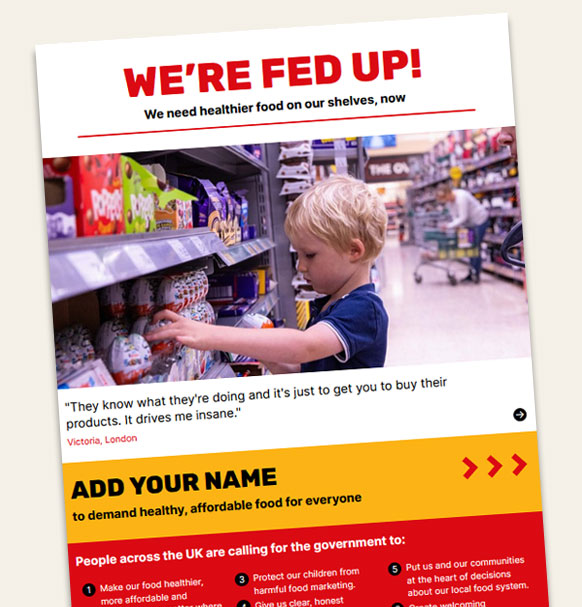
 Young boy says yes to school food for all. Credit: Sustain


New school food standards aim to boost healthier appetites
The government has launched a nine week consultation on proposed new School Food Standards for England, aiming to reduce sugar, fried foods and processed meat and boost pupil intakes fibre, fresh fruit and vegetables, beans and pulses. Sustain's parent ambassadors welcome the opportunity to push for change.
Sugary desserts and deep fried foods will disappear from school lunch menus under proposed new School Food Standards published jointly by the Departments for Education and Health and Social Care.
The measures published as part of a nine week consultation aim to bring food served in schools into line with the latest nutritional guidance from the Scientific Advisory Committee on Nutrition (SACN) around reducing sugar and increasing fibre intakes.
Launching the consultation, Education Secretary Bridget Phillipson said:
"Today we are launching the most ambitious overhaul of school food in a generation, and it is long overdue.
Every child deserves to have delicious, nutritious food at school that gives them the energy to concentrate, learn and thrive – meals that children will actually recognise and enjoy, backed by robust compliance so that good standards on paper become good food on the plate."
Health Minister Sharon Hodgson said:
"Children are consuming twice the recommended amount of free sugar and offering more nutritious meals at school is a great way of ensuring they eat healthier food.
We’re determined to reduce the child obesity epidemic and the new School Food Standards represent another piece in a jigsaw of measures designed to help raise the healthiest generation of children ever."
Children's Food Campaign Manager Barbara Crowther welcomed the start of the consultation, and said:
"Current school food standards have reached their use-by date. They no longer reflect the scientific evidence on the harms of high sugar, low-fibre diets and risks associated with high consumption of meat and ultra processed foods both for children’s health and the planet. This consultation is a golden opportunity to raise the bar. We urge government and schools to be bold and ambitious in setting new standards, so that our schools can become beacons of a healthier and more sustainable food system, and our children can grow up healthy wherever they live and learn."
There is widespread support for improving the quality and health of school meals amongst parents, as evidenced by polling conducted as part of the development of Sustain's parent ambassador manifesto Our Children, Our Future. According to the government's own parent polling:
- 74% of parents have at least one concern about their child’s nutrition - including too much sugar (43%), too many fatty foods (24%), not enough fruit and vegetables (30%)
- 50% of parents in England saying they don’t get enough information about what their child is being served, this means parents, pupils and communities can hold schools to account.
Sustain’s parent ambassador, Mandy Mazliah, who has 3 children aged 15, 14 and 10, said:
"I’m pleased the government is reviewing school food standards. As a mum of three, I’ve been shocked by how often options like doughnuts, sausage rolls and sugary or ultra-processed foods dominate. This is a real opportunity to improve what children are eating by cutting sugar and ultra-processed foods while increasing vegetables, whole foods and plant-based options. Our children need good quality food to fuel their learning and ensure that they can live healthy lives."
Sustain’s parent ambassador, Gemma McFarlane, a parent of children aged 17 and 14, said:
"I welcome the School Food Standards consultation, it’s a positive and much-needed step. Parents are frustrated that it’s still too easy for students to fill up on less healthy options like tray bakes and fizzy drinks instead of balanced meals. I’d like to see limits on these, alongside more sustainable options and better support in schools to help children make healthier decisions. Families see first-hand how food impacts children, so it’s vital our voices are heard. I really hope the government will listen to parents like me."
The government has also pledged to introduce a "robust national enforcement mechanism" to ensure School Food Standards deliver the healthy change on the plate and in the canteen. At present there is no formal monitoring or reporting system, with the quality of school meals varying widely from one school to another, even within the same local area. Further details are expected to be published in September 2026, with schools and caterers given 12 months to implement necessary changes before the new compliance system is enforced from September 2027.
Our Children's Food Campaign, alongside parents and many Sustain members and partners working together as part of the School Food Review network welcomes this commitment.
Children's Food Campaign Manager Barbara Crowther added:
"There's often a real mismatch between what School Food Standards say, and what ends up on children's plates. This is especially true in secondary schools where a grab 'n' go culture is more prevalent. We have long called for a monitoring system whereby school leaders and governors, local councils, academy trusts and Ofsted combine to ensure schools are adopting and delivering robust food and nutrition - both on the plate and in the classroom. Getting such a system in place will be a game changer, replacing the current piecemeal approach with a drive to improve quality across the whole school system."
See the full consultation document here
More responses from Sustain members
Katharine Jenner, Executive Director of the Obesity Health Alliance and a Sustain trustee, said:
"Schools should be a place that actively supports children’s health. Strengthening school food standards, so children can enjoy affordable, tasty and nutritious meals, is a vital and welcome step.
Right now, children are surrounded by unhealthy food at almost every turn — not just at school, but also online, on the high street, at home and beyond. Action cannot stop at the school gates — it is needed across the wider food environment to truly give every child the best start in life."
Naomi Duncan, Chief Executive at Chefs in Schools, said:
"We are pleased to see the first update to school food standards in over a decade, and a commitment to monitoring that means these measures will have real impact. Suggested changes will see a shift towards more freshly prepared and delicious meals that are packed full of nutrition. More fruit and veg and fibre will be served so that young people get all the goodness they need to grow up healthy and thrive."
Anna Taylor, Executive Director, The Food Foundation, said:
"With government announcing higher school food standards, which will also be monitored, and rolling out universal breakfast clubs and wider access to free school meals, the huge potential of school food to nourish and energise the next generation is finally being recognised. This must be the moment the whole sector pulls together to make school food delicious and nutritious, and embed food education into the school day."
Stephanie Slater MBE, Founder and Chief Executive of School Food Matters said:
"This is a truly exciting moment for school food. Government’s move to update the school food standards will strengthen the extension of free school meals and the continued roll-out of universal primary breakfast clubs. This has the potential to revolutionise access to delicious, nutritious and sustainable food for children and young people across the country."
See also

Children's Food Campaign: Campaigning for policy changes so that all children can easily eat sustainable and healthy food.





Sustain
The Green House
244-254 Cambridge Heath Road
London E2 9DA
020 3559 6777
sustain@sustainweb.org
Our mission is to catalyse systemic change in the UK’s food and farming system – securing a healthy, fair, and sustainable future for all people, nature and a stable climate.
© Sustain 2026
Registered charity (no. 1018643)
Data privacy & cookies
Icons by Icons8
