

Sustain / Real Bread Campaign / Articles
Shoots for the hip
An introduction to sprouted grains in bread by Argentinian chef and baker, Martín Tufró.




The artisanal bread renaissance is the result of the efforts of bakers, chefs and other professionals who refuse to give in to the numerous theories and fad diets that demonise this staple food. This Real Bread revival is built on knowledge and techniques, some learned from ancient traditions and others innovative, that allow us to create healthy and, above all, very tasty bread. In addition to the well-known use of natural sourdough fermentation, a breadmaking practice that has gained many followers in recent years is the use of sprouted grains.
What are sprouted grains?
Flour is primarily made from grains with purposefully reduced water content. Farmers try to wait until cereals have a suitably low moisture content (typically 14-18% for wheat in the UK) before harvesting. If necessary, they dry the grain further before storage to help avoid spoilage.
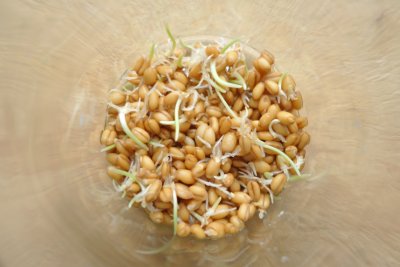
Sprouting, on the other hand, involves wetting seeds to ‘awaken’ the germ (which is simply a potential plant) contained in each seed, to produce a few millimetres of root and perhaps shoot. These sprouted grains can be added to dough in a number of forms: whole (fresh or dried), puréed or pulped, or dried and milled to produce flour.
What are the advantages of using sprouts in bread?
They are whole grains, which is a great start. Beyond this, research results vary between test conditions and grain types but, generally, sprouting tends to improve their nutritional value. Enzymes transform storage compounds into ones the growing plant (and humans) can use more readily: starches are converted to simpler sugars, while proteins are degraded into amino acids and peptides. Some studies have found an increase in dietary fibre, perhaps due to formation of cell walls during germination.
Germination also significantly reduces the content of phytic acid (or phytate), plants’ main form of phosphate storage, which is concentrated in seed casings - bran. Phytic acid is sometimes referred to as an 'antinutrient', because binds with minerals (such as iron, calcium and zinc) so that the body is unable to make use of them. Reducing levels of phytic means that greater amounts of those minerals remain bioavailable.
Beyond nutritional considerations, sprouts also provide a completely different dimension of flavour and texture. They can impart herbaceous notes not found in unsprouted grains and, when used fresh, add an interesting moisture content.
How can we use sprouts in bread dough?
As mentioned above, there are three basic options: first, use them whole, adding them at the end of the kneading process. For this method, I recommend sprouts from smaller or softer seeds, such as alfalfa, quinoa, or amaranth. Wheat, rye, or rice can also be used in this way and work very well in the crumb, but they can become too dry and hard in the crust.
A second option is to grind the fresh sprouts in a meat grinder, food processor or mortar and pestle to produce a purée or pulp. I personally use this option primarily, adjusting the processing level according to the type of grain and the final texture I want for the bread. These first two options are very easy to use in both home and professional baking, as they don't require extensive equipment.
The third, which is very popular in artisanal baking in the United States and some countries in continental Europe, is flour milled from dried sprouts. It's a bit more complicated as it involves more steps and equipment: drying the sprouted grains at a low temperature and then milling them, preferably with a stone mill.
These flours give very good results without compromising the bread's structure. They can also allow for shorter fermentation times, as many of the processes involved in a long fermentation (flavour development, changes to gluten structure etc.) also occur during germination.
An optional step beyond sprouting is malting. This involves drying and then roasting the germinated grains, providing not only flavour but also some benefits due to their enzyme content.
The use of sprouted grains, in any of the forms described, presents very interesting avenues of experimentation for bakers seeking to create nutritious bread full of flavour and texture.
Martín runs the Spiga microbakery and baking school and teaches at Le Cordon Bleu Peru.
Originally published in True Loaf magazine issue 64, September 2025.
Got something to share?
See YOUR words in print , my baker’s dozen and my favourite bakery.
See also

Published Monday 19 January 2026
Real Bread Campaign: Finding and sharing ways to make bread better for us, our communities and planet.