

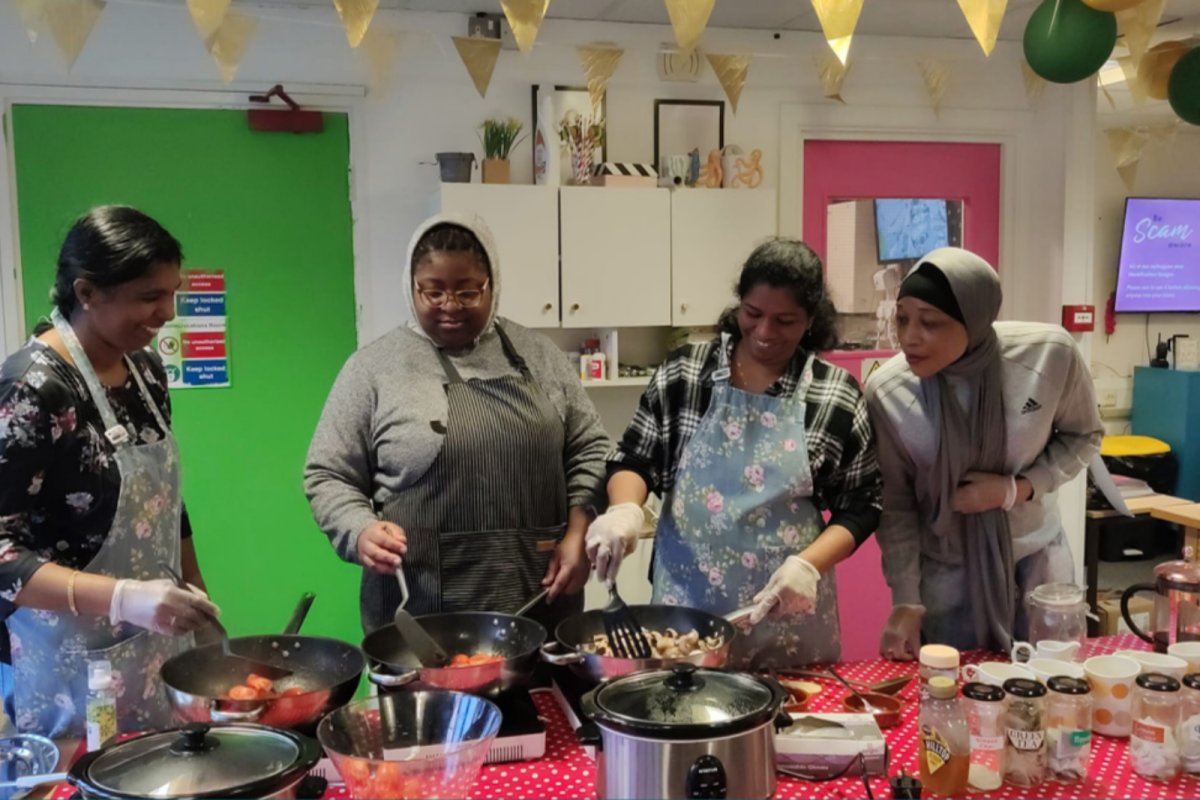
 Community hot meals in Newham. Credit: Newham Food Alliance

New £10 million to boost food access in deprived places, but long-term commitment unclear
Sustain welcomes Defra's Good Food Neighbourhoods funding to 45 of England's most deprived areas, whilst calling on Government to turn the one-off fund into lasting community food infrastructure, backed by a legal duty at both national and local level to enable equitable access to healthy food, integrated with cash-first solutions.
The Sustain alliance has welcomed Defra's announcement of the Good Food Neighbourhood funding, which will see almost £10 million go to 45 local authorities in England with the highest levels of deprivation and childhood obesity.
This works out as £222,000 for each council to develop local solutions, which could include "community food shops, mobile greengrocers, lunch clubs, community kitchens, and cooking and nutrition programmes". The money can also strengthen councils' capacity to plan for and meet local food needs.
Over half of the selected 45 places are members of the Sustainable Food Places network that Sustain helps to coordinate (with Soil Association, Food Matters, Food Sense Wales and Nourish Scotland), each with a food partnership working to improve the local food system. Several other recipients are in areas where cohorts of councils are engaged with Sustain’s Good Food Local benchmarking of local authority action on food.
Kath Dalmeny, Chief Executive of Sustain, said:
"This is a welcome signal that the Government understands the essential role of local authorities, food partnerships and community food enterprises working together to build the lasting infrastructure that enables low-income communities to access the good food they need.
Alongside the priority of cash-first solutions and nutritional safety nets such as free school meals, investment in community food assets such as community kitchens, retail outlets and sustainable food supply chains is a vital way to build connections, local jobs and food system resilience.
Sustain looks forward to working with the places and the Good Food Neighbourhoods programme to ensure that this work is joined up with policy, investment and learning that can result in enduring change.”
Lucy Antal, who helps run mobile greengrocer Queen of Greens with her team at Alchemic Kitchen CIC, operates in two of the 45 areas that will receive Good Food Neighbourhoods funding.
Lucy Antal said:
“In some areas of Liverpool and Knowsley it is easier to buy a vape than an apple. Making fresh fruit and veg accessible to all, irrespective of location and income, is an achievable dream, as Queen of Greens has demonstrated, welcoming 10,000 people from under-served households, enthusiastic to access affordable fresh food. This builds physical and mental health, enabling people to reach their full potential. Yet it takes a lot of logistical work and organisation, so this funding – and explicit commitment to supporting mobile greengrocers like ours – is very welcome news!”
Queen of Greens works with Alexandra Rose Charity to make the fruit and veg affordable, and is supplied by Kindling Farm and Organic North Cooperative Wholesalers. The work is also supported by Feeding Liverpool, the city’s food alliance. Queen of Greens has also launched a crowdfunder to help secure the future of this vital service.
Sustain, our alliance members and the Sustainable Food Places network, supporting coordinated and community enterprise initiatives, have long argued that local food partnerships and alliances – established over the past 15 years – are critically important infrastructure for a fair, accessible and resilient local food system.
The scale of the problem of inadequate food access, however, far exceeds the scale of the response. The Government's own figures show that 9% of people lived in food insecure households in 2024/25, while children living in the most deprived communities are significantly more likely to experience obesity and related health inequalities. Just over £200,000 per council cannot close that gap, and a time-limited fund will not build the capacity, systems and infrastructure that local food systems change depends on.
Glen Tarman, Sustain’s Director of Policy and Advocacy, said:
"The Good Food Neighbourhoods Fund is welcome, but cannot tackle the structural drivers of household food insecurity. Those drivers are low incomes, inadequate social security and a food system that makes healthy food the less accessible and affordable choice. If this is the start of meaningful change, it will require long-term funding and coherent government policies, so that everyone can afford life's esssentials, including food, with thriving community food infrastructure making good food accessible everywhere. We also want to see a Good Food Bill that puts duties on local and national government to drive food system change, and to be held to account for doing so."
Sustain is calling on Government to:
- Tackle the root causes of food insecurity by prioritising cash-first solutions, nutritional safety nets (such as free school meals and Healthy Start), and ensuring investment in community food capacity, assets and infrastructure, as set out in Sustain's Four Pillars of Dignified Food Access.
- Invest and support for Good Food Retail SMEs and community food enterprises that sell healthy, sustainable food at affordable prices while building community wealth, building on good practice and innovation developed as part of Sustain’s Bridging the Gap programme.
- Treat the Government's Good Food Neighbourhoods programme as the foundation for lasting investment in community food assets and local food infrastructure, recognised in local retail, regeneration and planning policy. That means multi-year funding and permanent capacity for local food partnerships in every area, not only the 45 selected.
- Introduce a national Good Food Bill that would provide the legislative framework to accelerate national progress and action by national government and local authorities to prioritise cash-first solutions and equitable access to good food, particularly for people on low incomes.
Notes to editors:
- The funding covers England only. The full list of 45 recipient councils is published here on GOV.UK. The photograph accompanying this news item shows a community kitchen in Newham, which is one of the 45 recipient areas.
- The Sustainable Food Places network is a UK-wide movement that unites local authorities, communities and organisations to transform food systems and make healthy, sustainable food a defining characteristic of local communities. Over 120 UK places are now members of the Sustainable Food Places network, with local food partnerships implementing food strategies, of which 23 are among the 45 areas selected for Good Food Neighbourhood funding.
- Sustain’s Good Food Local programme is a national benchmarking platform to help local authorities drive food system change. Through Good Food Local, local authorities can track and drive meaningful action in their area while learning from others nationwide to help build healthy, sustainable communities.
- Sustain’s Four Pillars of Dignified Food Access, devised by groups working locally to address food poverty, provide the framework to achieve household food security while helping to end mass dependence on emergency food parcels.
Further note
This work runs alongside the Crisis and Resilience Fund (CRF) Alliance (see also the entry on the Local Government Association website), which brings together councils, government and partner organisations to support CRF implementation, share learning, build evidence and improve outcomes for people facing financial crisis.
This provides guidance to local authorities that will disburse £2.52bn of funds to support people in crisis in England, over a three-year period, and to build financial resilience to prevent future crisis.
The CRF Alliance currently includes members of the Crisis Support Working Group (CSWG), other third-sector organisations (including Sustain and the Independent Food Aid Network), academic researchers, the Local Government Association (LGA), councils, and the Department for Work and Pensions’ (DWP’s) CRF team.
Sustain's Chief Executive Kath Dalmeny is currently Chair of the CRF Alliance, and Sustain's Food Poverty Campaign Coordinator Isabel Rice coordinates a range of work to support local authorities implement the CRF guidance effectively, and to connect with frontline charities and advice services that can help people in crisis, and help to build financial resilience longer term.

Sustainable Food Places: Network bringing together over 100 local food partnerships.




Sustain
The Green House
244-254 Cambridge Heath Road
London E2 9DA
020 3559 6777
sustain@sustainweb.org
Our mission is to catalyse systemic change in the UK’s food and farming system – securing a healthy, fair, and sustainable future for all people, nature and a stable climate.
© Sustain 2026
Registered charity (no. 1018643)
Data privacy & cookies
Icons by Icons8
