

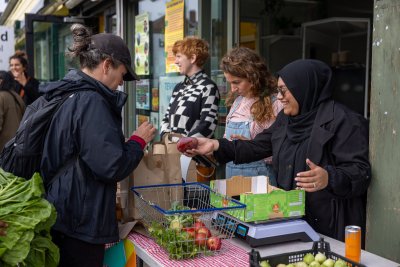
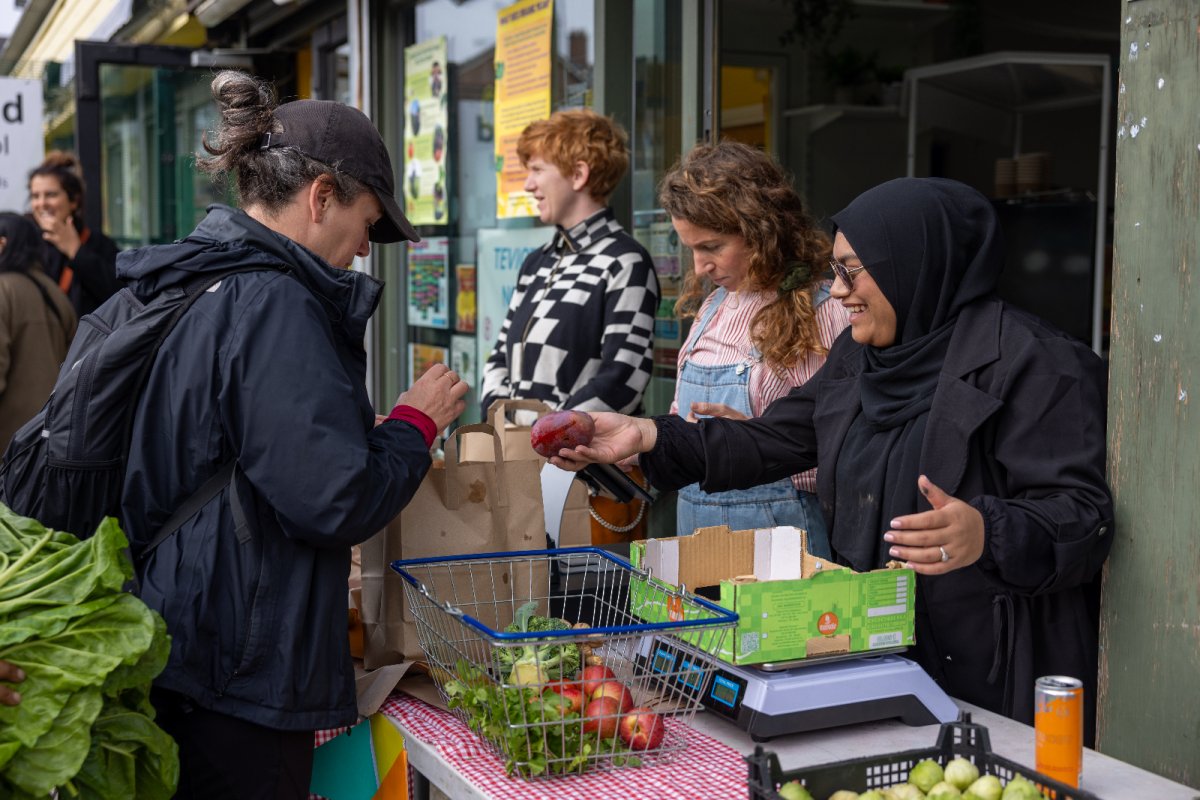
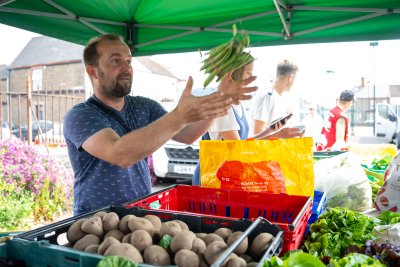
 Buying organic veg at Tower Hamlets Food Co-op. Credit: Eleanor Church

Rising food prices and extreme weather mean we need a new way to shop, argues Sustain report
The UK just recorded its hottest May day on record, while food prices are now main worry for most Britons. We need new ways to shop that connect climate-friendly growers with shoppers and keep money in communities, says latest Sustain report.
A new report from Sustain's Bridging the Gap programme argues innovative retail solutions such as voucher schemes and mobile greengrocers can connect local organic growers to low-income communities and keep money circulating locally, leading to more resilient, stronger communities.
With food inflation rocketing and extreme climate change exposing the fragility of the current UK and global food systems, the report How organic in local shops benefits people and communities spotlights alternative shopping incentives that make healthy, climate-friendly food more accessible. It contends that deploying schemes, similar to the existing Healthy Start or Best Start schemes, could offer an opportunity to achieve multiple benefits for people, their local communities and planet.
The report is the third in the Bridging the Gap series that looks at how to make changes across the supply chain to fix the UK food system.
Looking specifically at retail, this new publication highlights six pilots established by the Bridging the Gap programme across the UK which successfully increased access to climate and nature-friendly fruit and veg for low-income communities. In the Cardiff pilot, over 120 households that were previously unable to purchase organic fruit and veg were able to do so using the Planet Card, which put £11 per week in their pockets for use at Cardiff Farmers Markets. As a result, households increased vegetable intake by over 10%, while local organic farmer Pawel Wisniewski increased sales by over 10%.
Meanwhile in areas of Liverpool where fresh fruit and veg were hard to come by, mobile greengrocers the Queen of Greens is bringing organic produce closer to people’s homes, building community and enabling people to access food that they feel is best for them.
The report comes just as the UK has recorded its hottest day in May on record. The week before, the UK’s independent climate advisers The Climate Change Committee warned that food prices will continue to soar and UK farming will become untenable unless the UK adapts to climate change.
The cost of living remains a chief concern for most Britons, with food prices cited as the number one concern in the most recent Food Standards Agency tracker. The Government has suggested asking major supermarkets to cap the price of basic goods as a measure to tackle food inflation, a move which generated vigorous debate online. Author of the 2022 National Food Strategy, Henry Dimbleby, argued via LinkedIn that capping prices on certain foods will lead to less availability of basic goods and price hikes elsewhere, while James Meadway in The Guardian said price caps can be part of the solution to soaring food prices.
Sustain argues pushing independent retail solutions that offer incentives to shop sustainable produce can create a ripple-effect of benefits for the wider community. The report calculates that by enabling people experiencing a low income to access organic by subsidizing the price, can benefit local economies and communities to the tune of £8.78 return on every £1 of public money invested.
The Bridging the Gap research shows that even in a cost of living crisis, eating healthy and chemical-free food remains a priority for shoppers. Over four years, it developed retail solutions for these two apparent contradictory shopping concerns: needing food that is affordable, and wanting food that is free of chemicals, which often comes at a premium.
A shopper at Bridging the Gap’s Tower Hamlet’s food Co-op in the Teviot Centre said:
“I collect Rose Vouchers at Chrisp Street Children Centre but I spend them at the Teviot Centre and not at Chrisp Street Market. I think at the market the produce is stored for a long time and it’s not organic, but at the Teviot stall the produce is fresh. Organic is more healthy and I like the taste. It’s so much fresher.”
In the Edinburgh pilot, local organisation Edinburgh Community Food, established a veg stall at the centre of low-income community, selling locally grown organic produce. One regular customer said:
“Shopping here has improved the quality of my life both mentally and physically. It’s a real pleasure visiting each week and I would miss it dreadfully if it was no longer functioning.”
Hannah Gibbs, report author and Bridging the Gap programme manager said:
“Families across the UK are really struggling with cost‑of‑living pressures and without faster action to adapt to climate change, food shortages and price shocks will only get worse. The Government needs to start investing in supply chains and affordability that help more people on low incomes buy and eat organic. These innovative retail solutions from our latest report show how to help grow the market for climate and nature-friendly food and enable dignified choices for everyone that improve health and wellbeing.”
Amy Deptford, Head of Advocacy, Impact and Communications at Alexandra Rose Charity said:
“Families using Rose Vouchers have told us how important it is to be able to buy organic fruit and veg, often for the first time, especially in areas flooded with shops selling junk food and takeaways. Parents also tell us that their children are developing a love of fruit and veg, which can shape lifelong health and well-being.
Rose Vouchers have helped to direct consistent trade to the co-op, helping to stabilise the business and improve access to fresh produce where people live.
These pilots show that when you combine affordability, accessibility and support for local healthy food retailers, you can begin to shift the wider food environment, creating lasting benefits for residents across Tower Hamlets.”
Pearl Costello, Sustainable Food Places Manager at Food Sense Wales, who helped manage the Planet Card incentive scheme in Cardiff, said:
“Planet Card was co-created with communities, growers, market managers and partners here in Cardiff, and the learnings will now inform the next stage of our work to improve access to good food in the Welsh capital.
However, the much bigger opportunity here is building on what this Planet Card pilot has shown is possible and rolling out at a much bigger scale: for local authorities and health boards to work with Local Food Partnerships to explore an Organic Fruit and Vegetable Voucher Scheme for low-income households all across the UK."
This Bridging the Gap report series looks at how to build ethical supply chains that support farmers and local communities, and bring organic fruit and veg to more people.
Nine co-designed pilots bridged the gap - between fruit, veg and pulses, grown using organic methods by Small and Medium (SME) farmers - and people on low incomes, in both retail and school settings. Through action-based research the programme found that it is possible to overcome barriers and identified how these approaches could be scaled to fix the UK food system.
Read latest report: How organic in local shops benefits people and communities.

Bridging the Gap: Demonstrating ways to make organic food more accessible via farmer-focused supply chains.

Sustain
The Green House
244-254 Cambridge Heath Road
London E2 9DA
020 3559 6777
sustain@sustainweb.org
Sustain advocates food and agriculture policies and practices that enhance the health and welfare of people and animals, improve the working and living environment, promote equity and enrich society and culture.
© Sustain 2026
Registered charity (no. 1018643)
Data privacy & cookies
Icons by Icons8
