

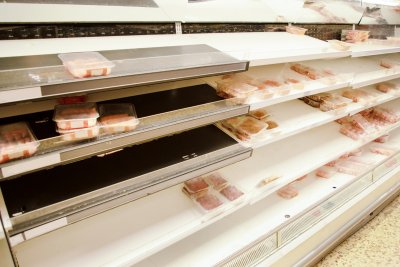
 Large UK supermarket selling out of food down the meat aisle. Copyright: jayfish | istock
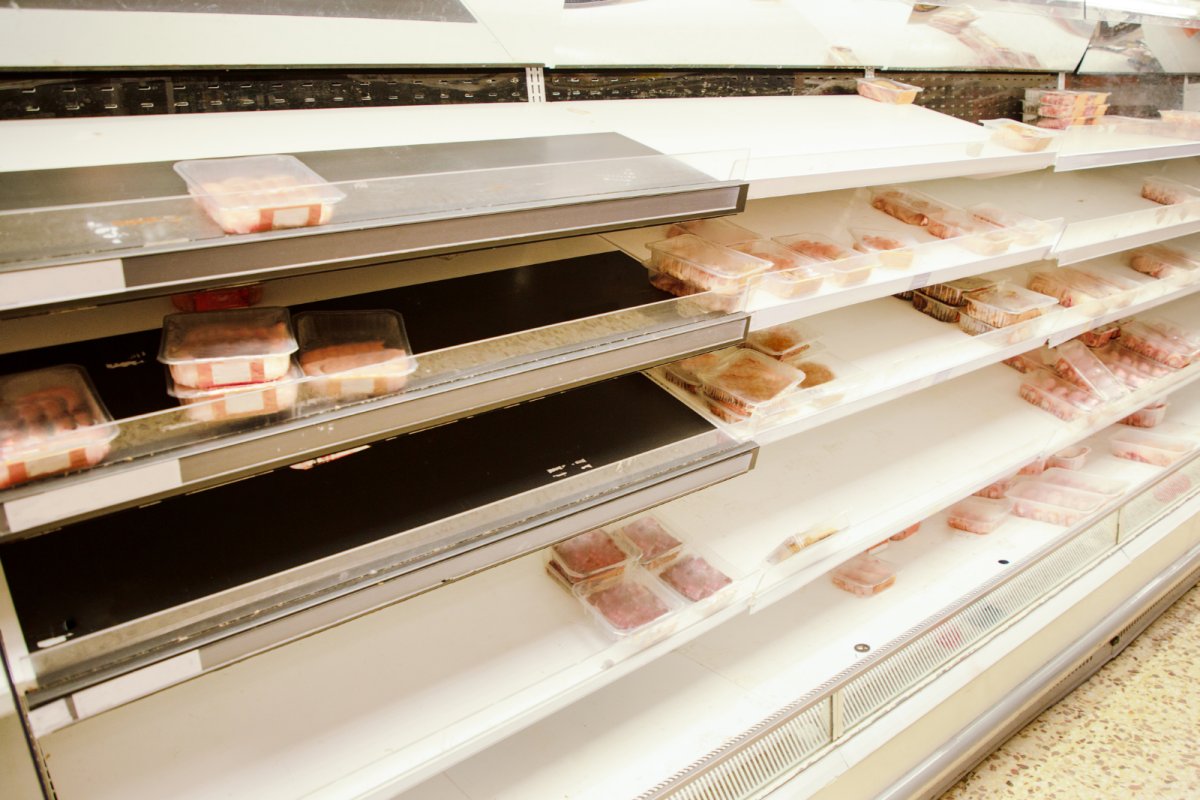

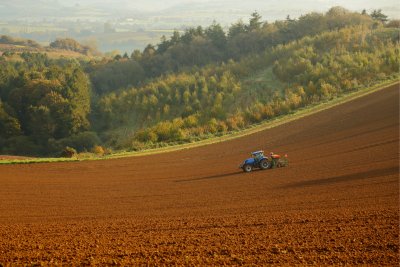
Food prices will rocket and UK farming will be untenable unless we adapt to climate, warns watchdog
The Climate Change Committee’s latest report finds farming losses are already costing hundreds of millions of pounds a year, and warns that without faster action to adapt to climate change, food price shocks and supply disruptions will worsen - hitting the poorest hardest.
The UK’s independent climate advisers have issued a stark warning about the threats facing British farming and the food available to UK citizens, as the Climate Change Committee (CCC) published its Fourth UK Climate Risk Independent Assessment (CCRA4-IA).
The CCC predicts without adaptation, the amount of high-quality farmland in England and Wales will shrink from 38% to 11% by 2050 if the planet warms by 2°C. The CCC also predicts an extreme year of heat stress could create agricultural losses up to £2.3 billion in the 2030s.
The CCC also warns that simultaneous crop failures across major global producing regions - an increasingly likely scenario as climate impacts intensify - could trigger significant food price spikes and supply disruptions. By 2050, 52% of the legumes and 47% of the fruit imported into the UK are projected to come from climate-vulnerable countries.
The report, ‘A Well-Adapted UK’, rates food security as an area requiring “critical action” across all four UK nations - the highest tier of concern in the assessment framework - and dedicates substantial new analysis to the accelerating economic and social costs of inaction.
For Sustain, the report reinforces the central argument the alliance has been making to government: that food security, food prices, farming viability, and the climate and nature emergency are inseparable challenges that require joined-up, adequately resourced policy responses - not incremental tweaks.
Farming already in the red
The report is clear that farming will need to adapt to remain viable in a changing climate.
The CCC has advised that Government needs to significantly change policy to support the farming sector to adapt to climate change, with urgent action needed in the next two years, including:
- improving access to training and advice so farmers can uptake adaptation measures (such as storing water on farms, changing farming practices, and varying crop production);
- removing regulatory barriers for vital on-farm infrastructure such as water storage; and
- amending farm subsidies (such as the Environment Land Management Schemes) to incentivise the transition to more climate-resilient farming practices.
Significantly, the report proposes the UK should have a 60% domestic food production target.
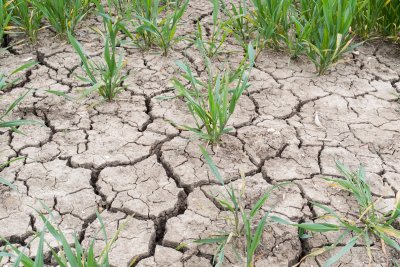
The impacts of climate change are already affecting our fields and farmers. In 2025, farmers in England were expected to lose over £800 million due to the impacts of the hot and dry spring and summer season. For arable farmers, oat and wheat crop yields fell more than 10% below the ten-year average in 2025. These weather events are no longer isolated incidents, and the report warns that, without adaptation, UK farming will continue to be placed under increasing strain.
Georgina Edwards, Sustainable Farming Campaign Officer at Sustain, said:
“This report confirms what farmers across the country are experiencing on the ground: weather extremes are no longer exceptional - they are becoming the norm.
We urgently need a government response equal to the scale of the problem. Government’s highly anticipated 25 Year Farming Roadmap must give the sector confidence and clarity of how the UK will transition to adaptive, nature-friendly farming systems.
Alongside this, the Government’s Environmental Land Management Schemes need to drive this transition by financially de-risking the uptake of resilient, agroecological, farming practices that can withstand the mounting climate threat.”
A food system under strain
The report is equally urgent on food security beyond the farm gate.
Food price inflation reached its highest point in 45 years in 2023, with the 2022 European heatwave alone responsible for pushing UK food price inflation up by around 49% that year. The CCC is clear that lower-income households bear the greatest burden: they spend 14.3% of their income on food, compared to 11.3% for average households.
The report calls on government to mandate climate risk disclosure for large food businesses including supermarkets, to undertake systemic stress-testing of food supply chains, and to consider emergency stockpiling of critical food supplies. It also calls for targeted social policies to protect vulnerable households during food price shocks.
Ruth Westcott, Climate and Nature Emergency Campaign Manager at Sustain, said:
“The Climate Change Committee is telling us what food campaigners have said for years: climate change is already making food more expensive and less secure, and it is people on low incomes who pay the price. A food system that leaves people unable to afford a nutritious diet when harvests fail or supply chains are disrupted, is not resilient - it is unjust. The report also offers hope. We have all the solutions we need, and the Government must use the Food Strategy and other policy processes to shift the UK in the direction of low-emission farming; more vegetables, pulses and legumes, and less meat and less industrial farming. These are the steps to address food price hikes and protect the environment upon which our food production depends. We need to see a Good Food Bill in this Parliament putting food security on a statutory footing for the long term.”
The political moment
The report lands at a pivotal moment. The Government’s Food Strategy needs greater momentum this year, and ministers in more dialogue with civil society and farming organisations about how its ambitions can be achieved. The CCC explicitly states that its food security objective is “consistent with the UK Government’s ambition in its forthcoming food strategy” – which creates a direct line of accountability if the action matches the intended outcomes.
The assessment also carries institutional weight for the farming sector: it is the first to rate risks to agriculture as requiring “more action needed” across all four UK nations, and it calls for farming subsidies to be explicitly aligned with climate adaptation - a direct challenge to the move forward on the design of Environmental Land Management schemes.
Glen Tarman, Director of Policy and Advocacy at Sustain, said:
“The Climate Change Committee has given the Government no room for ambiguity. Food security is a critical risk. Farming is under threat. And the window for the kind of policy action that can make a difference is narrowing. With the Food Strategy process underway, the Farming Roadmap in preparation and COP30 on the horizon, ministers have both the mandate and the opportunity to act decisively. Sustain and our alliance of over 100 organisations will be pushing hard to make sure they take it.”

Sustain: Sustain The alliance for better food and farming advocates food and agriculture policies and practices that enhance the health and welfare of people and animals, improve the working and living environment, enrich society and culture and promote equity.


Sustain
The Green House
244-254 Cambridge Heath Road
London E2 9DA
020 3559 6777
sustain@sustainweb.org
Sustain advocates food and agriculture policies and practices that enhance the health and welfare of people and animals, improve the working and living environment, promote equity and enrich society and culture.
© Sustain 2026
Registered charity (no. 1018643)
Data privacy & cookies
Icons by Icons8
