

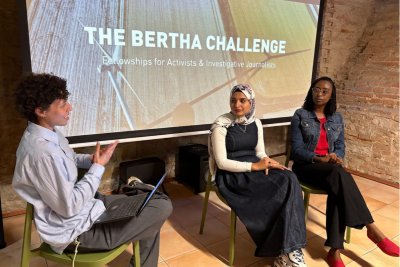
 Lily O'Mara hosts discussion at the 2026 International Journalism Festival with Bertha Challenge Fellows Eman Mounir and Cynthia Gichiri. Credit: Lily O'Mara
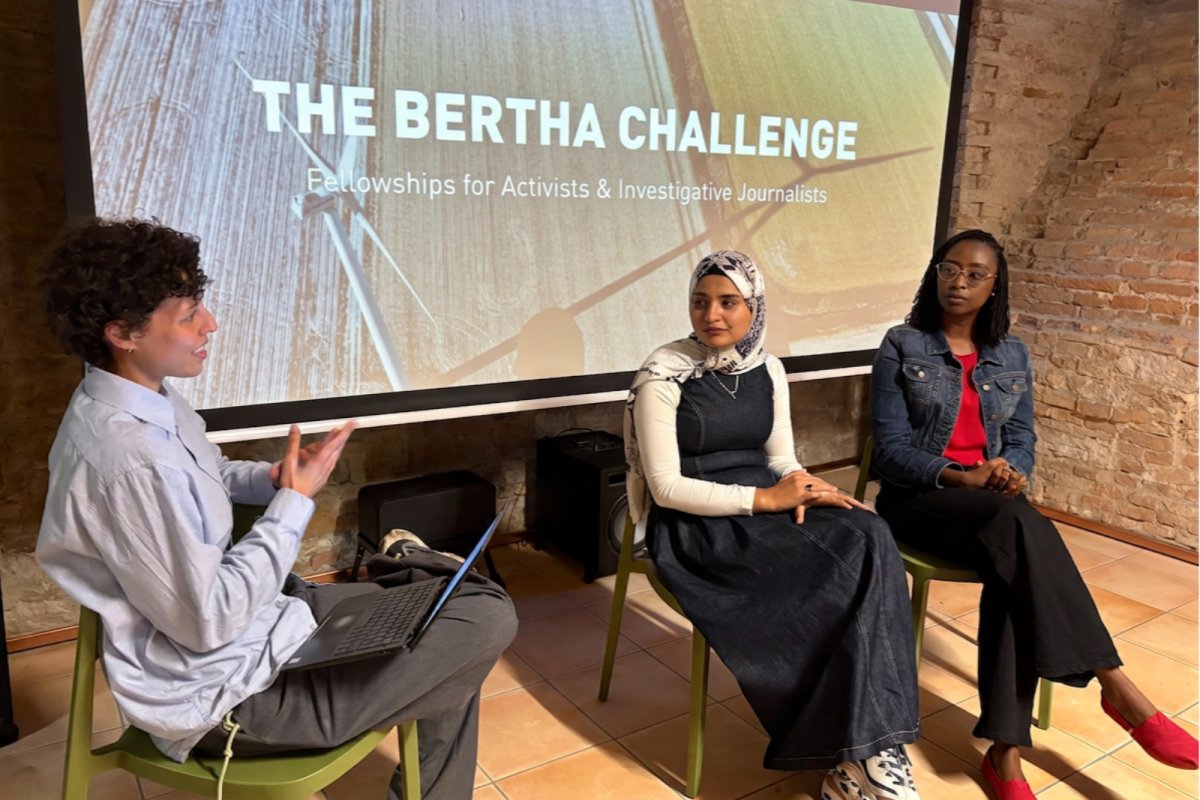

The Bertha Fellowship at the International Journalism Festival
Lily O'Mara, Sustain's Climate Campaigner, reflects her time hosting sessions at the International Journalism Festival in Perugia with Bertha Challenge Fellows Eman Mounir and Cynthia Gichiri, and what it says about the future of journalist-campaigner collaboration in the climate crisis.
It would be impossible to attend a journalism festival in 2026 without feeling the weight of this moment. Press freedom is under sustained and deliberate attack. Climate campaigners and activists are seeing hard-won gains reversed and the climate crisis is deepening in ways that put international food security at serious risk. Extreme weather, the displacement of people from their land, soil degradation, water scarcity and the increasing fragility of global supply chains are converging with conflict and economic instability to push hunger to levels the world has not seen in decades. The World Food Programme warned in early 2026 that up to 45 million more people could be pushed into acute hunger in the next coming months. Even before the successive global crises that have dominated the headlines this year somewhere between 638 and 720 million people faced hunger globally in 2024, and the world remains far above pre-pandemic levels with little prospect of meeting the 2030 target of zero hunger. The food system sits at the centre of all of this.
In this context, it would be easy to become defensive and insular, to retreat into our own disciplines and organisations and wait for conditions to improve. We think the opposite is needed. The more hostile the environment, the more important it becomes to build genuine, sustained alliances across the people doing this work: journalists, campaigners, scientists, lawyers, communities. The question is how to do that without pasting over the tensions in what we each do, and where we come from, and why.
That is the question three Bertha Challenge fellows took to Perugia in April, for the International Journalism Festival (IJF). We include Sustain’s Lily O'Mara, Eman Mounir and Cynthia Gichiri - two investigative journalists working on food, land and agriculture in Egypt and Kenya, respectively. We met on the Bertha Challenge Fellowship in 2025 where we each worked on an issue related to food and farming injustice in our respective countries. Broadly speaking, we were hugely successful in our endeavours. Eman’s project, The Green Paradise, investigated six decades of land reclamation policies in Egypt, revealing how rising salinity and the expansion of large corporations have deepened the suffering of Indigenous farmers in Siwa Oasis, as well as small-scale investors in Moghra and women agricultural workers in Fayoum. Cynthia’s two-part documentary, The Seed Syndicate, investigated and exposed the corporate and political powers behind the Seeds and Plant Varieties (Amendment) Act 2012, a law that criminalised the act of saving, sharing and selling indigenous seeds; disenfranchising millions of small scale farmers who produce the bulk of food consumed in Kenya while favouring commercialised and hybrid seeds. Lily contributed to the refusal of one of the largest megafarms in Europe.
The fellowship was split into two cohorts - the activists (where Lily sat) and the journalists, where Eman and Cynthia worked. At the close of that year, we started asking each other the kinds of questions about collaboration and independence and political conditions between campaigners, journalists and other stakeholders in the climate and food space that felt important to test in public. The IJF, one of the largest gatherings of international journalism practitioners in the world, felt like the right place to do that.
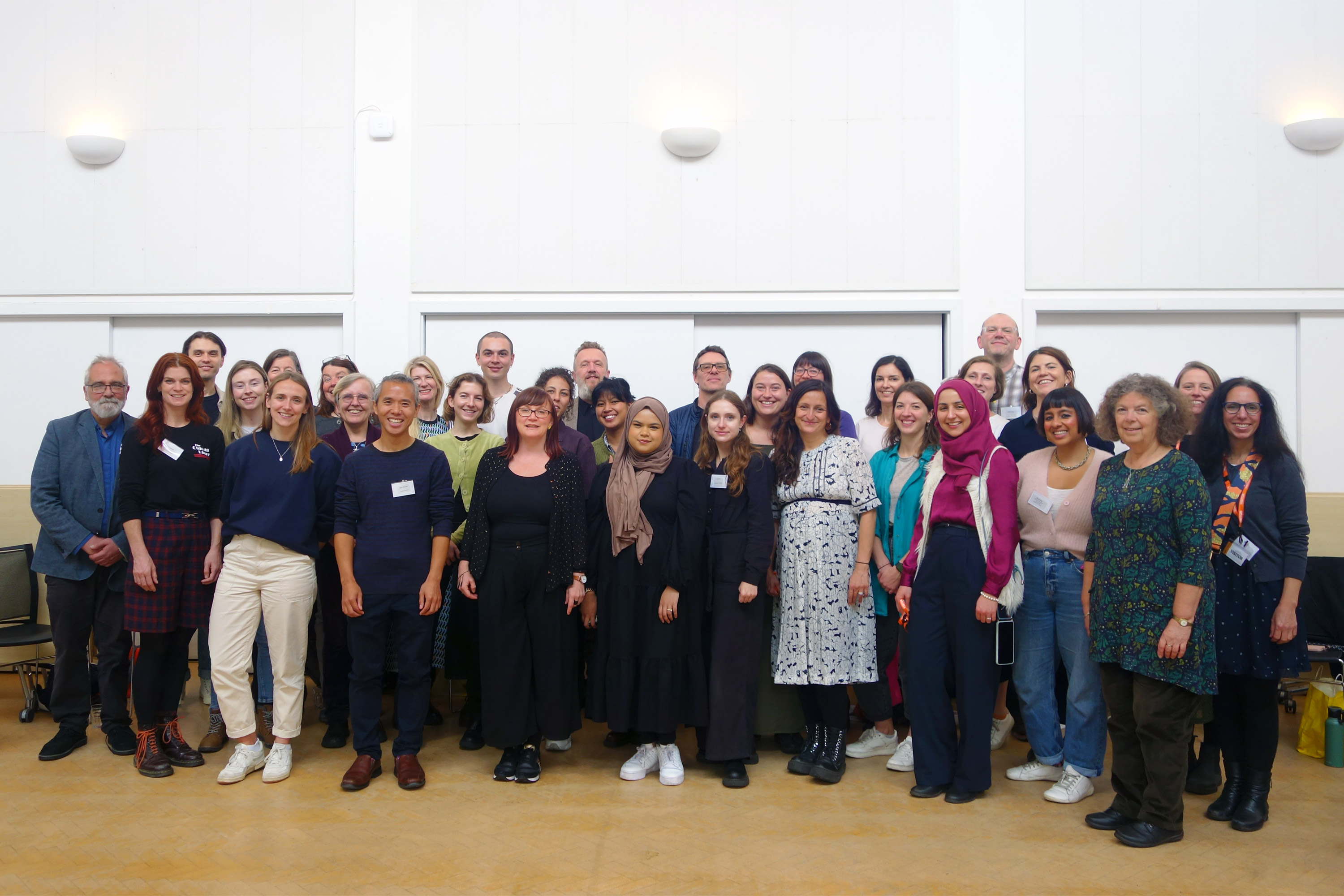
There were over 200 sessions and fringe sessions on offer, spanning from government crackdown on journalist integrity, practical workshops on AI and social media and discussions on how journalists can double up as community stewards by enhancing trust, participation and sustainable engagement in matters of public interest. We ran two side sessions at the Umbra Institute, a university space in Perugia's old town, funded by the Bertha Foundation's Connect Fund - one a film screening of Cynthia’s and Eman’s work and another a panel discussion and facilitated conversation about the reasons why journalists should look outward in their working relationships, and the urgency of cross-sector collaborations between campaigners, journalists and other stakeholders.
Our first session was a screening and Q&A of Eman and Cynthia's film, its international debut. The room was full and the conversation that followed was rich - spanning the ethics of documentary journalism, how to properly balance responsibility and integrity to the people whose stories you are telling, and on how you make work rooted in a specific political context reach audiences who do not share it.
In her films, Eman produced short documentaries accompanying her multimedia investigations, bringing a deeply human perspective to the families and individuals affected by rising salinity. In her film Bitter Land, she documented the story of Alaa El-Din’s family, who leased land in the Moghra agricultural project only to discover that the groundwater was entirely unsuitable for irrigation, with salinity levels far exceeding the permitted limits for agriculture.
Cynthia’s film, The Seed Syndicate, is a two-part award-winning investigation into the Seeds and Plant Varieties (Amendment) Act 2012, an infamous law that was unconstitutionally passed more than a decade ago to criminalise the sale of “unindexed seeds” which in simple terms mean indigenous seeds. While the law mainly favoured hybrid seeds patented to global and a few local agro-companies, it locked out local, small scale farmers from the seed industry and disregards their right to seed sovereignty. The documentary exposes the events leading to the passing of this law, the local and international forces behind it, the irregularities and illegalities surrounding it and its implication on indigenous seed-growing, an age-old practice that is hailed in Africa for keeping the region food secure and climate resilient future generations.
Cynthia Gichiri:
The Seed Syndicate is not just about Kenya, but also other indigenous communities around the world and their right to use, preserve and exchange traditional knowledge and expertise on agriculture in the face of climate change. It is also about nature’s way of correcting its own misgivings through cross-pollination of seed varieties, allowing them to adapt to the slightest changes in the environment and other practices that have sustained agriculture and food production for generations. Long before the introduction of hybrid maize seed varieties in Kenya, for example, our fore-fathers enjoyed a variety that could withstand adverse weather conditions such as prolonged rains and droughts, and a sorghum variety that would require just one cycle of rain to germinate, grow and mature. While there is a need for modern and technological interventions to mitigate the effects of changing weather patterns and climatic conditions, the story demonstrates why these solutions should also integrate indigenous knowledge, better known as traditional knowledge.
In addition, while change is good, it must be transparent, inclusive and devoid of machinations. Any alteration on a country’s sovereign constitutional law; no matter how good the intention, should follow due processes such as public participation. While this right is enshrined in Article 10 (2) (a) of Kenya’s 2010 constitution, the documentary shows that it was clearly disregarded. It also documents how the SPVAA 2012 was passed in haste, and after intense lobbying by the private seed sector, which forced Kenya’s 10th parliament to unconstitutionally align the law with the 1991 UPOV Act, four years before it was officially ratified.
Thus, even on global platforms such as IJF, it is our duty as journalists to stand firm as defenders of the rule of law in our respective countries and the voice of the voiceless.
The following day we held our session on cross-sector collaboration in the climate crisis, which, as the resident campaigner in the space, Lily chaired. Each of us presented concrete and compelling work: Cynthia on how working alongside lawyers and community groups gave her reporting reach and consequence it could not have achieved alone; Lily on how Sustain's impactful work significant wins on health and climate in recent years was strengthened by building sustained relationships with investigative journalists, scientists and legal experts; and Eman on how the political conditions she operates in shape who she can work with and how.
Eman Mounir:
I believe that working within a complex political environment has pushed me to rely more heavily on science in my investigative work. Climate and environmental reporting are inherently tied to science, yet the scientific dimension is often overlooked in investigative journalism. For me, strengthening this aspect is essential. Policymakers and officials are often far more willing to engage with evidence when it is grounded in strong and verifiable scientific findings, and in some cases, the outcomes of my investigations have directly informed public discussions and responses.
I reflected on the ethical complexities of these collaborations and how they can be navigated responsibly. I discussed the importance of building transparent relationships between journalists and researchers, including clear agreements, proper attribution, protection of intellectual contributions, and ethical handling of scientific data and findings. For me, these collaborations should not be transactional or temporary, but rooted in trust, accountability, and a shared commitment to serving the public interest.
Lily O'Mara:
I made the case that there is so much we can learn from each other - good campaigners have the grassroots knowledge and connections, can translate stories into wins and long-term change. Good journalists can achieve credibility, national reach and the way to present a story that hits home. I talked about the climate team’s work with DeSmog and local press to impact change, and Sustainer Fran Bernhard’s health work with the British Medical Journal and the successes there. Each impressed upon the audience that campaigners are willing and able to work successfully with journalists and that where we are now conflated can be turned into a strength.
While our session attracted a strong, thoughtful and engaged crowd of journalists, there was a reticence when it came to talking openly about working with campaigners. I wonder if that is because our work can feel quite incompatible in some ways. Journalism is story-first and journalists move on. Of course, campaigning is often reactive and can move fast too, but in many ways we are in it for the long game. Policy work, which is central to what Sustain does, takes even longer. But I have loved building relationships with outlets like DeSmog as part of this role, and some of the work I am most proud of has come from finding ways to make those two things talk to each other. I’m not quite resolved on how we can better marry these together, but I think there is a lot more we could do.
Closing thoughts:
- We need to avoid universalism when making the case for collaboration. Journalist-campaigner collaboration looks very different depending on your political context, and has looked differently for me in London than it has for Eman in Cairo and Cynthia in Nairobi. Real solidarity means understanding that rather than assuming our model travels.
- The most useful thing UK organisations can offer international partners is practical support - be it funding, connections, genuine engagement.
- Climate and food is still sorely underrepresented - Several people at the festival told us ours were among the only climate sessions on the programme. The IJF convenes some of the most significant practitioners in global media, and food and agriculture remaining a niche track rather than a central concern is surprising. It is perhaps all the more reason that campaigners turn up to these spaces as collaborative partners.
- Let’s talk more! Joint funding bids, long-term partnerships, getting to know each other before the story exists - we are starting to see more of this and it is exciting. We want to do more of it.
You can watch Cynthia's film here and read about Eman's work here. Lily and the Sustain climate team's work to end intenisve livestock continues, so please check out the Food for the Planet webpage for campaign updates.

Food for the Planet: Helping local authorities to tackle the climate and nature emergency through food.

Sustain
The Green House
244-254 Cambridge Heath Road
London E2 9DA
020 3559 6777
sustain@sustainweb.org
Sustain advocates food and agriculture policies and practices that enhance the health and welfare of people and animals, improve the working and living environment, promote equity and enrich society and culture.
© Sustain 2026
Registered charity (no. 1018643)
Data privacy & cookies
Icons by Icons8
