
Sustain / Real Bread Campaign / Recipes
Yuletide rye bread
A Russian inspired nut and raisin-studded festive rye.
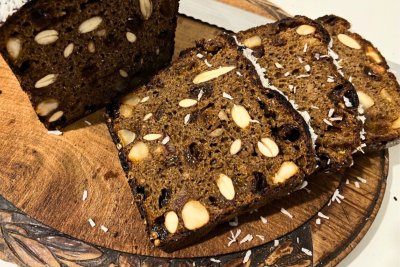




Andrew Whitley, who developed this recipe, says: ‘This is a festive development of the raisin Borodinsky bread that I started producing at my Village Bakery in Melmerby soon after I returned – with a sourdough starter and new understanding – from visiting friends and bakers in Russia in the early 1990s.’
Named after the Battle of Borodino (or perhaps Alexander Borodin), Borodinsky bread is a sourdough rye with malt and coriander. A raisin version is said to come from the Karelian region of northern Russia / Finland.
Unlike many Christmas bread recipes, this one has no added fat. As with German stollen, this bread will keep quite well if wrapped in parchment or waxed cloth or put in a (reused) plastic bag.
‘If you can resist it long enough, it will start to stale and dry out but will remain delicious. Try warming gently and spread with unsalted butter, or dunk in tea or coffee. ‘At this point, if you are sharing, you might wish your companions a happy Christmas, or С новым годом (S novym godom) – Russian for a good New Year.’
Ingredients
Makes one 1500g or two 750g loaves.
Production sourdough
85g active, mature sourdough starter (rye or wheat)*
250g wholemeal rye flour
415g warm water (at about 35°C)
Soaker
75g raisins
75g dates (chopped)
75g apricots (chopped)
75g almonds
75g Brazil nuts (chopped)
5g ground coriander
10g cinnamon powder
110g hot water (or fruit juice, rum or vodka)
Final dough
625g production sourdough (from the above)**
250g rye flour
5g sea salt
25g honey
5g cinnamon powder
5g grated nutmeg
10 g cardamom seeds (crushed)
75g water
500g soaked fruit & nuts (from above)
A little oil or fat for greasing the tin(s).
*if you haven’t got a sourdough starter, the Scotland The Bread website has a guide to nurturing one in about four or five days.
**the remainder goes back in your sourdough starter pot in the fridge.
Method
Mix together the production sourdough ingredients and leave to ferment at room temperature for 18-24 hours. In a separate bowl / container, combine the fruits, nuts and liquid, then cover and leave, shoogling a few times as it soaks.
The following day, sift the spices through the rye flour. Mix with 625g of the production sourdough, adding the water once you have mixed in most of the dry ingredients. The end result should be a pretty soft dough – more like the texture of a thick batter. Fold the fruit and nut mixture into the dough until well incorporated. It is hard for the naturally-occurring yeasts in sourdough starter to aerate a dough if it is too firm, so add a little extra water if the mixture seems too stiff.
Using wet hands and a smear of warm water on your worktop, tip / scrape the dough out of the mixing bowl – if making two loaves, divide it in two.
Lightly oil / grease the tin(s). Dip your hands in water and pick the dough up (a scraper helps here) and then shape it into an oval roughly the size of the tin. Smooth the surface with your wet hands and then slide the dough gently into the tin, trying to avoid touching the sides. There’s no need to pat it down or smooth it out as it will find its own level during the final rise.
Keep the dough loosely covered with something like a polythene bag to prevent the top of the loaf skinning over (which will also inhibit the rise), leaving plenty of space so the dough doesn’t make contact as it rises. This should take about 3-5 hours, depending on the vigour of your starter and the temperature of your kitchen. It will be ready for the oven when the surface of the dough looks a bit puffy, perhaps starts to break apart a bit, and doesn’t provide much resistance when gently pressed with a moistened / oiled finger.
Heat the oven to 180°C (fan) and bake for 20 minutes, then reduce to 170°C for another 30 minutes or so. The loaf will colour up quite a bit due to the sugars in the fruit. To allow enough time for the loaf to bake through without catching / burning on top, you may need to cover it with a tray or foil after the first half an hour or so.
Turn the loaf out onto a wire rack and leave to cool fully before slicing – ideally leave overnight as rye breads can be gummy when cut straight away.
Optional finishes
As soon as the loaf comes out of the oven, baste the top with a tablespoon of honey (warmed in a small pan first), then immediately sprinkle with medium or fine coconut as ‘frosting’. Alternatively, you can dust the cooled loaf with icing sugar, though this will take up moisture and disappear over time.
Baker’s tips
Andrew says: ‘Scotland The Bread organic rye flour is naturally malty in flavour, so this recipe doesn’t need extra malt. I’ve substituted a small amount of honey, which is also traditional in Russian baking, but really there’s sufficient sweetness for most tastes from the dried fruits.’
Note that as fruit and nuts account for a third of the mix, and they don’t expand as the dough rises, this bread is heavy for its size. It should, therefore, fit into a 'standard' 2lb / 900g tin, or two 1lb / 450g tins.
About the baker
In 1976, Andrew Whitley left London and headed to Cumbria, where he created the wood-fired, organic Village Bakery Melmerby. A visit to Russia in the early 1990s led to him becoming an advocate of genuine sourdough bread. Andrew moved on in 2002 to found Bread Matters, publishing the award-winning book of the same name in 2006. In 2008 he joined forces with the charity Sustain to launch the Real Bread Campaign and later published the book Do: Sourdough. In 2012, Andrew and Veronica Burke co-founded Scotland the Bread.
Recipe text © Andrew Whitley / Bread for Good Community Benefit Society. Reproduction prohibited without written agreement of the copyright holder.
Social sharing
If you make this, please share your photo(s) with the world on social media using #RealBread and other relevant hashtags, linking back to this recipe. Better still if we can see you in the photo, too: #WeAreRealBread!
Please don't forget to tag us, and the recipe's author. You can find the Real Bread Campaign on:
- Instagram: @RealBreadCampaign
- Facebook: @RealBreadCampaign
Got a recipe to share?
If you’ve created / developed a recipe for Real Bread (or using stale bread), would you be happy for us publish it on our website? We're particularly keen to fill gaps in our A to Z of Real Bread.
We’d need the full recipe (in grams) and method. We'll also need a photo of the finished bread - horizontal / landscape (rather than vertical or square), 3:2 aspect ratio, at least 1500 x 1000 pixels.

Published Monday 15 December 2025
Real Bread Campaign: Finding and sharing ways to make bread better for us, our communities and planet.
Support our charity
Your donation will help support the spread of baking skills and access to real bread.