
Sustain / Real Bread Campaign / Recipes
Three ingredient flatbread
Flour, water, salt.
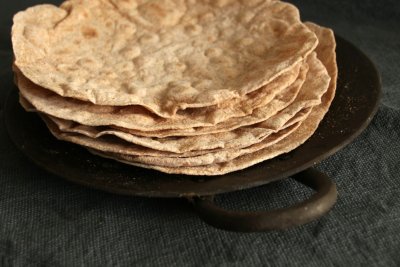




In some people’s minds, the term Real Bread conjures up crusty, well-risen, sandwich loaves; or hand-shaped, basket-proved boules. For many people round the globe, however, Real Bread is flat – chapati, tortilla, injera, lavash, arepa, matzo, näkkileipä, pitta, guokui…the list goes on.
Flatbreads can be soft or crisp; unleavened, long fermented by yeasts and bacteria naturally present in the flour, or raised using baker’s yeast. Some are enriched or laminated. There are types made with almost every flour, and ideal for being stuffed, wrapped round, topped with, or mopping up something delicious.
Forget industrial wraps, laced with humectants, artificial preservatives and emulsifiers: this is a cheap, simple, unleavened version, packed with fibre that you (including your heart and gut microbiome) will love!* Fun to make with kids, too!
Ingredients
300g wholemeal flour
225g water
3-4g salt (about ½ tsp)
(It’s not essential, but adding a few grams of your favourite fat or oil can help the flatbreads stay soft and pliable.)
Method
Mix the ingredients together until no dry bits remain. If the dough feels stiff (or if you’re comfortable making higher hydration doughs) add more water.
Cover the dough and leave for about an hour, giving it a stretch and fold a couple of times, until it’s smooth and stretchy. If not using the dough straight away, you can seal in a container and leave in the fridge for up to two or three days.
Divide the dough into pieces of equal weight (or, at least, size) depending on the thickness and diameter of flatbread you want: for example, 60-75g could make one about 20cm x 2mm. Shape each piece into a ball, dust it and your work surface with flour, then roll the dough out into a circle(ish) of the desired thickness and diameter, turning and flipping it during the process - the internet is awash with ‘how to’ videos.
Warm a frying pan over a medium heat, then cook each flatbread for a couple of minutes on each side, flipping it occasionally and perhaps pushing it down with a spatula to ensure even cooking.
Stack the flatbreads up, wrapped with a clean cloth or tea towel, on a wire rack or in a basket to cool. If not eating them the same day, flatbreads freeze well.
Stale flatbread can be revived with a splash of water and a few moments of heat (microwave, frying pan, oven – if it’s on already) or made into crispbread by leaving in an oven as it cools.
You can find more Real Bread (made using baker’s yeast or the sourdough process) in the recipes section of the Real Bread Campaign website.
*If you live with IBS, or another condition that is aggravated by fibre or FODMAPs, you might find making bread by the sourdough process allows you to enjoy wholemeal - but check with an expert on your condition first.
Recipe text © www.realbreadcampaign.org
Reproduction prohibited without written agreement of the copyright holder.
Social sharing
If you make this, please share your photo(s) with the world on social media using #RealBread and other relevant hashtags, linking back to this recipe. Better still if we can see you in the photo, too: #WeAreRealBread!
Please don't forget to tag us, and the recipe's author. You can find the Real Bread Campaign on:
- Instagram: @RealBreadCampaign
- Facebook: @RealBreadCampaign
Got a recipe to share?
If you’ve created / developed a recipe for Real Bread (or using stale bread), would you be happy for us publish it on our website? We're particularly keen to fill gaps in our A to Z of Real Bread.
We’d need the full recipe (in grams) and method. We'll also need a photo of the finished bread - horizontal / landscape (rather than vertical or square), 3:2 aspect ratio, at least 1500 x 1000 pixels.

Published Wednesday 21 January 2026
Real Bread Campaign: Finding and sharing ways to make bread better for us, our communities and planet.
Support our charity
Your donation will help support the spread of baking skills and access to real bread.