

Sustain / Real Bread Campaign / Articles
A view from the farm bakery
You might think that running a bakery surrounded by wheatfields is ideal but, says Hilary Chester-Master, it still has its challenges.
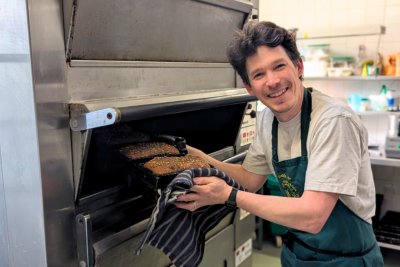




Together with my husband Will, daughters Bex and Maya and a team of 41 wonderful people, I run Abbey Home Farm in Gloucestershire. In this ever-challenging world for farmers and other growers, we keep our head above water, just about. We are a diverse bunch, with myriad skills, all particularly passionate about growing and producing organic food for people in our local community.
Our 12-acre farm is pretty mixed (up?), producing beef, lamb, pork, eggs, fruit, flowers and veg. We have a butchery, a dairy and tiny creamery, a shop and a 100% organic café. There’s our mainly residential educational CIC [community interest company], day nursery, greenfield campsite, huts, yurts and holiday cottages. We also host a few low-impact weddings and business meetings / team-building mini breaks.
You might wonder why I am writing in a bread magazine. When I opened the bedroom window each morning in summer 2024, I was greeted by the most beautiful sight of long-strawed Miller’s Choice wheat growing just metres away. Even in the summer drought, Andy Forbes’ heritage wheat population seemed to thrive, standing up tall and proud. I imagined it talking to the modern Mulika wheat nearby and saying: ‘Look at me, how tall I am. I am what should be here, not you.’
Our bakery begins
Back-pedal a bit to the ‘eighties. In another life, we went on small tours to Rajasthan and in one of our groups was Andrew Whitley, who would go on to co-found the Real Bread Campaign. He, of course, talked passionately about all things bread. In around 2010, after a third extension to the original tiny farm shop, and café, we bought a secondhand, three-deck oven. With the help of Andrew, and Clive Mellum from Shipton Mill, one of our chefs started making bread.
When I said that my mission was to use only our own wheat, I was laughed at by many. It was indeed a challenge for our baker to make bread with it and then a challenge for us in the shop getting people to buy it. It was 100% wholemeal with a few seeds and we called it the Abbey Loaf. Some people loved it but there was resistance from many customers, so we soon went down the dark (or, rather, lighter) path of making white bread with flour from wheat grown all over the place, albeit always organic.
Modern vs. heritage
Fast-forward to the present day, when we don’t have a separate bakehouse – the deck oven is in the kitchen of our shop and café. Four of our chefs take turns baking our daily bread, alongside producing delicious, healthy (mainly vegetarian) food for the shop, café, residential groups and day nursery. The vast majority of baked products (bread, cakes and savoury pastry dishes) for the shop and café are now made with our flour. The Abbey Loaf, now made with Mulika and / or heritage wheat, is our most popular loaf. Close behind it comes Abbey White and then our white sourdough.
The farm shop and café buy from the farm, as we are separate businesses, which bring me back to the swaying, summer beauty of Miller’s Choice. At the moment, heritage wheat is over twice the price of modern wheats, so I am torn. With my farm hat on, I would love to grow many more heritage wheats for future resilience, for the fantastic straw and for its (so far) dependability in the very variable weather patterns that seem to be becoming the new normal. With my bakery and café hat on, it’s a non-starter: when Mulika has a good year, it gives us great bread, both white and wholemeal, at under half the price per tonne.
Customer choice
Interestingly, our customers are not really concerned about whether it is heritage wheat or not, they just want a delicious loaf. You might have experienced the same. A lot of them want it sliced. We have an old slicer but only use it to slice any bread left at the end of the day, which we then put in the freezer. We’ve found that some customers buy our frozen bread because it is sliced.
Changing from using commercial white flour to our own sifted stoneground flour met with a certain resistance. ‘The colour is not white,’ they said. The texture of the bread is coarser, it’s not soft and spongy. To keep those customers slightly happier, I now ask the miller to sieve the flour through a finer mesh so it looks a bit lighter, even though it’s totally against my desire to sell more nutritious bread. Thankfully, over time, our whiteish bread sales have gone back up to nearly where they were before.
Wholemeal sourdough dilemma
Our customers want sourdough bread to have holes but not too many, sour but not too sour, nutritious but light. They want long loaves, not pretty, round ones - and they want them sliced. I have partly relented, unhappily, so our white sourdough currently has 20% imported wheat flour mixed in with our homegrown to make a loaf people will buy.
I am not sure how sourdough has become the perceived healthier choice of bread. Research suggests that natural fermentation might offer some benefits over using baker’s yeast, but many ‘artisan’ sourdough loaves are made using white flour, stripped of high-fibre bran and nutritionally-dense germ. Is anyone producing 100% wholemeal, sourdough bread, from locally grown wheat flour - and managing to sell it well? I think we should try it, and bet we will sell one wholemeal loaf to every fifty white ones. Shared experience welcomed!
Originally published in True Loaf magazine issue 66, April 2026. Be the first to read new articles by joining the Campaign.
Got something to share?
See: YOUR words in print, My baker’s dozen, My favourite bakery, Who are your Real Bread Heroes? and Sharing your recipes.

Published Monday 28 September 2026
Real Bread Campaign: Finding and sharing ways to make bread better for us, our communities and planet.