

Sustain / Real Bread Campaign / Articles
Bread to hold a community together
Nathan Cal Danby and Amalia Sacchi are baking a future in the Veneto region of Italy
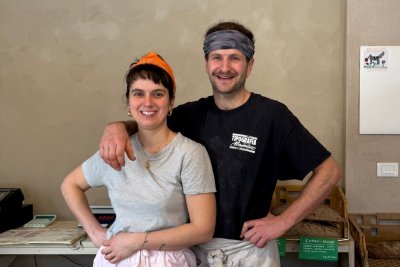



We called our bakery Foresta Forno di Comunità because it connects where we came from with where we’re working to put down roots. Neither of us was born here in the Alpago municipality, around which people who come from elsewhere are known as foresti. The name is also evocative of the nearby Cansiglio forest, a beautiful place that helped persuade us to make our life here.
Nurturing relationships
Amalia is from Mantua in northern Italy and Nathan is from Yorkshire in northern England. We met in Milan through a shared passion for bread and food more generally. Nat previously worked as a chef and baker, spending time at Wild Hearth Bakery in Scotland with John Castley and at Tartine in California, as well as establishing and managing the bakery at Tipografia Alimentare in Milan. He also has a master’s degree from L'Università di Scienze Gastronomiche di Pollenzo (the University of Gastronomic Science in Pollenzo). Amalia worked with the L’Alveare che dice Sì! (The Hive That Says Yes!) network connecting small producers directly with customers, started baking at Milan’s Forno Collettivo (collective oven) and undertook an apprenticeship at Tondo Forno Radicale, also in Milan.
What united us was the belief that food should not be simply transactional but should create relationships. We wanted to live in the mountains and imagined starting a farm. Amalia knew Alpago through a friend and we were drawn by its landscape, slower pace and the people building a thoughtful local food culture.
We moved here in 2023 and spent time listening. Arriving in a rural community with a polished idea of what it needs is rarely helpful. As we met growers, cooks, shopkeepers and neighbours, we began to understand the gaps and possibilities. Gradually, we realised that a bakery could make a more immediate contribution than a farm. Bread is bought regularly, shared instinctively and understood by everyone. A bakery could become a thread connecting the people here.
We launched Foresta in the town of Farra d’Alpago at the end of December 2025, then opened the shop with a village celebration on Valentine’s Day the following year. Reaching that point involved restoring neglected premises, finding second-hand equipment and working in stages. A €12,000 grant, awarded through our local action group, helped but careful spending and practical help were just as important.
For the table not a display cabinet
We describe Foresta as a community bakery but strongly believe it is not enough to just put that title over the door: it must be earned. For us, it begins with making bread that local people want to eat regularly and can reasonably afford. Our loaves are naturally leavened and intended for the table not a display cabinet. We use organic and other carefully chosen flours, including stoneground flours from small producers Renzo Nadalutti in Friuli and Mulino Terrevive in Veneto, whose consistency helps our small bakery work reliably.
Our breads include spelt, einkorn, wheat and rye, as well as a seeded tin loaf and a tipo 2 (sifted wheat flour, about 85% extraction) loaf. We also bake Roman-style pizzas, savoury tarts, seasonal brioche, fruit breads, cinnamon rolls and other simple things that make the bakery useful throughout the week. We like using professional techniques to make bread with the familiarity of a good home-baked loaf. We prefer to prove our doughs at ambient temperatures, so mix, ferment and bake on the same day, which gives us a bread with a thinner crust, well balanced acidity and most importantly is the kind of bread we most like to eat.
Affordability is part of our craft, not precluded by it. A mountain bakery cannot survive by presenting every loaf as a luxury object and our village does not need bread designed to impress visitors. Tourism is welcome, but our first responsibility is to people who live here through winter as well as summer. We want Foresta to be somewhere our neighbours can return to every week without ceremony.
Our shop is intended to be a shared space. We want to host baking classes, book presentations, discussions and small cultural events, and offer the space when someone locally has an idea worth trying. In a city, such opportunities are scattered across many venues. In a small village, one warm, open room can make a disproportionate positive difference. It gives people a place and reasons to meet, exchange news, learn something and feel that useful things are being created close to home.
Revolution and resilience
The greatest challenge is also the point of the project: building a viable business at a human scale. We must balance quality, price, workload and waste while learning the rhythms of a small, seasonal place. We cannot solve that through volume alone. We depend on trust, regular customers and cooperation with other local enterprises. Foresta already supplies bread beyond the shop through relationships with people whose values are close to ours and we hope that network will deepen.
Our biggest highlight so far has been the welcome we have received. We arrived as foresti but the bakery has given us a practical way to participate in the life of Alpago. Every loaf is a small promise that we intend to be here tomorrow, next week and next winter. Recently, on the campsite by the lake, next to the locally-owned Kite Surf school, a guy was tucking into a Foresta loaf and was heard to say: ‘It’s a revolution for this village, a very good one!’ That makes us smile and think we are getting it right.
Next, we want to develop classes and events, strengthen links with local growers and experiment with locally-grown grain. Our longer ambition has not changed: to help create a resilient food culture rooted in this landscape. We know that a bakery cannot transform a place on its own. It can, however, keep a door open, an oven warm and a daily conversation going. In a small community, that is no small thing.
Originally published in True Loaf magazine issue 68, October 2026. Be the first to read new articles by joining the Campaign.
Got something to share?
See: YOUR words in print, My baker’s dozen, My favourite bakery, Who are your Real Bread Heroes? and Sharing your recipes.

Published Monday 5 October 2026
Real Bread Campaign: Finding and sharing ways to make bread better for us, our communities and planet.