

Sustain / Real Bread Campaign / Articles
Agege a-go-go
Chris Young looks into the story of a Nigerian favourite bread.
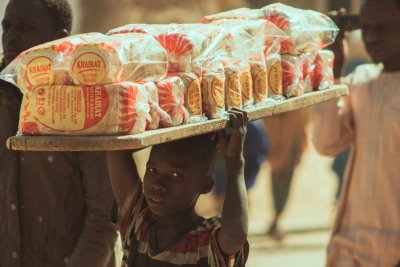




Soft, sweet and chewy, Agege (pronounced something like ah-geh-geh) bread is a Nigerian take on the white sandwich loaf.
Typically baked in a lidded Pullman tin, this dense, close-crumbed, white bread, enriched with butter (or margarine), sugar and sometimes milk, is a version of 'sugar bread' or 'butter bread'. It takes its name from a suburb in Lagos state, but how does it fit into the country’s bread history?
A (sketchy) history of bread in Nigeria
It’s unclear when bread was first made in the place now known as Nigeria. Grains native to West Africa include pearl millet, fonio, sorghum and African rice (Oryza glaberrima). Some of the early (medieval) surviving written accounts, by visitors to the region, mention bread, though this was 'a term used broadly by Muslim traders to include staple starch preparations like flatbread and porridge made from a variety of grains.' During his travels of 1350-51CE, Ibn Battuta wrote of receiving three pieces/loaves/cakes of bread from the mansa (sultan/king) of the ancient city of Mali, though this was more than 1,000 miles from present day Nigeria.
Portuguese explorers in 1472 reported encountering kingdoms in western parts of the African continent with well-established agricultural, artistic and culinary cultures but, though no mention of bread specifically. In his book Stirring the Pot: A History of African Cuisine, James C. McCann quotes a 1600 account from Pieter de Marees. The Dutchman reported people pounding millet and maize to form a dough, adding water and salt ‘then make Rowles thereof as bigge as two fists, and that they lay upon a warm harth, whereon it baketh a little, and this is the bread which they use.’ This account is of Gold Coast (now Ghana), but is it too much of a stretch to suggest that something similar might have been done a few hundred kilometres away?
From around 1558, manioc (aka cassava) was introduced to African countries from the Americas by Portuguese colonisers. In his 1668 Description de l’Afrique, Dutch writer Olfert Dapper reported that ‘mandihoca’ was ground into flour and made into bread in the Kingdom of Ouwerre, now the Nigerian city of Warri. It should be noted, however, that having not visited Nigeria (or anywhere in African, for that matter) Offert is – at best – a secondary source. As it seems he based his notes on observations made by someone else, nearly a quarter of a century earlier, even ‘unreliable narrator’ might be generous.
Wheat based bread
In 2024, archaeologists reported finding the earliest known evidence of wheat in West Africa. They retreived 48 grains of durum wheat at Ilé-Ifè in Nigeria, which they dated to 1294–1397CE, though found no evidence of bread making, hypothesising the wheat might have been used to make forms of porridge or couscous. A 1974 paper on indigenous bread wheat varieties from northern Nigeria stated, very vaguely: 'it is not known when and how bread wheat reached Northern Nigeria. It is probably a very old crop.' I've not found a better attempt made since.
For his 1965 book African enterprise: the Nigerian bread industry, Peter Kilby began a modern history in early nineteenth century Brazil. Formerly enslaved Black people had become artisans in trades including bakery. Prompted by an expulsion of Muslims in 1835, people began emigrating to western Africa, taking with them a taste for, and skills in making, bread. Kilby reported that the new Nigerian bakeries were run by one or two people, making dough entirely by hand and baking it in mud ovens – demonstrating that microbakery is simply a newish name for an old idea.
Caribbean connection
Kilby went on to write that the commercialisation of baking in Nigeria was pioneered by Caribbean émigrés. Perhaps the most prominent of them was Amos Stanley Wynter Shackleford. He was born in 1887 at Charles Town on Buff Bay in Jamaica. This was a ‘maroon’ community, established by people who escaped from enslavement on sugar plantations at around the time that British colonisers took over from Spanish ones in 1655.
Inspired by his interest in Pan Africanism, in 1913 Shackleford emigrated to Nigeria, where he took up a position with the national railway. His contract ended in 1917 and, after a brief return to Jamaica, he moved back to Lagos and became head clerk of a lumber company. That job came to an end in 1921, during a period of national economic downturn.
At around the same time he married Catherine Ricketts, another member of Lagos’ growing Caribbean community. The Shacklefords set up a baking business from their home in the Lagos suburb of Ebute Metta.
In the days of family trades, how did the son of a saddlemaker become a railway agent and then retrain as an accountant, and end up being known as ‘The Bread King of Nigeria’? In Heroes of West African Nationalism, Rina Okonkwo noted: ‘One account was that he woke up one morning wanting to have some good bread. Another version was that he got the idea from Letitia Ricketts, wife of Edward Ricketts, who was well-known for her bread baking. It also seems likely that Shackleford had assessed the economic conditions in Lagos and judged the potential of the bread industry.’
Brake time
Peter Kilby wrote that Shackleford secured the services of a Jamaican army-trained baker called John Martin. Though I’ve been unable to find a record of the types of bread made by the bakery, is it unreasonable to think that they might’ve used recipes and techniques from Jamaica? One innovation that Shackleford (or should that be Martin?) is credited with introducing to the Nigerian bakery industry was the brake, which is used to work stiff doughs until smooth.
Use of the dough brake can be traced to the UK and other European countries at least as far back as the Middle Ages. It was originally a lever-like device, attached to a wall or bench by a hinge at one end. Later versions have been based around a pair of rollers, operating a bit like a pasta machine or laundry mangle. It’s unclear when the dough brake was introduced to Caribbean islands, or by whom, but this bit of kit is still used to produce Jamaican hard dough (aka hardo) bread1, to which Agege bread bears a resemblance. In the Yoruba language, the slang for its soft, heavy texture is ‘ki’, which means robust.
In 1954, E.A. Idowu revolutionized the Nigerian baking industry by launching the first domestically designed and made dough brake. According to Kilby, the new machines cost less than a tenth of imported ones, helping to cut a bakery’s capital set-up costs by 50-75%.
Agege
Mbonu Ojike bought the bakery in 1950 when Shackleford retired but his name lived on. Just as William Henry Hoover’s name became a generic term for vacuum cleaners in the UK, Chanté Joseph, Amos’s great-great-granddaughter, notes that his surname became synonymous with bread in Nigeria.
In 1960, Nigeria secured its liberation from British colonial rule. Disruption to rail services during the subsequent readjustment period affected distribution from the former Shackleford bakery, which at some point went out of business. Alhaji Ayokunnu seized the opportunity to set up a bakery and named a loaf after his home city in Lagos State: Agege bread.
Adulteration
I have been unable to find Ayokunnu's original recipe but Nigerian breads generally used to be additive-free. In the commercial bakery recipe Kilby included in his book: ‘for each 100lb of flour adding 4 gallons of water, 3 ounces of yeast, 1 pound of salt, and 8lb of sugar.’ He noted that few bakeries used preservatives and that, of the five bakeries used for detailed case studies, only one used 'improvers'.
As with white sandwich loaves in the UK, USA and elsewhere, however, the use of additives became common. In Fresh Agege Bread, a FABA (For Africans By Africans) documentary by food researcher Ozoz Sokoh and director/producer Chika Okoli, Prince Jacob Adejorin, president of the Association of Master Bakers and Caterers of Nigeria, traces the widespread use of additives to a 1986 ban on wheat imports. This legislation was passed by President Ibrahim Babangida’s government, with the intention of boosting domestic production and escaping ‘the wheat trap’ reliance on imports.
According to Adejorin: ‘wheat grown in Nigeria was not high quality back then.’ Additive manufacturers seized the opportunity to convince bakers that, rather than adapting recipes and processes to the abilities and needs of domestically-grown wheat, the way to respond to the challenge was to throw a chemistry set at it. Initially, these additions included potassium bromate, which the World Health Organisation later declared a probable carcinogen. That flour ‘improver’ was banned in the UK and the rest of Europe in 1999 and by NAFTA in 2004.
The importation ban was lifted in 1990 and ‘bread quality’ foreign wheat now floods the Nigerian market. Despite this, and potassium bromate being illegal in the country, a number of studies have found that this oxidizing agent is still widely used, though other bakeries have switched to using ascorbic acid instead – we’d love to hear from any that don’t use additives at all.
Back to basics
One non-UPF way of achieving the characteristic chewy softness for which Agege bread is known and loved, is using scalded flour. Now often known in baking circles by Japanese or Chinese terms (commonly transliterated as yudane and tangzhong, respectively), this involves mixing flour and boiling water, or boiling the two together. This gelatinizes starch, effectively ‘locking away’ some of the water. This simultaneously enables a higher hydration level without making the dough slack, while reducing the amount of water available for gluten formation, which results in a soft and more tender crumb. This is the method that food blogger Kemi Amusa used in the recipe published on her K’s Cuisine website.
Agege today
In May 2026, Swit Cakes & Desserts owner Mercy Okon Atang (aka Queen Mercy Atang and Queen BBNaija) attended the Africa Magic Viewers' Choice Awards. Her gown was made of 500 loaves from her bakery.2 The dress was designed as a marketing stunt by Toyin Lawan of Tiannah's Empire.
Agege-style, and other types of 'butter bread' and 'sugar bread' (terms that seem to be used more or less interchangeably), is now made in places around the world that ex-pats have settled. Some bakers have returned to the bread’s roots by making it without additives. Examples include Divine Bakery in Maryland, USA, Wumi’s Bakery in Qatar, Solomon’s Bakery in Minnesota, USA. If your bakery makes additive-free bread of any type, you’re welcome to add your details to our Real Bread Map!
Footnotes
1The origins of hard dough bread don’t seem to be well documented. A number of accounts say it was first made in Jamaica during the second half of the 19th century in bakeries owned by indentured Chinese people, perhaps based on Chinese baking traditions that might have been influenced by European recipes and methods introduced by Portuguese colonisers in Macau. Others pin down hard dough’s creation / introduction specifically to a baker named Chin Bwang, sometime in the 1920s, though I have not found (or seen anyone cite) contemporary sources for these assertions. The OED dates the first known use of ‘hard dough’ in print to no earlier than August 1911, in an advertisement for Verley & Robinson bakery, published by The Daily Gleaner newspaper. It's a subject for a long form article in its own right, if anyone fancies writing it...
2‘Swit Bread’ is made using ‘flavour, improver & preservative’ so falls outside our definition of Real Bread.
Thank you to Ozoz Sokoh for replying to my email. As part of my research, I also attempted to contact a number of other people and organisations in Nigeria but did not receive responses. If you have information from reliable sources that could help to improve this article, please email me.
Got a story to share?
See YOUR words in print , my baker’s dozen and my favourite bakery.
Or have you developed a recipe from your culinary / baking heritage that you'd be happy for us to publish on our site as part of our A to Z of Real Bread?

Published Saturday 16 May 2026
Real Bread Campaign: Finding and sharing ways to make bread better for us, our communities and planet.