

Sustain / Real Bread Campaign / Articles
Flour ‘fortification’
An old subject generating a lot of current interest in the UK.




The Real Bread Campaign stands for freedom of choice. We work towards everyone having a realistic chance to choose bread made without additives, for whatever reason(s) they need or want to do so.
The mandatory ‘fortification’ of almost all non-wholemeal wheat flour sold in the UK more or less denies the majority of us from having the option of additive-free bread.1
As the policy’s stated aim is as a preventative health measure, we see it as involuntary mass medication of our nations. Effectively it leaves most people in the UK with just two options: wholemeal bread2 or no bread at all.3
Can Real Bread be made with 'fortified' flour?
In the UK (and other territories where flour ‘fortification’ is mandatory) the additions have always been exceptions to the no additives criterion of our Real Bread definition.
A (very) brief overview
More than 90 countries have mandatory flour ‘fortification’ (aka 'enrichment') policies, while voluntary addition of minerals and synthetic vitamins to food (breakfast cereals and baby formula, for example) is widespread.
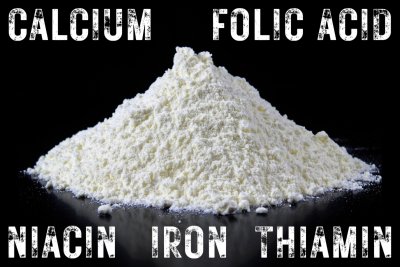
Mandatory ‘fortification’ of non-wholemeal wheat flour in the UK began in the 1940s with the addition of calcium carbonate. This was followed in the 1950s by iron, niacin and thiamin(e), though most of us were left unaware of this until 2014.
In November 2024, an amendment to The Bread and Flour Regulations added folic acid to the list of mandatory ‘fortificants’, giving millers a two-year transition period and setting 13 December 2026 as the final deadline to comply with the new requirement.
Exemptions
To date, the Campaign has helped to secure two, small exemptions to the UK’s ‘fortification’ requirements but they only apply to a very small percentage of the flour sold in the UK. We have long called for a wider exemption in The Bread and Flour Regulations that would allow any mill to produce a quantity of non-wholemeal wheat flour without the mandatory additions.
While the Campaign calls for such an exemption to the UK’s flour ‘fortification’ requirement, we do not lobby for it to be revoked altogether. Product labelling would make it clear whether or not the ‘fortificants’ had been added.
The majority of non-wholemeal wheat flour would still be ‘fortified’ but (this is the key point) the derogation would open up the opportunity to make an informed decision to people across the UK, not just those able to access and afford the currently very limited amount of exempted flour and Real Bread made from it.
Questions and concerns
The Real Bread Campaign / Sustain acknowledges that people have a range of health, nutritional and other questions and concerns about flour ‘fortificants’. Our initial investigations found a wealth of data and other information, including study results that contradict or conflict with others.
We concluded that it is beyond the Campaign’s / Sustain’s capacity to conduct (or commission) further research sufficient to take an adequately-informed position on any ‘fortificant’ individually. As such, we're not in a position to engage in discussion or speculation about any of them specifically. If you have personal health questions or concerns related to any flour ‘fortificant’, you can consult a registered dietician with the relevant expert knowledge.
When conducting your own research, we encourage you not to base conclusions / decisions on mainstream media articles, social media posts, or AI-generated answers / search results, all of which can include ill-informed (and even totally unfounded) statements. Please also avoid jumping to conclusions based on a single study / scientific paper. You might find 8 ways to determine the credibility of research reports by the European Association for International Education useful / of interest.
1The Real Bread Campaign considers the mandatory additions to be additives but food composition, labelling and marketing legislation does not categorise them as such.
2We LOVE wholemeal bread and encourage people to eat more of it!
3’Fortification’ requirements don’t apply to gluten-free and other non-wheat flours, but they only account for a very, very small percentage of the flour sold in the UK.
See also
Finding folic-acid-free flour and bread

Published Wednesday 15 July 2026
Real Bread Campaign: Finding and sharing ways to make bread better for us, our communities and planet.