

Sustain / Real Bread Campaign / Articles
Folic-acid-free flour and bread
A guide for people who want or need to avoid this synthetic addition to their food.
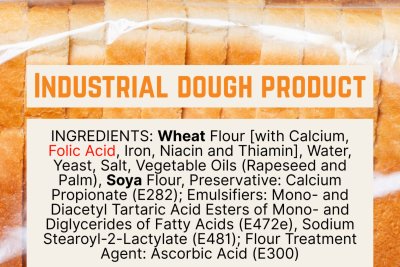




In November 2024, an amendment to The Bread and Flour Regulations was enacted, requiring folic acid to be added to the list of so-called 'fortificants' included in most non-wholemeal wheat flour sold in the UK since the 1950s.
Since then, the mills from which the majority of bakeries and industrial dough fabricators in the UK buy their flour have been moving over to adding folic acid to their non-wholemeal wheat flours, as mandated. All will have done so by the compliance deadline of 13 December 2026.
Note: Rather than suggesting that anyone should not consume 'fortified' flour, this article is for the information of people who already know they want or need not to consume one or more of the mandatory additions.
Find out more
For more information about flour 'fortification' in general, including an outline and history of the UK legislation, the Campaign's position, our responses to governmental public consultations, and discussion of the issues / concerns, please head to our flour ‘fortification’ page.
Can I choose additive-free flour?
The 'fortificants' have to be added by mills to almost all non-wholemeal wheat flour sold in the the UK.
This means that, other than giving up bread (and industrial dough products) altogether, the main option for most people in the UK is wholemeal wheat flour and bread made from it.
As the result of lobbying by the Real Bread Campaign and others, the 2024 amendment to the Regulations added two (small) exemptions from all flour ‘fortification’ requirements:
- Non-wholemeal wheat flour from mills that produce no more than 500 tonnes of flour a year.
- Flour milled from wheats other than Triticum aestivum: spelt (T. aestivum var. spelta), einkorn (T. monococcum), emmer (T. turgidum subsp. dicoccum), durum (T. turgidum subsp. durum or T. durum), khorasan (T. turgidum subsp. turanicum or T. turanicum) etc. are exempt.
Otherwise, people in the UK who want or need not to consume one or more of the mandatory flour ‘fortificants’ have these options:
- Non-wheat flour (rye, barley, oat, soya, pea, bean, rice, cassava, buckwheat, potato etc.) to which mandatory ‘fortification’ does not apply.
- Mill your own. The Regulations only apply to non-wholemeal wheat flour sold in the UK, so some people choose to obtain tabletop mills and make their own fresh flour.
- Stick it in your suitcase. It's generally legal to bring back ‘unfortified’ wheat flour from overseas trips for personal use, but check the Governmental website for any import restrictions.
- Imported baked products. Strangely, although it is illegal to import and sell ‘unfortified’ non-wholemeal wheat flour, it is legal for companies to import and sell products that were manufactured outside the UK from ‘unfortified’ flour. The ingredients list will show if ‘fortificants’ have been added.
Additionally, bakeries, retailers, eateries etc. in Northern Ireland can still import and sell ‘unfortified’ flour from EU or EEA countries - a choice taken away from the rest of the UK in the wake of Brexit.
Anecdotally, we have received reports of some small shops selling imported non-wholemeal wheat flour that does not ahve the additions. Unless such flour was produced by small mills, we are unsure how this does not breach the regulations.
Where can I buy ‘unfortified’ flour?
To find out if a bag of flour contains only flour, read the ingredients list.
Places where you can find details of independent mills (many of which produce only wholemeal flour and / or 500 tonnes of flour or less a year) include the:
- Real Bread Map (if you own a flour mill, you can add your details)
- Britain and Ireland Community Grain Associations map
- Brockwell Bake Association’s map of mills that produce stoneground flour
- Traditional Cornmillers Guild (TCMG) members' list
Once you have found a mill, you can ask them about their flours.
Ratton Pantry has curated a list of 'unfortified' flours for sale.
Which bakeries use ‘unfortified’ flour?
As we say anyway: always read the ingredients list or, if there isn't one, ask a member of staff for the list of ingredients.
The Real Bread Campaign doesn’t have the capacity to research and compile a list: there are hundreds of bakeries, producing thousands of different products and the situation is continually changing.
Some Real Bread bakeries buy all of their flour from small, exempted mills, or mill their own flour - you can search the Real Bread Map for a bakery and ask them.
If our funding situation improves (which you can help by joining us and / or making a doughnation) we might be able to add an ‘only uses unfortified flour’ option that bakeries adding their details to our Real Bread Map can tick.
Why am I seeing this now?
Since the 1950s, The Bread and Flour Regulations have required that mills add four so-called ‘fortificants’ (calcium, iron, thiamine and niacin) to almost all non-wholemeal (white, brown, multigrain, GranaryTM, malthouse etc.) wheat flour sold in the UK, including certified organic products. As a result, bread and other foods made using those flours contain these, also referred to as ‘token nutrients.*
Following lobbying by the Real Bread Campaign, in 2014 it became necessary to declare these on ingredients lists, though only after the EU mandated it. In the wake of Brexit, it is no longer legal to sell 'unfortified' flour imported from the EU.
After an announcement and public consultation in 2021, an amendment to the Regulations was enacted in November 2024. It requires mills to now also add folic acid (a synthetic form of the folate found naturally in green vegetables and other foods), with a final deadline of 13 December 2026 to comply.
The stated aim of this latest measure is to reduce the number of babies being born with (or miscarried due to) neural tube defects (NTD). Based on figures given by the most recent governmental consultation on this issue, this addition to the existing involuntary mass mediation of the nation (around 66 million people in 2019) was predicted to reduce the number of pregnancies affected by NTDs by (not to) about 150-200 a year.
There are a range of questions and concerns related to 'fortification', many of which were raised in the 2013 and 2021 public consultations.
*Some companies choose to add minerals and synthetic forms of vitamins to their foods voluntarily, notably breakfast cereals. This allows marketers to make a range of nutritional claims, even on foods that are otherwise unhealthy - low in fibre, high in sugar etc.
Can we get the law changed?
Having helped to secure the two small exemptions in the Bread and Flour Regulations amendment enacted in November 2024, our opinion is that we doubt the Government will consider another review any time soon.
The Real Bread Campaign has been questioning and challenging the so-called ‘fortification’ of flour since 2009, including through public consultations that successive governments have run. Our belief remains that there are better ways to improve public health and nutrition than involuntary mass medication of our nations, which effectively denies most of us our right to choose what goes into the food we eat.
The Campaign has long called for a derogation to The Bread and Flour Regulations that would allow any mill to produce a quantity of non-wholemeal wheat flour without the mandatory additions, for whatever reasons people want or need to buy it. Product labelling would make it clear whether or not they were present.
If you would like to support our ongoing work, you can join us and / or making a doughnation.
Organic flour
In response to a comment on an Instagram post, Soil Association replied: 'Organic standards prohibit fortification except when it’s mandated by government. In the absence of a cohesive food strategy, and in the context of folic acid deficiencies, fortification of non-wholemeal wheat flour might provide benefit for vulnerable groups. Over-refining has led to severe nutritional depletion in bread-making flour.'
Soil Association went on to state: 'However, we don’t see fortification as the ideal long-term solution - government priority instead should be creating an environment in which healthy diets, based around minimally processed foods, are affordable and available to everyone.' The organisation concluded that it would be publishing a full statement on its website 'soon'.
Update: In January 2026, Soil Association published this article.
'Fortified' wholemeal?
Millers are not mandated to 'fortify' wholemeal wheat flour. Unlike breakfast cereal manufacturers, which 'fortify' some 'wholegrain' products voluntarily, we have yet to see any mills do so to wholemeal flour.
If you see the 'fortificants' listed on a product, it's probably because it isn't wholemeal (brown, wholegrain, malthouse etc. are not the same as wholemeal) or the manufacturer has used some non-wholemeal flour in the product, which is a different can of worms.
See also
Additive-free flour (by former TCMG chair, and past Real Bread Campaign working party member, Jon Cook of Prior's Mill)
- Flour 'fortification'
- The Real Bread Campaign's response to the 2022 public consultation
- The Real Bread Campaign's response to the 2013 public consultation
Updates
You can also search the UK Parliament website for written questions, answers and statements on the subject of folic acid.
15 July 2026: We published this article on the subject of flour 'fortification'.
8 June 2026: a petition was published on the UK Government and Parliament website, titled 'End the mandatory fortification of white flour with folic acid immediately', with a 6 December 2026 deadline for signatures.
24 December 2025: a petition was published on the UK Government and Parliament website, titled 'Ensure access to non-wholemeal flour without folic acid fortification', with a 24 June 2026 deadline for signatures.
19 November 2025: Responding to a written question about the addition of folic acid to flour, Ashley Dalton (Parliamentary Under-Secretary in the Department of Health and Social Care) stated 'The Government is exploring options to evaluate the policy, which will assess health impacts across different population groups.'

Published Monday 3 November 2025
Real Bread Campaign: Finding and sharing ways to make bread better for us, our communities and planet.