

Sustain / Real Bread Campaign / Articles
Deutsches Brot
Brighton-based baking book author, trombonist and Great British Bake-Off semi-finalist, Jürgen Krauss sends a postcard from his homeland.
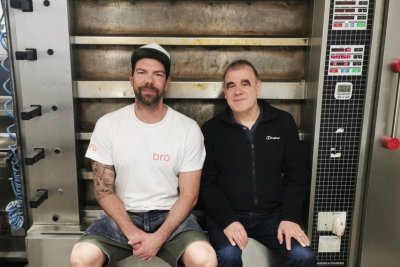




Traditionally in Germany, bread is not just a carrier of other food; it is a main part of breakfast and other meals. Supper is even called Abendbrot – evening bread. Wherever I lived in Germany, I always sought out the best bakeries. My taste for good bread has been fostered by excellent bread from the village bakery, baking farmers, and bakeries selling their bread via the store next door.
Views from here and there
Breadmaking in Germany and the UK evolved under different laws and historical frameworks, yet the industry and consumers in both places face very similar problems. On return trips since moving to England over 20 years ago, I have noticed many changes in the German bread landscape. In addition to my own perspective, for this article I reached out to respected educators and bakers to get some professional views. Lutz Geißler is a prominent voice in German bread culture, co-founder of Echtes Brot (Real Bread Germany) and founder of the award-winning Plötzblog website. Bernd Jakobs is from Landbäckerei Jakobs, a small village bakery with a lively Instagram presence, and Wolfgang Pfeifle runs Bäckerei Pfeifle in Freiburg.
All three agreed that Real Bread should consist only of grain / flour, water, salt and time. Pfeifle and Jakobs mentioned the importance of crust and mouthfeel, preferences for which depend on local traditions. Jakobs stressed the role of the oven in achieving these qualities.
A land of variety
Like many countries, Germany supports agriculture and the baking trade through academic institutions. A very influential one is the Arbeitsgemeinschaft Getreideforschung e.V. in Detmold. When researching German bread it is inevitable that you come across various Detmolder rye sourdough processes. There are many other ways to develop rye sourdoughs with specific properties, but the Detmolder name sticks, probably because it has been promoted in English language media, for example by Jeffrey Hamelman in his 2004 book Bread.
Bread making is a process that can be varied endlessly, working reliably to produce a huge variety. In 2014, Deutsche Brotkultur (German Bread Culture) was added to the country’s UNESCO National Register of Intangible Cultural Heritage. Many local specialities exist, often rooted in the history of local grain production, and it is said that there are more than 3,200 types in Germany.
Lutz Geißler views this as a marketing construct, noting the lack of clear definition of what constitutes a distinct variety. He estimates there are closer to around 200 genuinely different varieties, the remainder being variations on a theme. Geißler pointed out that the Zentralverband des Deutschen Bäckerhandwerks (Central Association of the German Bakery Trade) changed their language to refer to ‘specialities’, rather than varieties. Bernd Jakobs is not concerned about official recognition; he simply enjoys bread tasting different wherever he goes.
Baking by das Buch
To run a bakery in Germany, one must qualify as (or employ) a master baker. The guiding document for all commercial bakers is the Leitsätze für Brot und Kleingebäck (Guidelines for Bread and Small Baked Goods) published by the German Food Ministry. It basically defines bread as food produced by mixing cereal products with water, then kneading, leavening shaping and baking. It also limits the addition of fat and sugars. Three other points are noteworthy:
- Bread can only be labelled as sourdough if made using a sourdough culture, with no other acidifier.
- Vollkorn (wholegrain) flour is made from all parts of the grain and at least 90% of the flour / meal in bread must be wholegrain for it to be marketed as Vollkornbrot.
- The addition of up to 20% old bread to a dough is allowed, though this doesn't have to be declared if it has the same ingredients to the new dough, and they are both made by a similar process.
Lutz Geißler said he avoids adding things he can’t produce himself, with the exception of malts. He also noted that the incorporation of old bread can elevate a sourdough. Wolfgang Pfeifle observed that old bread alters the crumb, therefore requires careful adjustments, particularly when used in combination with soakers (soaked grains, nuts etc.). All three bakers saw the addition of old bread as an effective way to use, rather than waste, surplus.
Large producers are growing while small bakeries decline. Some big operations deliver packed goods to supermarkets, while others distribute part-baked products to be re-baked in stores and other outlets. In March 2025, the Süddeutsche Zeitung German newspaper published a DPA (German Press Agency) report that 55 industrial bakeries in Germany now account for 36% of the sector’s total turnover.*
Half baked
The Leitsätze guidelines brought in rules for modern industrial processes, such as partially baking, freezing, storing, and later re-baking products – in what the Real Bread Campaign calls ‘loaf tanning salons’. Unlike the UK, these products must be labelled accordingly and cannot be marketed as traditional bread.
On an industrial scale, part-baking allows centralised mass production. Outlets that re-bake aren’t classified as bakeries, so don't require a qualified master baker or any other skilled personnel. Many town centres are now overrun by loaf-tanning salons. This creates a big problem for artisan bakeries in areas with too few affluent customers to pay what small businesses need to charge, and unable to compete on price with big retailers or loaf tanners.
Interestingly, part-baking has some positive aspects for artisan bakers: Bernd Jacobs told me they store small amounts of part-baked bread and rolls to be flexible in times of high or unforeseen demand. Wolfgang Pfeifle finds such processes useful for scheduling and capacity planning but insists that all his products must be produced on his premises and to his standards. Lutz Geißler highlights a different concern: finishing part-baked bread increases energy consumption.
The future
Personnel shortages are another problem. Apprentice bakers are hard to find and one in four will not finish their apprenticeship. This is in part due to working times, as bakers traditionally toil through the night to make fresh products for when the rest of the nation are ready for breakfast.
How can small bakeries compete and survive? To solve various problems of the industry, bakers need to be creative. Brotbruder founder Michael Schulze runs his Freiburg bakery very successfully on an 8am to 5pm schedule. Many small bakeries find committed apprentices with immigrant backgrounds. Some bakers go to extremes in marketing – in September 2022, German newspaper Die Zeit reported Munich-based baker Julius Brantner chasing down celebrities in the city to hand them bags of his bread.
Across Germany and the UK alike, the future of bread depends on creativity, craft, transparency and an educated public.
*Compare with the UK, where (if you believe industry figures) just three companies account for around 80% of the ‘bread’ market [ed].
Originally published in True Loaf magazine issue 66, April 2026.
Got something to share?
See YOUR words in print , my baker’s dozen, my favourite bakery and sharing your recipes.
See also

Published Tuesday 14 July 2026
Real Bread Campaign: Finding and sharing ways to make bread better for us, our communities and planet.