

Sustain / Real Bread Campaign / Articles
A lifetime of connections with bread
Richard Roggan reflects on his changing relationship with bread and baking.
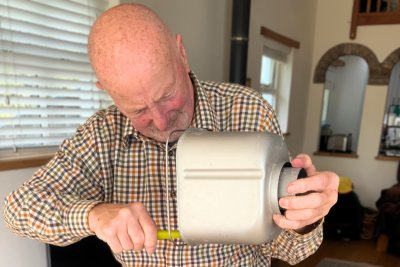



I’m 83 and my search for decent bread started as a teenager, strongly affected by my German heritage and escaping Germany to England after the Second World War. My influences came from the mainly German and Polish Jewish émigrés, who started making bread from home for barter during rationing.
After their deprivation, white loaves from factories were a revelation to many people and highly sought after. White bread was not as appealing to me or my parents and siblings, though. Whilst we did eat it, we always searched for more wholesome, sourdough bread made from rye and less refined wheat flour. It was available to us because those German and Polish Jews, amongst others, eventually started up small bakeries supplying delicatessens, which were re-emerging as more foods became available.
Panis ex machina
From the late ‘sixties I worked in engineering and was caught up in the push to modernise large baking factories towards what we now have. In the early days, I still saw scaled-up versions of traditional bread making in factory bakeries. At the mill, men carried sacks of flour onto lorries and more men unloaded them into the factory’s flour store at the other end. They later carried and emptied the sacks into huge paddle mixing machines, along with the other simple ingredients, then left the dough to ferment in large, wheeled containers. The bakers would cut the dough into big chunks and lift them onto a table, where they would portion, weigh and shape the dough, before placing the pieces onto a rolling conveyor on its way to baking.
I was involved in developing prototype flour conveying systems, which used an aerated pipe within a pipe to push the flour along. It heralded the end of men carrying sacks of flour. Flour would now be piped from the mill into a tanker like oil, then piped directly into huge hoppers at the baking factory.
Then came a production line I knew very little about. All I knew was that everything was piped in at one end and finished loaves came out of the other. At the time I didn’t realise what had happened or what the far-reaching implications would be. Those huge paddle mixing machines and the whole traditional method of making bread were removed, along with the need for most of the skilled men and women who had performed that craft. Slowly, many of the small bakeries that had given us good bread disappeared because they couldn’t compete on price with the factories and supermarkets.
Back to bread
As a young parent, I suffered factory loaves for many of the years during which my children were growing. I needed to work, with little time to consider our need for good bread. When I eventually started making my own bread, I didn’t find the help I needed and what I produced was probably awful. Eventually, around 25 years ago, my bread making started to come together, though still in need of help. My now partner attended one of the first courses that Andrew Whitley organised at his Village Bakery at Melmerby in Cumbria. Later, after Andrew and his Bread Matters school had moved to the Scottish Borders, I joined a two-day course in around 2016 and the die was cast for good, Real Bread in my life once again.
I also took a course run by Alex Gooch at Kate Humble’s farm in the Welsh Marches. In hindsight, Alex has been as much an influence on my bread making as has Andrew. Whilst Andrew holds guru status to me, (for more reasons than making organic, sourdough bread available from that little shop and, eventually, nationally) Alex helped steer me towards heritage grains and different ways of working with dough.
Online nonsense
I’m not altogether sure my views on what is (and what is not) Real Bread are going to be popular. I usually make sourdough bread, using my bread machine as a mixer. I tend to look down my nose at bread made with baker’s yeast, even though I accept that it falls within the Campaign’s Real Bread definition, that baker’s yeast is easily available and that lovely, nutritious bread can be made using it. I also get annoyed by the online nonsense from those of the sourdough ‘influencers’ who are more interested in financial gain than making good bread and teaching people about it. I try to pull back from my criticism, though, on the basis that even the nonsense helps to create interest in good bread.
Discovering the difference
I’m gratified that the Real Bread Campaign is having results, though it appears that the population as a whole is slow to respond. Many people in the UK have only ever eaten factory-made products because that’s all that have been available where they shop for food. As more and more people are now setting up small bakeries, it is slowly having an effect as others get to discover the difference between the only ‘bread’ they have ever known and Real Bread.
Originally published in True Loaf magazine issue 64, October 2025.
Got a story to share?
See YOUR words in print , my baker’s dozen and my favourite bakery.

Published Monday 26 January 2026
Real Bread Campaign: Finding and sharing ways to make bread better for us, our communities and planet.