
Sustain alliance members’ briefing: The case for a Good Food Bill
A Good Food Bill could create a legally binding framework with statutory targets, independent oversight, and 5-year action plans, giving farmers, businesses, and governments long-term certainty. The Bill's three core objectives are protecting children's health, boosting domestic food resilience and production, and resetting food policy so that progress cannot be quietly dropped when the political weather changes.


Introduction
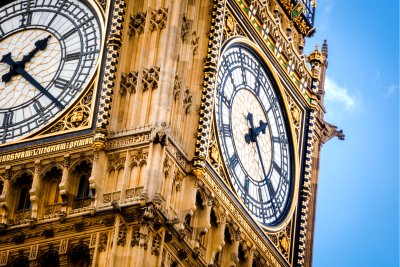
For too long, food policy in England has been a rollercoaster. We've been promised at least six national food strategies in recent decades, and none has come to fruition - each one derailed by changes in government, shifts in priorities, or simply a response to the latest crisis rather than long-term need. In the highs, our movement has won real victories: the sugary drinks tax, junk food advertising restrictions, the public money for public goods principle in the Agriculture Act. But within months or years, we find ourselves plunging back down into business as usual, with food policy going invisible and hard-won progress quietly dropped when the political weather changes.
A Good Food Bill is about smoothing out those ups and downs for good - locking in a direction of travel so that no future government can simply abandon what we've built. A Bill would significantly raise the salience of food, and food production within the UK Government. It would also provide the Government with a mechanism, for the first time in decades, for the food and farming system to be looked at in the round.
A Good Food Bill could provide a durable legal framework that sets clear, legally-binding targets, mandates independent oversight, and give the long-term policy certainty required for farmers, businesses, and investors. This could help pivot successive governments from drawing up successive strategies, to focussing on delivery and implementation.
We live in a time of national and international political uncertainty. Legislation is a way to secure long-term thinking and consistency across electoral cycles. This is important to provide confidence for food businesses and investors, as well as farmers and growers who are currently put under extra pressure by frequently changing government priorities.
The overlapping challenges:
Public health deterioration
The health of the nation's children is declining at an alarming rate, with diet being a major driver. Without bolder action, Labour will fall far short of its ambition to raise the healthiest generation of children ever.
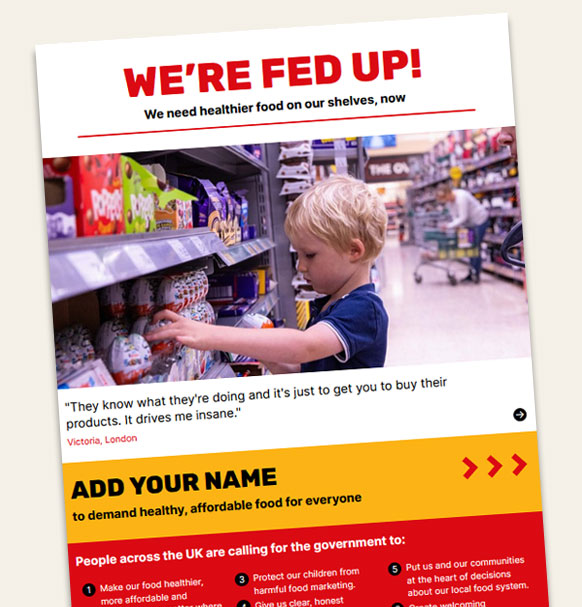
- Rising Chronic Disease: Type 2 diabetes is increasingly prevalent among young people, having not existed in young people before the year 2000.
- High Overweight and Obesity Rates: Approximately 1 in 3 UK children are now classified as having overweight or obesity by the time they start secondary school.
- Economic Impact: The UK loses approx. £8 billion per year to sick days caused by obesity.
Declining food security and production
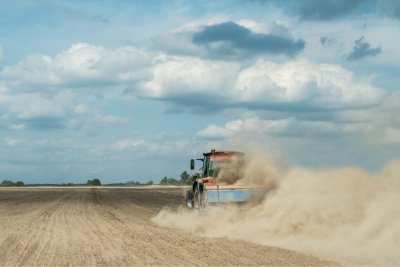
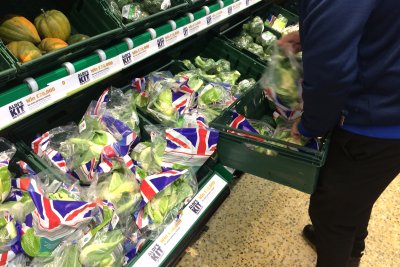
- Reduced Domestic Supply: UK production of fruit and vegetables has fallen by 16% since 2015, leaving us increasingly vulnerable to external climate shocks or political instability.
- Exposure to Volatility: This growing dependency on imports exposes our food supply to frequent climate shocks and international disruption, leading directly to more volatile prices.
Economic pressures on households and producers
Record food price inflation, a key component of the UK cost-of-living crisis, which reached nearly 20% in March 2023, has remained persistently above comparable economies in Europe. This financial pressure both makes it harder for families to afford healthy food and for farmers and growers to sustain themselves.
The proposed solution
A durable statutory framework will provide the long-term direction and resilience which the UK will need going forward. It would also ensure an enduring legacy for the Government's food strategy.
The primary strategic objectives of a UK Good Food Bill:
- Protecting Children’s Health: Establish a national duty to ensure every child has access to nourishing food, providing legal underpinning for Labour’s ambition to raise the healthiest generation of children ever.
- Boosting Food Resilience: Help farmers produce more fruit and vegetables by creating a supportive policy environment. This would strengthen national food security, increase the use of British produce in procurement, and contribute to healthier diets.
- Providing Long-Term Certainty: Give farmers, food manufacturers, and investors the confidence to make long-term plans and investments through a stable, legally-defined framework.
By setting these clear, long-term goals in law, the Bill provides the architecture for more effective policymaking in the future.
Proposed legislative components
Recommendation 14 in Henry Dimbleby’s Independent Review for the National Food Strategy in 2021 is a well researched and starting point for a future Good Food Bill.
Statutory Targets
Potential targets are:
- Reduction in childhood obesity
- Increase the national average consumption of fruit and veg among children and an increase in the proportion of the fruit and veg supply which is produced in Britain.
- Reduction in household food insecurity.
A Healthy and Sustainable Reference Diet
An updated version of the Eatwell Guide which factors in our environmental targets and which is intended to guide policy as part of ministerial duties rather than individual behaviour.
5-Year Good Food Action Plans
Governments would be required to set out a plan for how they will achieve the targets set out in the Bill. Successive Government will have flexibility as to how they achieve these targets.
Cross-Government Ministerial Duties
Ensures all relevant Government departments consider the impact of their policies on creating a healthy and sustainable food system, preventing contradictory actions.
Local Authority Food Plans
Puts food strategy higher on local government agendas, empowering councils to integrate planning, public health, and procurement.
Independent Progress Reporting
An accountability mechanism, ensuring progress is independently monitored.
FAQs
How does a Food Bill differ from a food strategy?
The Government’s food strategy is aiming to provide an overview of the UK food system, to diagnose problems with it and propose Government policies that could help solve those problems. A Food Bill, which would become an Act after it passes through Parliament, would be a law requiring the Government to actually implement the policies that a strategy may recommend.
Why a Food Bill? Why not just better policy?
We've tried better policy such as the Soft Drinks Levy, advertising restrictions, public money for public goods are all fantastic policies. But ultimately, they are piecemeal.
Without legally binding targets there's no minimum level of achievement for the Government policies get delayed, diluted or quietly dropped when the political weather changes. A Bill sets the destination in law; each government then decides how to get there, but can't simply abandon it.
Is the government actually going to support this?
The political landscape is more favourable than it's been in years. The Labour has made strong commitments on children's health and food security. It also has a key interest in the cost of living which is an increasing concern for voters. The Bill is framed as the mechanism that delivers on those commitments - not a challenge to them. The ask is to lock in what they've already said they want to do.
How long would it take to pass?
Legislation takes time, no getting around that. We are working to get a Good Food Bill into the next King’s Speech in May 2026, and if necessary, will keep campaigning to get the Bill into law following that. It is a bold ambition but we feel we have more favourable conditions in Parliament than in the past.
"How does this relate to...?"
School food
- Cross-government ministerial duties would require DfE to consider healthy food in its decisions
- Local authority food plans would likely cover how school meals support the Reference Diet and British producers
- Statutory targets on childhood obesity and fruit and veg consumption create direct pressure to improve what children eat during the school day
- The Bill doesn't mandate specific school food standards itself, but creates the framework that makes strengthening those standards a logical next step.
Agroecological farming
- The Bill doesn't prescribe particular farming methods, but could create conditions supportive of agroecological approaches.
- The statutory target to increase UK fruit and veg production would require Government to think seriously about what makes farming viable.
- A Reference Diet emphasising fruit, vegetables and sustainable production could align strongly with agroecology.
- The Bill sets the destination; how we get there - including the role of agroecology - is shaped through the action plans that follow.
Food poverty and access
- A possible statutory target specifically on household food insecurity would mandate the Government to make progress here.
- Local authority food plans would need to address how food insecurity is reduced through community food assets and local support
- The Reference Diet would need to be achievable and affordable - so access and cost have to be part of the policy conversation from the start
Local food systems and procurement
- Local authorities would be required to produce food plans covering procurement - how councils spend their food budgets to support local growers and the Reference Diet
- Statutory target on increasing the proportion of fruit and veg from British producers points directly toward stronger public sector procurement of British food
Farming and farm viability
- A statutory target to increase UK fruit and veg production gives government a legal obligation to create conditions where that production is viable
- Five-year Action Plans would need to set out how farmers are supported to meet that goal. The same would apply for mandatory local food action plans.
- Long-term statutory certainty - knowing where policy is heading - is exactly what farmers and growers have said they need to make long-term decisions
Ultra-processed food (UPF)
- Not specifically named in the Bill, but statutory targets on childhood obesity and fruit and veg consumption, combined with a scientifically grounded and regularly updated Reference Diet, create strong policy pressure in this direction.
- If Government has a legal obligation to reduce childhood obesity, promoting minimally processed whole foods would become a necessity.
Animal welfare
- Not a direct focus, but the Reference Diet - which government would be required to publish and use to guide policy - can be designed to reflect high welfare standards
- If procurement policy is aligned with the Reference Diet, that has downstream implications for the welfare

Good Food Bill: New legislation is necessary to transform our food system, giving successive governments clear goals to ensure the country is well-nourished in an increasingly uncertain world, while providing food businesses, investors, farmers, and growers with the confidence they need to operate in the most sustainable and beneficial way possible.
Sustain
The Green House
244-254 Cambridge Heath Road
London E2 9DA
020 3559 6777
sustain@sustainweb.org
Sustain advocates food and agriculture policies and practices that enhance the health and welfare of people and animals, improve the working and living environment, promote equity and enrich society and culture.
© Sustain 2026
Registered charity (no. 1018643)
Data privacy & cookies
Icons by Icons8
