

Sustain / Real Bread Campaign / Articles
Inside the loaf tanning salon
A former supermarket baker exposes a sector axing skilled jobs and freshly-made bread.




For 13 years I worked as a baker for one of the UK’s largest supermarket chains where, for the first eight of those years, I was proud of what we did. Skilled bakers were hired and trained, bread was made properly – from scratch – in store and I personally believe the products were of a high quality. Unfortunately, that is no more.
Things changed in 2021 when the company moved to a ‘bake off’ system and made many bakers redundant. There was a major reduction in paid hours available at the chain’s in-store ‘bakeries’, resulting in overworked staff members and fewer products making it to the shop floor. Because of the changes, I believe the ‘freshly baked in store’ marketing and labelling tactics used by the company are now totally false.
Browned off
By the time I left, the vast majority of products were either ‘thaw and serve’ (finished products that are just defrosted and put on display) or ‘bake off’ – prebaked products that are loaded into what the Real Bread Campaign calls loaf tanning salons for a few minutes to brown and crisp the crust. Think of those part-baked loaves, baguettes, rolls and so on that you can buy to re-bake – they are the exact same style of product, except that you probably don’t pretend to anyone that you make them fresh from scratch at home.
Many of the bake-off loaves arrived deep-frozen from a company that manufactures them in Belgium. All of the baguettes came in frozen, from Ireland and elsewhere. A handful of products (including tiger tin loaves and wholemeal tin loaves) arrived at ambient temperature from a manufacturer in the UK and were merely re-baked in store. The use-by dates of deep-frozen products can be up to 12 months after manufacture, though most are then sold as best eaten on the day or purchase or with a best before date within one to three days of it because they stale so quickly.
Frozen food
Some of the filled doughnuts were also manufactured in Belgium. They arrived frozen, were left to thaw for 90 to 120 minutes and then put out for sale. Frozen ring doughnuts came from a company in the UK in large boxes containing trays of 12, which were thawed and either sold as they were, or split into smaller trays of four doughnuts. Boxes of 120 ball doughnuts (filled with jam, custard or chocolate) also arrived frozen. I could not find any information on the boxes about where they were manufactured or by which company. All that happened in store was that they were thawed, tossed in a large tub of granulated sugar, bagged and put on display. Job satisfaction for a skilled baker? Not for this one.
Almost all the other products in the ‘bakery’ (iced buns, yum yums, flapjacks traybakes, Belgian buns etc.) came in frozen. Again, none of these products were made from scratch in store – or even saw the inside of an oven there. They were just thawed, date labelled and then put on sale.
Some of the cookies were marketed as ‘freshly baked in store’ but all actually arrived from a UK company as puck-like discs of frozen dough. They were trayed up, put into the preset oven, left to cool and then bagged. No real baking skills are involved, unless you count loading frozen products into an oven as skilled baking. The same applied to pre-shaped, frozen dough pieces for all the croissants, pains au chocolat and other pastries. Is any of this what ‘always baked in store’ (as it says on many of the bread bags) or ‘freshly baked daily’ (as per signage in some stores) means to you?
Packet mixes and poison
At the time I left the company, the closest it came to making anything in its store ‘bakeries’ were coconut macaroons and loaf cakes. Even those were not made from scratch with basic ingredients (flour, butter, sugar etc.) but from bags of premixes, to which a staff member added water and oil. This was then mixed, put into paper cases and baked in the oven. Pancakes were made from 6kg bags of packet mix and cooked on a hotplate in store.
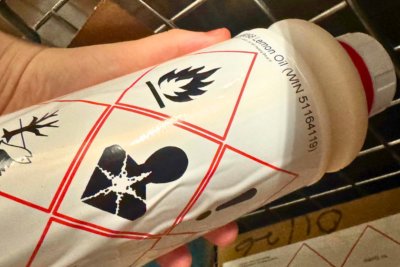
Something I find very concerning about those products was the flavouring / oil added to the premixes for the lemon and fruit pancakes and the lemon loaf cakes. The front of the bottle had multiple warning symbols, indicating the contents were corrosive, flammable and deadly to aquatic life. Written warnings on the back included ‘may be fatal if swallowed and enters airways’, ‘toxic to aquatic life with long-lasting effects’ and advice to ‘immediately call a POISON CENTER’ if swallowed. Yum! Staff members in the store where I worked were not provided with the gloves and face or eye protection recommended on the bottle. The worst part? The ‘lemon’ oil contained zero trace of lemons. Why was it even being added to food?
Loss of skilled jobs and staff morale
The greatest issue since the company chose the cost-cutting measure of ended scratch baking in store is the effect on people. Training became minimal and we stopped benefitting from learning real baking skills and knowledge. For the most part, all ‘bakery’ team members do now is simply taking products out of a freezer, leaving it to thaw and then placing them on sale. At most, it’s putting frozen items into an oven on one of the pre-set functions.
We were told to keep quiet about these processes and to go along with the ‘baked from scratch’ and ‘baked in store’ claims. I believe that customers are still being massively misled by the company about the ‘bakery’ products it sells and this has caused a major decrease in staff morale. Given the loss of hours, being overworked when I was there, and not agreeing with the company’s processes, products, promotion or policy of silence, I’m sure you can see why I chose to leave.
Thank you to the baker, who asked to remain anonymous.
None of the UK’s 10 largest supermarket chains makes every 'in-store bakery’ product from scratch in every store. Only two of the chains make some things from scratch in some stores – good luck to anyone trying to find out which products where…
Originally published in True Loaf magazine issue 66, April 2026. Be first to read every issue by joining the Real Bread Campaign.
Got something bready to share?
From grain to flour to Real Bread, see YOUR words in print , my baker’s dozen and my favourite bakery.

Published Wednesday 8 April 2026
Real Bread Campaign: Finding and sharing ways to make bread better for us, our communities and planet.