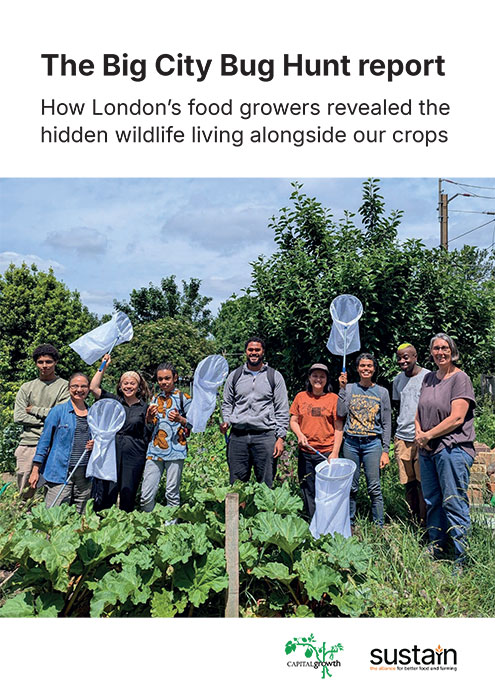

The Big City Bug Hunt report
This report shares insights and findings from Capital Growth's Big City Bug Hunt, showing how citizen science can make the biodiversity value of urban food growing spaces visible in London's nature recovery and planning decisions.


The Big City Bug Hunt demonstrates that London's community gardens, urban farms and allotments are important habitats for wildlife as well as places for food production and community connection. Working with Greenspace Information for Greater London CIC (GiGL), Capital Growth supported growers to notice, identify and record wildlife, making the biodiversity value of food growing sites more visible within London’s evidence base.
1,775 species have been recorded on food growing sites in our network of London members. That’s one fifth of all species recorded in London. This includes four of London’s priority species who have been identified by the London Nature Recovery Strategy as being in need of help the most.
Across 95 registered sites, the project's iNaturalist umbrella project captured 9,512 observations, recorded by 625 food growing volunteers and visitors. Records were collected through a citizen science engagement campaign whose strength was in its ability to mobilise food growers, encourage learning and inspire communities to take action to help nature thrive. The recording activity provided a snapshot of a range of taxonomic groups of each garden at the time of the Bug Hunt, rather than the ecological baseline which could be obtained through repeated, controlled ecological surveys.
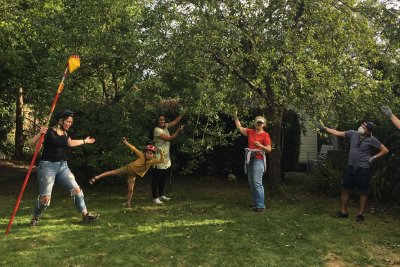
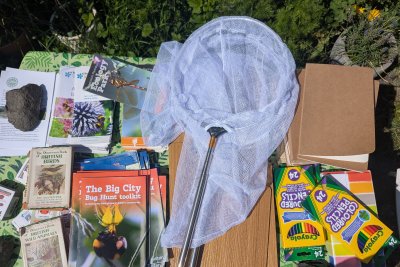
The project responded to a clear monitoring gap and addressed the barriers faced by urban food growers in engaging with biological recording. We created accessible and practical toolkits, digital resources, in-person training and 21 workshops led by locally rooted Critter Consultants. In total, 82 gardens actively monitored wildlife and an estimated 992 people engaged with the programme.
Evaluation findings suggest the approach was accessible and effective: 73% of garden leaders described bug hunts as easy or very easy to run; 89% of participants planned to continue monitoring; and all surveyed garden leaders expressed interest in further ecology, learning and community science opportunities. The train-the-trainer model delivered by the small team of Critter Consultants was particularly effective in increasing engagement and supporting more inclusive approaches to community science. Participants reported greater confidence in monitoring and species identification, alongside intentions to change planting, soil management and habitat creation. However, sustained positive impact will depend on continued support and investment that reduces reliance on individual volunteers or champions.
Our key recommendations from the Big City Bug Hunt:
- Recognise and protect food growing spaces as green infrastructure. The Greater London Authority, boroughs and planning authorities should explicitly include community gardens, farms and allotments in biodiversity strategies, Local Nature Recovery work and planning decisions.
- Invest in long-term, community-led monitoring. Funders, councils and environmental organisations should provide multi-year support for training, coordination, equipment and data management so participation can continue beyond short project cycles.
- Connect records to decision-making. Capital Growth, GiGL and partners should maintain clear data pathways from community observations into London-wide biodiversity evidence, which can be accessed from GiGL, while communicating the limits of citizen science data and avoiding comparisons that rank sites by recording effort.
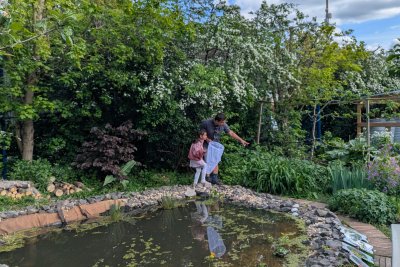
- Embed biodiversity in everyday growing. Garden leaders should schedule regular bug hunts or seasonal monitoring tasks where capacity permits and use findings to guide practical habitat improvements such as pollinator planting, ponds, deadwood, undisturbed soil and nesting areas.
- Build the evidence base. Future programmes should pair accessible citizen science with consistent, structured surveys and follow-up evaluation to understand ecological change, participation and lasting changes in garden management.

Capital Growth: Connecting a network of London growers.



Sustain
The Green House
244-254 Cambridge Heath Road
London E2 9DA
020 3559 6777
sustain@sustainweb.org
Our mission is to catalyse systemic change in the UK’s food and farming system – securing a healthy, fair, and sustainable future for all people, nature and a stable climate.
© Sustain 2026
Registered charity (no. 1018643)
Data privacy & cookies
Icons by Icons8
