

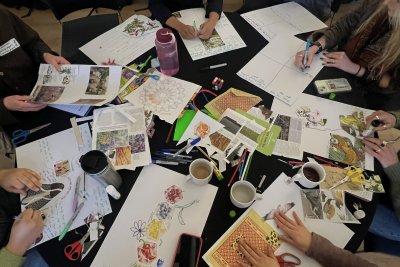
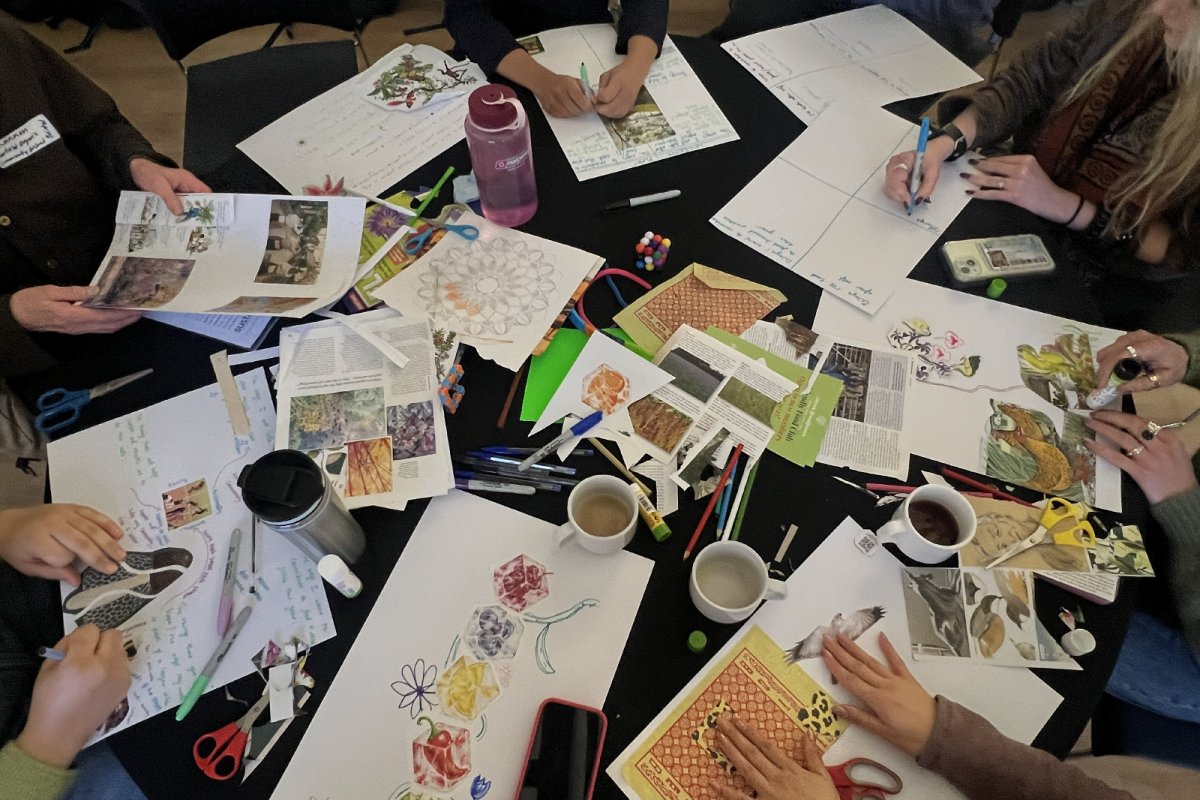
 Participants collaging at a workshop on collective care and solidarity. Credit: Sareta Puri | Sustain

Centring solidarity and collective care in the sustainable food movement
Over 30 people from across the sustainable food and farming sector recently gathered in London for an honest conversation about what solidarity actually means in racial justice work.
Organised by Sustain and Eating Better as a follow-up to the June 2025 food and racial justice summit: The Gathering Table, the session created much-needed space to reflect on how we show up for racial justice in our work. What emerged was both challenging and hopeful.
Centring wellbeing and care
The session provided a rare opportunity to focus on individual and collective wellbeing and care – something that is vital to solidarity and justice-focused work, as without it people burn out, feel disconnected, hopeless, or struggle to see progress being made. Carving out time for reflective practice should be the norm in any justice-centred work. This may be less tangible (therefore less relevant to a traditional funding model) in project deliverables, however you can count the cost of burnt out or demotivated staff. And when we talk about justice, equity and anti-oppression, we must centre those principles across all parts of the movement, including at every level of the organisations and networks doing this work.
Solidarity not charity
Participants emphasised a crucial distinction: solidarity is fundamentally different from charity. It's non-hierarchical, grounded in partnership, and rooted in interconnected struggles. Charity maintains power imbalances; solidarity dismantles them. But practising solidarity comes at a cost. Many shared experiences of being silenced when speaking up on issues and organisations failing to act due to Charity Commission guidelines and funding power dynamics that create barriers to meaningful action.
The emotional load on racialised people and their allies was acknowledged. This underscored a key insight: we must create conditions where solidarity is the norm, not the exception.
What's working
Despite challenges, several impactful examples of action were shared. In 2025 Sustainable Food Places ran a session on countering divisive narratives, and they have also embedded steps addressing marginalisation in membership criteria, with tools like the REDI toolkit available.
People are also mobilising. Hate Out Of Farming (HOOF) is one of several collectives that is working to fight the rise of the Far Right in farming.
Meaningful solidarity with Palestine has been demonstrated by several actions of The Landworkers’ Alliance and other grassroots organisations – from Zoom calls with Palestinian farmers to seed saving initiatives to fundraisers.
Several individuals recognised the strength of staff solidarity through networks, forums and Union membership. Coming together in collective spaces such as this one was heralded as much needed.
The leadership gap
A topic that is raised repeatedly is that organisations know racial justice is necessary, yet leadership engagement lags. Barriers include overwhelmed leaders, lack of senior-level representation, insufficient capacity in well-resourced organisations, and treating diversity and inclusion as an add-on, instead of centring justice and anti-oppression across an organisation. Funders face similar issues: short-term cycles, discomfort with race conversations, and limited lived experience create a landscape where racial justice work struggles to secure sustainable support.
Recommendations for change
For practitioners: Share tools and networks that are prioritising change. Develop commitments beyond statements with real accountability. Create protected spaces for staff and community members to shape this work.
For leaders: Move beyond risk-averse avoidance. Cultivate relationships built on trust and accountability. Create facilitated spaces to reflect on power and assumptions. Clarify internal responsibilities so racial justice cannot be delegated away. Model the leadership the sector needs.
For funders: Provide flexible, long-term funding that can enable deep change. Lead rather than follow trends. Engage in open dialogue about partnership opportunities and funding ethics. Commit fully rather than treating this as optional.
Creating change
The session demonstrated the power of coming together. In-person connection was noted as essential and energising. Ideas emerged for building a shared network map and creating more spaces for celebration and learning. The session highlighted needs: individuals require wellbeing space, trust-building opportunities, education, and peer networks. Organisations need to enable this whilst building deeper understanding of racial justice's relevance to food systems, support for implementation, and critically, capacity and funding.
The context against rising hate and racism, genocide and war, surging far-right politics makes this work urgent. Real solidarity requires those with privilege to act differently: share power, listen, and create conditions where more voices are heard. It requires standing alongside marginalised people despite risk and discomfort. It requires embedding solidarity into how we operate, not treating it as optional.
Sustain and Eating Better will review everything that came up to identify where we can make progress and explore ideas with our food and racial justice working group to identify any collaborative actions and potential for funded projects. And to others in the sector, we ask you to reflect on what needs to be done differently? How can we move beyond statements to build the solidarity our movement urgently needs?
For more information on this programme of work, contact Sareta Puri, Diversity Outreach Coordinator, Sustain: sareta@sustainweb.org

Sustain: Sustain The alliance for better food and farming advocates food and agriculture policies and practices that enhance the health and welfare of people and animals, improve the working and living environment, enrich society and culture and promote equity.






Sustain
The Green House
244-254 Cambridge Heath Road
London E2 9DA
020 3559 6777
sustain@sustainweb.org
Sustain advocates food and agriculture policies and practices that enhance the health and welfare of people and animals, improve the working and living environment, promote equity and enrich society and culture.
© Sustain 2026
Registered charity (no. 1018643)
Data privacy & cookies
Icons by Icons8
