


At the end of 2025, we asked Children’s Food Campaign networks for resolutions they'd like to see Government and food companies make in 2026. Campaign officer Naema Janneth looks at hopes for the year ahead and the role we all play in securing healthy, equitable food for every child.
In our December blog, we explored some of the key breakthroughs in 2025 that moved children’s food and health closer to the centre of national policy debates, driven by sustained campaigning and evidence.
While we were able to celebrate some important commitments across school food, early years and the wider food environment, many organisations also noted that progress remains patchy and insufficient, with too many families still facing significant barriers in accessing sustainable and nutritious food.
Here are our seven hopes for children’s health in 2026.
1. Make the government food strategy deliver for children's health
The forthcoming government food strategy for England is a critical opportunity to reshape the food system so that it genuinely works for children. While recent progress on school meals, early years nutrition and restrictions on unhealthy food advertising are all welcome, these gains must be embedded within much broader system-wide reform aimed a delivering healthy, fair and sustainable food and farming.
In a joint open letter signed by more than 160 organisations from health, environmental, food production and social justice sectors, the Food Strategy Alliances set out three core requirements the Government must address: creating a joined-up healthy food and sustainable farming plan backed by legislation via a new Food Bill, putting nature- and climate-friendly farming at the core of the Strategy, and making healthy, sustainable diets affordable and accessible for all.
Sustain’s Public Affairs Manager Joss MacDonald adds:
“Fixing our food system isn’t just about what’s on our plates — it’s central to solving many of the challenges the Government is facing. Better access to healthy, sustainable food would ease pressure on the NHS and social care, help reduce the cost of living, boost productivity, and tackle the climate and nature crises. That’s why we are urging the Government to introduce a Food Bill through the National Food Strategy, establishing clear food system impact targets and the long-term levers needed to drive genuine improvement across the food system. This Strategy is a once-in-a-generation opportunity to make that change happen.”
As an example of the potential opportunities for cross-government collaboration, our Follow the Carrot report, produced in collaboration with Bremner & Co, provides a clear roadmap to ensuring expansion of free school meals is leveraged in a way that delivers better food on children's plates as well as unlocking these markets for UK producers, strengthen public sector supply chains, and deliver a win-win for children, farmers and the planet. However, school meal funding systems are not currently supporting this vision, despite a government ambition to ensure 50% of all public sector food is procured locally, sustainably and from British farmers. This is exactly the kind of reform the food strategy must lean into with bold ambition in 2026.
2. Ensure Child Poverty Strategy commitments deliver real change
The publication of the government Child Poverty Strategy at the end of 2025 was an important moment, recognising what families have long known: poverty and food insecurity are deeply connected. But recognition alone won’t ensure children have access to the nutritious food they need every day. What matters now is how these commitments are put into practice in families’ lives.
Free school meals, Holiday Activities and Food programmes, Healthy Start and breakfast provision are all proven effective ways to support children’s health and reduce the impact of poverty. However, there is still often a post code lottery of access, complex eligibility and application systems and funding falling behind recent inflation and real costs of delivery. In 2026, our members are calling for them to be properly funded, delivered at greater scale, and designed in ways that reduce stigma rather than reinforce it, including auto-enrolment for eligible families. Coordinated action across government will be key to turning policy into meaningful, everyday support for children and families.
Sustain's Food Poverty Campaign Coordinator, Isabel Rice says:
"In order to meet their manifesto commitment to end reliance on emergency food parcels, we want to see continued focus on boosting incomes so people can afford the essentials they need, further bolstering of nutritional security policies that help people to access healthy food, and investment in community food infrastructure that goes beyond charitable provision and helps communities to thrive. We need this strong national policy to empower and support regions and local authorities to do the innovative, place-based work we know is possible to drive meaningful change in their areas."
Shona Goudie, Head of Policy and Advocacy at the Food Foundation adds:
“Expanding the Healthy Start scheme to align with Free School Meal eligibility would provide that vital nutritional safety net for children from pregnancy right through school. Food retailers have a role to play too – including supporting calls for expanding eligibility and work with Government to overcome the barriers to them adding value to the Healthy Start Scheme so that it can go even further.”
3. Raise the bar on school food quality and access
From September 2026, the expansion of Free School Meals in England will ensure more children can access nutritious meals at school, reducing stigma and supporting learning. This builds on expansion and improvements already taking place in London, Wales and Scotland. The review of the School Food Standards being conducted during 2026 offers a once in a decade opportunity to raise the bar on school meals. Updated standards should reflect the latest nutritional guidance, support sustainability and local sourcing of food, and ensure meals are appealing for pupils. Equally important is ensuring school food systems are backed by clear monitoring and enforcement, with local level support to improve delivery and share best practice. Schools and caterers need the resources, training, and practical support to deliver healthy, high-quality meals consistently.
Stephanie Slater, Founder and Chief Executive of School Food Matters says:
“For Government in 2026: Three key wins delivered. Free school meals extended to all families on Universal Credit (auto-enrolment is the game-changer!), smarter breakfast clubs informed by Early Adopters lessons, and school food standards with proper monitoring and accountability. Bonus resolution: a review of school food funding.“
Universal provision remains the most effective way to make sure no child is left behind, and the Government should keep universalism on the table with a clear, step-by-step plan for achieving a “school food for all” vision.
Breakfast provision is important too, helping children start the day ready to learn. 2026 will see an expansion of the primary breakfast club programme with another 2000 schools joining the current 750 Early Adopter schools. This is still a small proportion of the nation's schools, and overall access remains uneven, particularly for secondary pupils and those with additional needs.
Magic Breakfast Campaigns Manager Katharine Voss says:
“The Government should commit to ensuring every child starts the day with a healthy, nutritious breakfast. Their resolution should be long-term, fully funded breakfast policy that is accessible to all children, including older pupils and those with SEND, so every child has the support they need to learn, thrive, and start the day ready to succeed.”
4. Hold the food industry to account on health
Through our Recipe for Change campaign, research has shown very low levels of trust in the honesty and transparency of food companies and only 13% of the British public believe that they will make their food healthier without government intervention. There is a growing public groundswell in support of decisive action to curb the over-production and promotion of unhealthy food and now Government leadership must match that ambition. Parents, young people, communities, health professionals and civil society organisations are all clear that they want the Government to take stronger action to create healthier food environments and hold the food industry accountable.
2026 has also started with implementation long-awaited introduction of the 9pm watershed and online advertising restrictions for products high in fat, salt and/or sugar (HFSS) that have the highest negative contribution to dietary health outcomes for children. Sustain has campaigned on this for over 20 years, so to finally have legislation being enforced is a huge milestone. However, constant industry push back and lobbying both delayed and diluted the final policy. That's why we joined the Obesity Health Alliance and over 50 organisations in calling on government to go further, monitor and address the many loopholes that remain.
Katharine Jenner, Executive Director of the Obesity Health Alliance, vice-chair of Sustain's trustees and chair of our Children's Food Campaign working party says:
"If the Government is serious about raising the healthiest generation ever and tackling widening health inequalities, this must be a starting point – not the end. Swift action is now needed to close these gaps and move towards ending unhealthy food and drink advertising to children across all media by the end of this Parliament.”
Meanwhile, 2026 will see the development of a new mandatory Healthy Food Standard, which presents a vital opportunity to hold the food and drink industry more accountable for transforming their food towards health, but this must learn from previous public health policy and not be delayed, watered down, or place undue emphasis on the involvement of health-harming industries in its development.
Nikita Sinclair, Head of Children's Food and Health at Impact on Urban Health says:
“We’re hoping for greater courage in the face of industry lobbying, with the Government demonstrating its steadfast commitment to children’s health by placing equity at the heart of the new Healthy Food Standard and working to deliver this policy at pace."
The scale of the challenge is stark. New analysis from the British Heart Foundation reveals that Britons are consuming the equivalent amount of salt each week found in 155 packets of crisps. They are urging the Government to cast a spotlight on salt and take decisive action to make everyday food healthier, including ensuring that the upcoming Healthy Food Standard includes mandatory targets that incentivise all major food companies to reduce salt levels in their products.
Likewise, the Soft Drinks Industry Levy (SDIL) has shown the power of financial incentives in getting companies changing their recipes more quickly and radically than voluntary measures - the government was right to strengthen this, including applying it to sugary milk-based drinks and lowering the entry threshold. But that only applies to soft drinks, whilst a broader reformulation levy across the food sector could have much greater impact in preventing diet-related diseases. 2026 is the year to build on learning from SDIL and explore models that could go further.
By combining mandatory standards with clear incentives for reformulation, the Healthy Food Standard could make healthy options more accessible for children and families, while holding the food industry accountable and driving a shift towards a fairer, healthier, and more sustainable food system.
5. Protect babies from commercial harm
Early years nutrition lays the foundations for lifelong health, yet commercial pressures continue to shape infant feeding environments. In 2025, scrutiny of the formula industry exposed excessive profit margins and misleading marketing practices.
Dr Vicky Sibson, Chief Executive of First Steps Nutrition Trust:
“Stop protecting 'Big Formula' & start putting babies before their bottom lines. The Competition & Markets Authority outed formula company profiteering & whopping profit margins of 50-75%, as well as deeply misleading marketing practices which push up prices. It's time to rein in corporate greed & better protect all families from the commercial influence of the formula industry. This means committing to strengthening formula marketing regulations in line with 'the Code' & enforcing them properly.”
Government has a responsibility to protect babies by strengthening and enforcing formula marketing regulations in line with the International Code, alongside clearer, enforceable standards for baby and toddler foods. Protecting babies’ health means putting public interest ahead of commercial influence.
6. Make high-caffeine energy drinks adults only
2026 is set to be the year that the government will publish its plan in relation to long-awaited ban on the sale of high-caffeine energy drinks to children.
This issue has been a persistent public health concern, uniting teachers, parents, public health professionals, and dental experts in calling for action.
While the government initially proposed restricting sales to under-16s, the autumn consultation sparked debate over whether the age limit should be higher and include ALL children. Sustain conducted public polling and engaged with parents, teaching organisations, and health bodies, collectively advocating for a minimum age of 18 – matching countries such as Latvia, Lithuania, Poland, Hungary, and Estonia. Together, we identified eight compelling reasons why these drinks should be restricted to adults only, reinforcing the need for stronger protections for children’s health.
For a ban to work effectively, we've also argued that its introduction must be accompanied by an awareness campaign and stronger rules on marketing and labelling for all energy drinks.
Children's Food parent ambassador Rounaq Nayak says:
“A ban would be a starting point, but there's more to addressing the issue. We need structured education around energy drinks in school. Including discussions in PE classes and broader curriculums can help children understand the potential impacts of these drinks. Simply banning sales to minors doesn't prevent parents from buying energy drinks for their children. It's a multifaceted issue that goes beyond regulation. While a ban is necessary, it's not sufficient".
Above all, we'd love to have the ban on energy drinks sales to children adopted in law by the end of 2026, with the earliest possible date for enforcement to begin!
7. Include parents and young people in shaping food policy
Children’s food policies are strongest when they are informed by lived experience. Parents and young people understand first-hand the realities of rising food costs, limited choice, stigma, and the practical challenges of navigating school and community food environments.
Ensuring policies work for families means embedding the voices of parents and young people throughout policy development from national strategies to local delivery. This could include co-designing programmes, creating advisory groups, or building in regular feedback mechanisms that ensure policies remain responsive and grounded.
Zoe Wright, Children’s Food Campaign Parent Ambassador says:
“When parents and young people are listened to, policies stop being abstract and start making sense in real life. We know what works for our families and we want to help shape the solutions.”
Luke Hall, Youth Activist adds:
“Young people are the experts in their own lives. Listening to their lived experience is the number one way that Government can ensure that the great policies they’re set to roll out in 2026 really have the impact they need to.”
A year for action
The New Year’s resolutions for 2026 are clear: protect the progress made in 2025, embed children’s food within wider food system reform, strengthen regulation, and ensure delivery works in practice for families.
If 2025 showed what is possible when evidence, campaigning, and political will align, the year ahead must be about making that progress permanent. Access to healthy food should not be a privilege, it is a foundation of public health, educational equity, and a fairer food system for every child.
In summary, Children’s Food Campaign Manager, Barbara Crowther says:
“The Government resolution for 2026 should be less talking about change and more focussed on getting things done and done well. Let’s make it a year of practical action on children’s healthy food.
"That means getting the right funding formula and healthier, planet-friendly food standards in place for school meals expansion in September.
"It means getting an effective energy drinks policy in place to protect all children under 18.
"It means implementing the recommendations on infant formula, publishing the missing data on Healthy Start, and supporting healthy food in early years settings.
"It means holding the food and drink industry accountable with a bold and ambitious new Healthy Food Standard, and exploring the financial incentives and levies that will best accelerate the pace of change.
"All of this could be captured in one big resolution for 2026: a government food strategy backed by a clear legislative framework holding future governments accountable for delivering a healthier, fairer and more climate resilient food system that works for farmers and families, children and communities – both now and for future generations.”

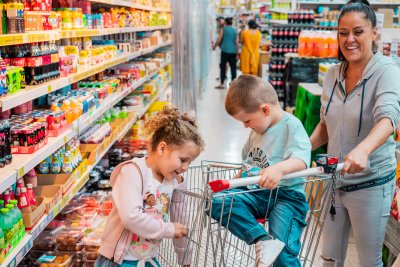
 Family shopping in supermarket. Copyright: Impact on Urban Health
Children's Food Campaign: Campaigning for policy changes so that all children can easily eat sustainable and healthy food.