
The problem
Mainstream global trade often discriminates against the poorest people in the poorest countries. There are many reasons for this, such as unfair rules governing international trade, which oblige many poorer countries to open their own markets to imports (that might be unfairly subsidised by richer countries) while their exports face trade barriers. Prices in global food markets are very volatile, and farmers planting crops take a risk that the price may have fallen by the time they reach harvest. Most international trade in food is funnelled through a few big companies, and if prices go up they often keep the profits rather than passing on any of the benefit to farmers. Usually poor farmers also need to buy food, so they are affected by price rises, just like other consumers. Since the global financial crisis, which began in 2008, the problem of high and volatile prices has been made worse by speculators ‘betting’ on the price of food on world markets.
The consequences can be devastating for both poor farmers and agricultural labourers. With few – if any – other employment opportunities open to them, and no welfare state to fall back on, many farmers are unable to afford basic necessities such as food for their families, healthcare, and education for their children. Labourers on plantations fare little better, often facing gruelling hours, low pay, no job security, unpleasant or downright dangerous living and working conditions, sexual harassment and serious health problems resulting from the use of hazardous farm chemicals such as pesticides. Many plantation workers have been prevented from joining trade unions by intimidation and sometimes even physical violence.
What we can do
Since Fairtrade’s beginnings in the 1980s and the launch of the current Fairtrade Mark in 2002, Fairtrade has become the most widely-recognised ethical label in the world. Estimated retail sales of Fairtrade products in 2011 in the UK reached £1.32bn, a 12% increase on sales of £1.17bn in 2010. There are now over 10,000 Fairtrade products sold in over 70 countries.
By buying products that carry the Fairtrade Mark, shoppers can be assured that disadvantaged producers and workers in poorer countries are getting a better deal: receiving a fair and stable price for their products that covers their costs of production; benefiting from longer-term trading relationships; and receiving the Fairtrade premium to invest in local schools and health clinics, for example.
Fair trade and food miles
 Fairtrade does not usually compete with UK farmers. Fairtrade focuses by-and-large on tropical agricultural products such as tea, coffee and bananas that are not well suited to being grown in temperate climates, or on products that are not grown in sufficient quantities in Europe, for example grapes and oranges. Often the choice facing shoppers is not between, for example, local honey and Fairtrade certified honey but between Fairtrade honey and ordinary honey imported from, say, the United States of America.
The Fairtrade system also includes some environmental standards as part of producer certification. The standard requires producers to protect the natural environment as part of farm management. Producers are also encouraged to minimise the use of energy, especially energy from non-renewable sources.
The Fairtrade premium can also help farmers to set up environmental protection programmes. Tea workers in India, for example, have invested some of their Fairtrade premium into replacing the traditional wood-burning heating with a solar-panelled system. Coffee farmers in Costa Rica have used the premium to replant trees to prevent soil erosion and have invested in environmentally friendly ovens, fuelled by recycled coffee hulls and the dried shells of macadamia nuts. This means that they no longer need to cut forest trees and so can preserve the rainforest.
What about food poverty in rich countries?
Although poverty in wealthy countries has never gone away, the global recession that began in 2008 has certainly made it worse. Organisations like Fareshare and Food Cycle.org.uk use surplus food, fit for consumption, to feed those suffering from food poverty in the UK, and they have found demand for their services rising rapidly in recent years. At the same time, these organisations also try to tackle the causes of poverty by offering training and other services so that people get skills and confidence as well as food. These skills could help people get a job and, even if this doesn’t happen, people’s quality of life can still improve.
Empowering low income communities has also been the focus of groups like Community Food and Health Scotland. They have been working for many years to ensure that everyone in Scotland has the opportunity, ability and confidence to obtain a healthy and acceptable diet for themselves, their families and their communities.
Ask businesses and policy makers to take action
The degree to which companies participate in the Fairtrade system varies a great deal. You may prefer to buy from companies that commit all or most of their range to Fa irtrade, or that work in close and long-term relationships with their producers. Some companies work entirely to the principles of fair trade, and may be part-owned by producers in poorer countries or reinvest a percentage of their profits in supporting producer development programmes. There are also major national and multinational corporations that have incorporated a few Fairtrade-certified options into their range as a result of customer demand.
- Buy Fairtrade certified products in your local retailer, restaurant or café. If Fairtrade products are not available, ask them why not.
- Use Fairtrade products at work, and explain to your colleagues why this is important. For the Fairtrade Foundation’s ‘Fairtrade at work’ campaign to switch workplaces to Fairtrade tea, coffee and other products.
- Become a Fairtrade Town (if you are not already living in one of the thousand or so worldwide).
Stay informed
- Details about Fairtrade products and standards are on the websites of the Fairtrade Foundation and Fairtrade International.
- You might also like to get involved in campaigns run by Fairfood International that engages people in encouraging the food and drinks industry to improve the sustainability of its products.
- You may see some businesses stocking Rainforest Alliance labelled products as an alternative to Fairtrade. Both schemes aim to improve social and environmental standards but the main benefits of each are quite different. Fairtrade is mainly about making sure producers are getting a better deal, and the Rainforest Alliance focuses more on protecting wildlife and ecosystems.

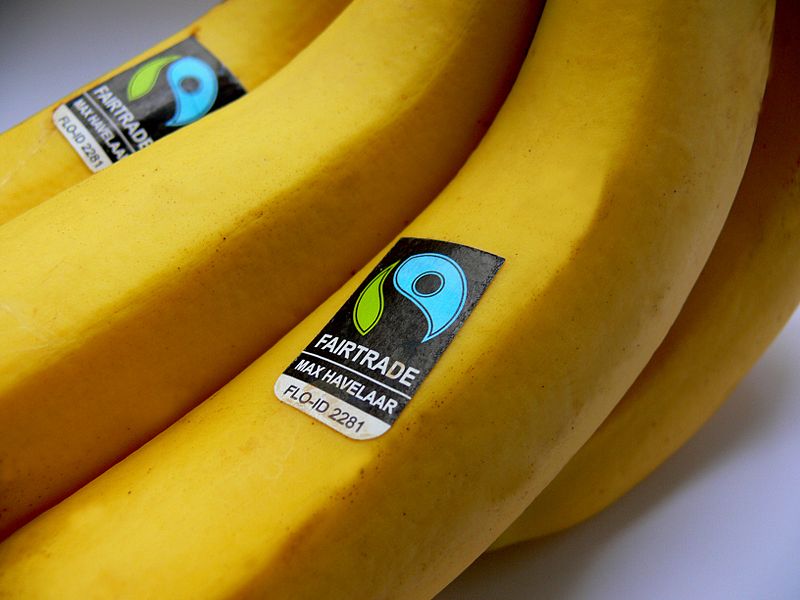
 Fairtrade bananas. Photo credit: Public domain

Sustainable Food: What you can do - and ask others to do - to help make our food and farming system fit for the future.
