How healthier food advertising policies improve public health without reducing advertising revenues
10pp - 2025 | 611Kb

Our research shows that adopting a healthier food advertising policy has not led to a reduction in advertising revenue. Given the well-evidenced public health and economic benefits, this demonstrates a strong case for robustly restricting the advertising of unhealthy foods and drinks.
How healthier food advertising policies improve public health without reducing advertising revenues
10pp - 2025 | 611Kb
Global health bodies including the World Health Organization and UNICEF now explicitly recommend mandatory, comprehensive restrictions on marketing of unhealthy foods and drinks to anyone under the age of 18. More recently, such restrictions have been endorsed by the United Nation’s Food and Agriculture Organization and identified as valuable policy interventions by global climate organisations like EAT-Lancet.
Local healthier food advertising policies are designed to remove the spotlight from less healthy food and drinks across advertising estates controlled by local governments, which often includes digital screens, bus stops and roundabout signs. Such policies put healthier rather than less healthy food centre stage within communities, while still allowing food and drink businesses to promote their products. They’re proven to prevent disease while saving money for healthcare and social care services that would have been spent on treatment and support.
Advertising policies are also an important intervention for addressing health inequality. What surrounds communities shapes their health, and evidence shows people living in more deprived neighbourhoods are more exposed to unhealthy food advertising. Therefore people living within these communities will have the biggest health benefits from policies that robustly switch the spotlight away from unhealthy foods and drinks.
Local governments have seized this opportunity, recognising the benefits of healthier food advertising policies and the savings of hundreds of millions of pounds for NHS and social care budgets. However, it is important to analyse whether the adoption of these policies is likely to impact revenue from local governments’ advertising estate. Efforts by the advertising industry to prevent the adoption of such policies regularly include claims that there will be negative financial repercussions. This report presents research from the University of Portsmouth which reveals that these policies also prove cost-effective immediately. It shows that local governments that have adopted healthier food advertising policies have comfortably maintained their advertising revenues over the 5-year period investigated.
The researchers analysed publicly available data, financial institutions’ records, and local governments’ responses to Freedom of Information requests to track and model the outcomes. Following analysis of all available data, this report found no evidence of revenue losses after the introduction of a healthier food advertising policy. This was regardless of location, size or contract type.
In recent years, institutions responsible for public health such as local governments have faced tough financial conditions, balancing funding cuts with growing service demands. The cost of social care to support people living with overweight and obesity in the UK was estimated to be £1.2 billion in 2025. In many areas, social care costs are increasing. Scottish local governments spend 30% of their budget on these services. In Northern Ireland, social care makes up 50% of the government budget. And in England and Wales, demand has grown from 52% to 61% of local government budgets over the last decade.
Preventative measures, designed to improve health, can reduce the financial pressure on public services, and healthier food advertising policies have been proven to do so. When unhealthy food adverts were restricted across London’s transport network (TfL) in 2019, it changed purchasing habits, resulting in households buying 1000 fewer weekly calories from unhealthy foods, and it led to a 20% reduction in high-sugar purchases like chocolate and confectionery. As a result, the policy is expected to lead to approximately 100,000 fewer people living with obesity, 3000 fewer living with Type 2 Diabetes and 2000 fewer living with heart disease. Crucially, researchers from the University of Sheffield were able to model likely savings to the NHS from reduced disease incidence, as a result of reduced exposure to less healthy food and drink advertising. They estimated this saving to be £218million to local NHS services over the course of the current population’s lifetime.
The positive findings from the Transport for London evaluation have broader and wider generalisability. As that research concludes “these findings provide support for policies that restrict HFSS [high fat, salt and/or sugar] product advertising as a tool to reduce purchases of HFSS products, as a way of improving population diet and preventing obesity.”
Advertising can play a key role in generating income for local governments. Prior to this research, there has been little work to systematically uncover the impacts on advertising revenues of introducing a healthier food advertising policy. The research underlying this report builds the clearest picture yet of these impacts.
There were two main findings:
This was true across different locations, size of advertising estate, contract and local government type.
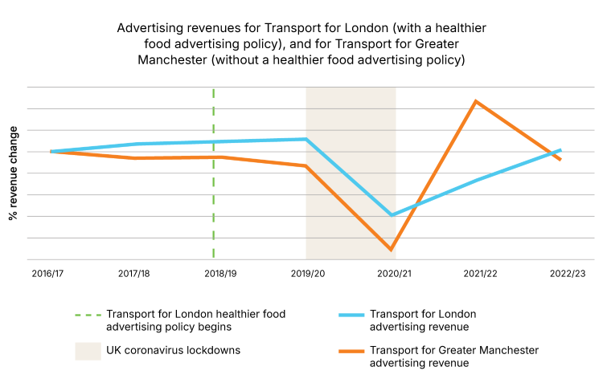
Figure 1: The standardised advertising revenues for Transport for London (which has a healthier food advertising policy) compared with one that does not have a policy (Transport for Greater Manchester). Transport for London’s policy was introduced in February 2019.
Figure 1 shows data for the UK’s largest single advertising estate and the first to have adopted a policy (Transport for London), for which we have a revenue dataset that tracks three years following policy adoption, and thus the clearest picture of revenue impact. Transport for Greater Manchester, by comparison, did not have a healthier food advertising policy over these years. Revenue in both Transport for London and Transport for Greater Manchester dropped in 2020/1 during the Covid-19 pandemic, when lockdowns led to lower customer numbers on public transport, and were recovered afterwards. The appearance of a quicker recovery in Manchester is likely to be due to the larger relative initial drop, and the change to London underground usage which was only operating at 60% of pre-pandemic levels by 2021/22, but makes up the majority of Transport for London’s advertising revenues. Manchester’s buses and trams were operating at 80 and 70% of pre-pandemic levels respectively over this time. Overall, since policy introduction, the revenue for Transport for London has not dropped in real terms, or in comparison to an area without a policy.
Our extended analysis showed that the Transport for London experience is not an exception. The researchers filed Freedom of Information requests to all local governments in the UK and received 360 responses, covering local governments in Scotland, Northern Ireland, Wales and England, with 140 of those confirming they had an advertising contract, and 44 contracts from 38 local governments provided sufficient data on the annual percentage change of revenue to allow for comparison. Analysis of these data reveals that when local governments with an advertising policy are compared to those without, the introduction of advertising policies did not result in a reduction in revenues.
The advertising revenues of local areas with policies continued to track the general trends in advertising expenditure across the UK, following the introduction of a policy. Therefore, there was no observed loss compared to expected revenues.
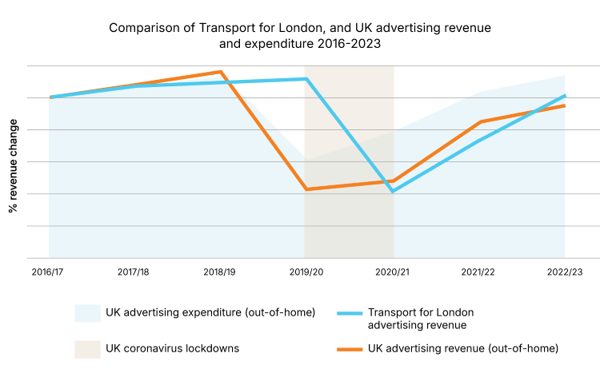
Figure 2: The overall trend of expenditure and revenue from UK outdoor advertising is compared with that of Transport for London. Both show a dip during 2019/20 and then recovery, with Transport for London marginally outperforming the overall UK outdoor advertising spend in 2022/3.
The UK outdoor advertising expenditure is the amount of money that companies – such as food and drink companies – spend on outdoor sites like billboards, planters, bus stops and roadside digital screens across the UK. It therefore represents the general trends in purchasing of outdoor advertising in the UK (including local government owned and non-local government owned sites). Revenues are the amount of profit derived from this outdoor advertising real estate.
Figure 2 shows that after bringing in a policy in 2019, the advertising revenues for Transport for London were in line with the outdoor advertising trends across the UK. We can be confident that introducing a healthier food advertising policy has not negatively impacted advertising revenues or potential revenues.
Robust healthier food advertising policies mandate that companies can only advertise foods and drinks lower in fat, salt and/or sugar. No company is banned from advertising, but their adverts must promote healthier products. These policies:

Figure 3: Example of adverts before (above) and after (below) implementing the healthier food advertising policy, based on real-life examples. Originally designed for Sustain’s Healthier Food Advertising Policy Toolkit (2022).
Following the success of the policy, there’s a movement of local leaders across the country who are working to introduce robust policies in their area. At the time of writing, 25 local governments plus the Mayor of London have passed robust healthier food advertising policies.
None of the local governments that introduced these policies have since reversed them.
Haringey Council – the first council to bring in a healthier food advertising policy - describes how the policy is succeeding in switching the spotlight away from unhealthy food advertising while maintaining advertising revenues:
“Haringey Council implemented our advertising policy in July 2019, aligning with the TfL [Transport for London] policy, restricting the advertising of HFSS [high fat, salt and/or sugar] products – the first borough in the UK to do so. Our advertising policy was catalysed by our School Superzones initiative and fits with our priorities as outlined in our Borough Plan and framework for Health and Wellbeing Strategy.
Our advertising policy is an integral part of our action to protect children’s health and encourage healthy behaviours through targeted interventions. All agreements with external providers adhere to this policy and there has been no financial loss to us as advertising spaces are allocated to other advertisements that don’t promote HFSS products, alcohol, gambling or other activities that are harmful to the health and wellbeing of our communities.”
Haringey Council statement 2023
This research demonstrates a clear case for introducing robust healthier food advertising policies. Where such policies have been adopted, they’ve incentivised businesses to continue to advertise but innovate and spotlight healthier products, and thus not led to a drop in advertising revenue for local governments, relative to places without a policy, or wider trends. As such, this research supports the widespread adoption of robust policies as a fiscally responsible and effective public health measure.
All tiers of government and health institutions:
Researchers:
Professor Lisa Jack: Professor of Accounting in the School of Accounting, Economics and Finance, Faculty of Business and Law at the University of Portsmouth.
Dr Alan Leonard: Senior Lecturer in the School of Accounting, Economics and Finance, Faculty of Business and Law at the University of Portsmouth.
Dr Kate Whitman, Research Fellow in the Revolution Plastics Institute and the Psychology Department at the University of Portsmouth.
Report author:
Fran Bernhardt is Sustain’s Commercial Determinants Coordinator. She co-designed Transport for London’s Healthier Food Advertising policy; a landmark initiative to restrict unhealthy food and drink advertising which is now recommended as part of global action to create healthy, sustainable and just food systems. A Churchill Fellow, she has delivered keynotes at global conferences and her research is published in PLOS Climate and Perspectives in Public Health. Her expert commentary has been featured in outlets including The BBC, The Times, The Guardian, The Daily Mail and The BMJ.
Fran convenes a network of more than 150 local governments providing strategic guidance to support them to successfully implement healthier food advertising policies. At the time of writing, 25 local governments and Transport for London have adopted such policies.
With thanks to the following for reviewing the report:
Sophie Gordon (Frameworks UK), Jamie Izzard (Gravesham Council), Stephanie Kennedy (Sustain), Dr Kathrin Lauber (University of Edinburgh), Natalie Lovell (Tower Hamlets Borough Council), Dr Katerina Psarikidou (University of Sussex), Nikita Sinclair (Impact on Urban Health), Professor Thijs Van Rens (University of Warwick), Ruth Westcott (Sustain).
And to Alan Karlik (Sustain) for designs.
With thanks to our funder, Impact on Urban Health, without whom this research and report would not have been possible.
Please download the briefing to access the references and appendix.

Commercial Determinants: Supporting policymakers and councils to introduce healthy food advertising policies.
Sustain
The Green House
244-254 Cambridge Heath Road
London E2 9DA
020 3559 6777
sustain@sustainweb.org
Sustain advocates food and agriculture policies and practices that enhance the health and welfare of people and animals, improve the working and living environment, promote equity and enrich society and culture.
© Sustain 2026
Registered charity (no. 1018643)
Data privacy & cookies
Icons by Icons8